
Unbiased headlines. Facts, not spin.
Every story is an unbiased news briefing written from 110+ sources across the spectrum — sources linked so you can verify it yourself.
 politics
Major Story (7/10)
June 30, 2026 at 12:05 PM
politics
Major Story (7/10)
June 30, 2026 at 12:05 PM
Justice Thomas Denies Roy Moore's Emergency Request to Preserve $8.2 Million Defamation Award
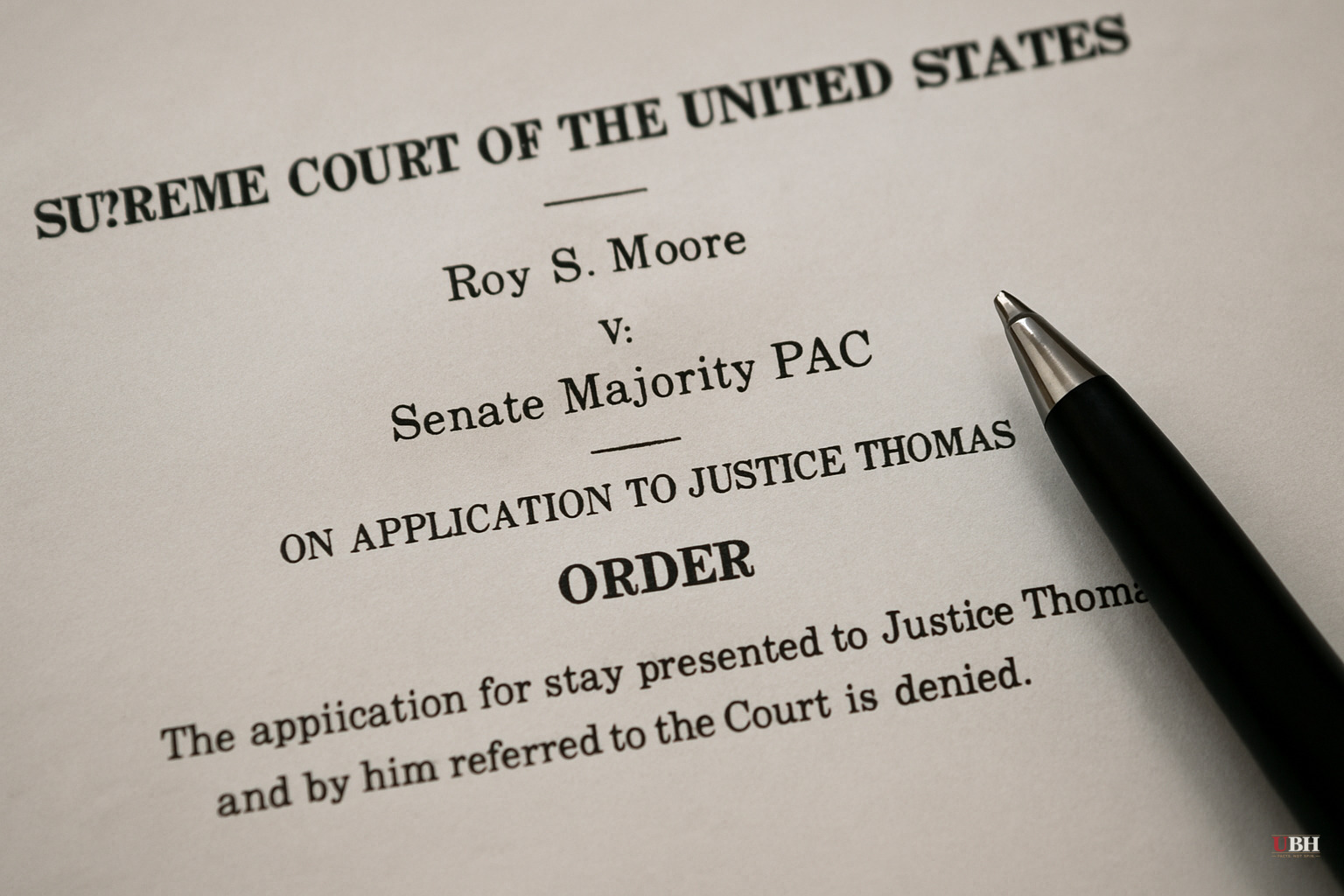
Roy Moore lost his emergency bid at the Supreme Court on Monday. Justice Clarence Thomas, who handles emergency applications from the 11th Circuit, denied Moore's request in a short, unexplained order, according to Courthouse News Service.
The ruling lets an April 11th Circuit decision, which unanimously overturned Moore's $8.2 million jury verdict, take full effect.
In August 2022, a federal jury in the Northern District of Alabama found the Senate Majority PAC, a Washington, D.C.-based Democratic organization, liable for $8.2 million in damages to Moore. The jury concluded the PAC acted with "actual malice" when it ran an ad during Moore's 2017 Alabama Senate campaign.
The ad aired 533 times over 10 days on Alabama television stations. It assembled a series of quotes referencing allegations of sexual misconduct against Moore, including the statement that "Moore was actually banned from the Gadsden Mall … for soliciting sex from young girls" and that "One he approached was 14 and working as Santa's helper."
Moore argued the combination of those statements, pulled from separate sources and placed side-by-side, created a false composite claim that he had specifically solicited sex from a named 14-year-old girl. His legal theory was defamation by implication.
The jury agreed. The 11th Circuit did not.
The Appeals Court's Reasoning
The Atlanta-based 11th Circuit reversed the verdict in April, finding the PAC made "a negligent error at best" with its "poor choice of words," according to Courthouse News Service. The appeals court sided with other circuit courts in holding that defamation-by-implication claims require a plaintiff to prove the defendant either intended the defamatory implied meaning or acted with "reckless disregard" for it.
Moore's camp argues the jury already found actual malice, which should cover that standard. The PAC's position is that actual malice as applied to explicit statements is a different showing than reckless disregard for a statement's implied meaning.
That distinction is the crux of this case, and it is an open legal question the Supreme Court has not definitively resolved at the national level.
Moore's emergency petition warned the justices that if the supersedeas bond — the financial guarantee securing the jury award during appeal — is released before the Supreme Court can decide whether to take the case, recovering the $8.2 million becomes a practical impossibility, according to his filing cited by 1819 News.
Thomas's denial means the bond can now be released. Moore still has the option to petition the full Supreme Court for review of the underlying 11th Circuit ruling, but the financial protection for the award is gone.
Moore's Record, in Full
Moore is not a sympathetic figure to much of the legal and political establishment, and that context is relevant. He was removed from the Alabama Supreme Court twice: first in 2003 for defying a federal court order to remove a Ten Commandments monument from the state judicial building, and again in 2016 for refusing to comply with the U.S. Supreme Court's ruling recognizing same-sex marriage. He lost the 2017 Senate race, in part because of the misconduct allegations the PAC's ad referenced.
The strongest case for Moore here is not about his character. It is about whether a political organization can assemble factually accurate individual statements into a configuration that creates a false overall impression, and then escape liability because no single sentence was technically wrong. That is a real First Amendment tension, and courts across circuits have not handled it uniformly.
What the Senate Majority PAC Says
The PAC has maintained throughout that the statements in the ad were drawn from real reporting and real sources, that the ad did not fabricate any individual claim, and that the 11th Circuit correctly identified the applicable legal standard. The PAC describes itself as "solely dedicated to protecting and expanding our Democratic majority in the U.S. Senate," per its own materials cited by 1819 News.
Critics of that framing note that assembling technically sourced quotes to manufacture a false composite is a well-documented political advertising technique, and that the actual-malice standard was developed to protect the press from government defamation suits, not to immunize political opposition research ads from accountability.
Where This Goes Next
Moore can still file a formal petition for certiorari asking the Supreme Court to review the 11th Circuit's substantive ruling on the defamation-by-implication standard. That petition would be a full-court request, not an emergency application to a single justice. Whether four justices would vote to take up the case, the number required to grant cert, remains unknown. The defamation-by-implication standard across circuits is unsettled enough that Moore's lawyers may have a credible argument for Supreme Court review, but without the bond in place, a favorable ruling would need to be followed by actual collection from the PAC, which is a separate and harder problem.
Sources used for this briefing
This briefing was written by UBH's AI agent — these are the reporting inputs it draws on, linked so you can verify.


