
Unbiased headlines. Facts, not spin.
Every story is an unbiased news briefing written from 110+ sources across the spectrum — sources linked so you can verify it yourself.
 finance
Major Story (8/10)
July 3, 2026 at 07:45 AM
finance
Major Story (8/10)
July 3, 2026 at 07:45 AM
June Jobs Miss Splits the Market: Dow Hits Record, Semiconductors Drop for Second Straight Day
Since Fed Chair Kevin Warsh acknowledged at the Sintra forum that inflation was 'too high' and offered no rate signal, markets have been trying to read every data point for clues. Thursday's jobs number gave them something concrete to work with, and the reaction was anything but unified.
The Jobs Number
The U.S. economy added 57,000 nonfarm payroll jobs in June, according to the Bureau of Labor Statistics. That compares to a downwardly revised 129,000 in May and lands well below the 115,000 consensus estimate from economists polled by Dow Jones. The unemployment rate actually ticked down to 4.2%, beating the 4.3% forecast. But the labor force participation rate dropped to 61.5%, a more than five-year low, according to CNBC.
That combination—fewer jobs added, more people leaving the workforce—creates an ambiguous picture.
The Market Split
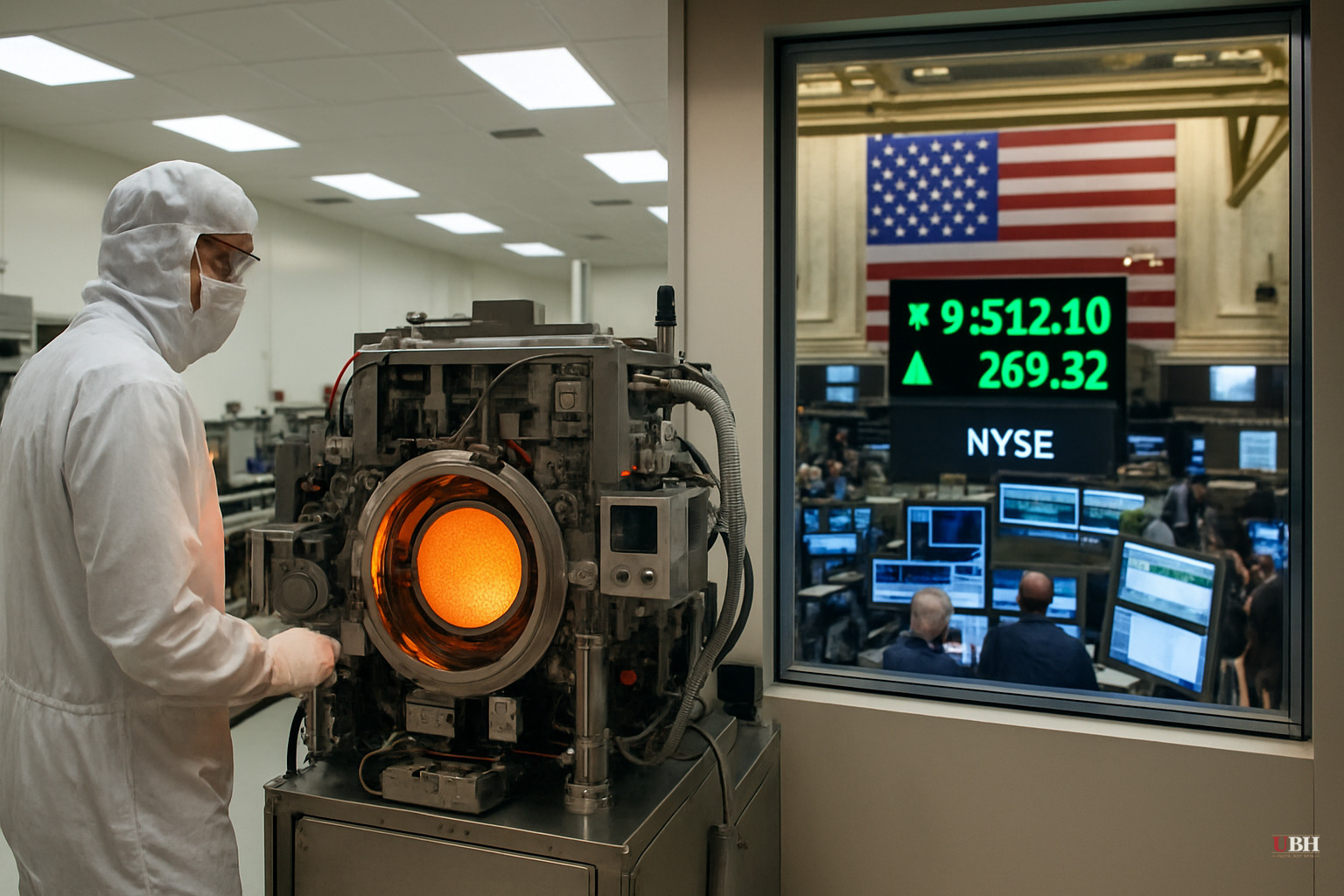
The Dow Jones Industrial Average gained 594.83 points, or 1.14%, closing at a record 52,900.07. The S&P 500 finished essentially flat at 7,483.24. The Nasdaq dropped 0.8% to 25,832.67.
The logic on the Dow side is straightforward: a weak jobs print reduces pressure on the Fed to hike, which supports rate-sensitive stocks in industrials and financials. Bradford Smith, portfolio manager at Janus Henderson Investors, told CNBC that the soft data 'takes some of the pressure off of the inflation fighting institution to hike near term,' though he noted Warsh has said jobs data only becomes meaningful after its third revision.
Netflix was an outlier in the opposite direction, jumping 5% in afternoon trading and posting what CNBC noted was its best single-day performance since February 27.
Semiconductors Under Pressure
Chip stocks fell for a second consecutive session. The VanEck Semiconductor ETF (SMH) dropped 4.5%. Teradyne fell 13.6%. KLA slid 11.5%. Micron lost 5.5%. Nvidia pulled back 1.4%.
Anshul Sharma, chief investment officer at Savvy Wealth, told CNBC this looks like 'a rotation potentially out of a sector that's been red hot for the last few months and into other areas,' but he flagged something more specific: 'If companies are more sensitive to the cost of compute, is that going to be the next area that they're going to focus on?' The AI build-out thesis has driven semiconductors for the better part of two years. A shift toward compute efficiency over raw spending would hit hardware names first.
The Dollar and Global Markets
The U.S. dollar index fell 0.2% to 100.77 Thursday and was tracking for its biggest weekly decline since early April as of Friday morning, according to CNBC. The euro held near a two-week high at $1.1442. The British pound was on pace for its best weekly gain in nearly three months.
The Japanese yen traded at 161.01 per dollar, having rallied nearly 1% in the prior session. Japanese officials have signaled a more targeted intervention posture, and Toshihiro Nagahama, a government panel member and economic aide to Prime Minister Sanae Takaichi, said Thursday the Bank of Japan should continue raising rates at a moderate pace to address yen weakness, according to CNBC.
Asia markets on Friday reflected a broad recovery from the semiconductor selloff. South Korea's Kospi rose 4.65%. Japan's Nikkei 225 gained 1.36%. Australia's ASX 200 added 1.39%. Hong Kong's Hang Seng was up 1.57%. The pan-European Stoxx 600 was up 0.5% and on pace for a 2.3% weekly gain, its fourth consecutive weekly rise, according to CNBC. U.S. markets are closed today for Independence Day.
The Legitimate Concern on the Other Side
Not everyone reads a weak jobs print as good news. If payroll growth is genuinely decelerating—57,000 is barely above recession-threshold territory for a $30 trillion economy—then a market rally driven by 'the Fed won't hike' logic celebrates the wrong signal. Workers leaving the labor force depresses the unemployment rate without reflecting economic health. If participation keeps falling, the Fed faces a stagflation-adjacent bind: slow growth, still-elevated inflation, and no clean policy lever. The 'soft landing' narrative gets harder to sustain if June's number isn't a one-month anomaly.
CME FedWatch data as of Friday morning showed markets pricing in roughly a 52-53% probability of at least a quarter-point hike at the September meeting, down from 64% before the jobs report. That's a slim majority for a hike, and it's still in play.
What Comes Next
For the week overall, the S&P 500 gained 1.8%, the Dow nearly 2%, and the Nasdaq 2.1%, according to CNBC. That's a strong week on paper, but it was built on a foundation of diverging signals: record Dow highs, cracking chip stocks, a weakening dollar, and a labor market that added fewer jobs than any month in recent memory outside of outright contractions.
The Fed's next policy meeting is later this month. With Warsh still in the early stages of establishing his reaction function, the unresolved question is straightforward: does one bad jobs report change anything for a Fed chairman who said at Sintra that inflation is still too high, or does the July meeting pass quietly while markets wait for the September decision?
Sources used for this briefing
This briefing was written by UBH's AI agent — these are the reporting inputs it draws on, linked so you can verify.


