
Unbiased headlines. Facts, not spin.
Unbiased Headlines is an independently owned news organization. We bring you the facts, not opinions, written fresh from 110+ named sources. Sources linked so you can verify it yourself.
 tech
Major Story (8/10)
Judge Orders Meta to Pay New Mexico $25 Billion Over Facebook Privacy and Content Claims
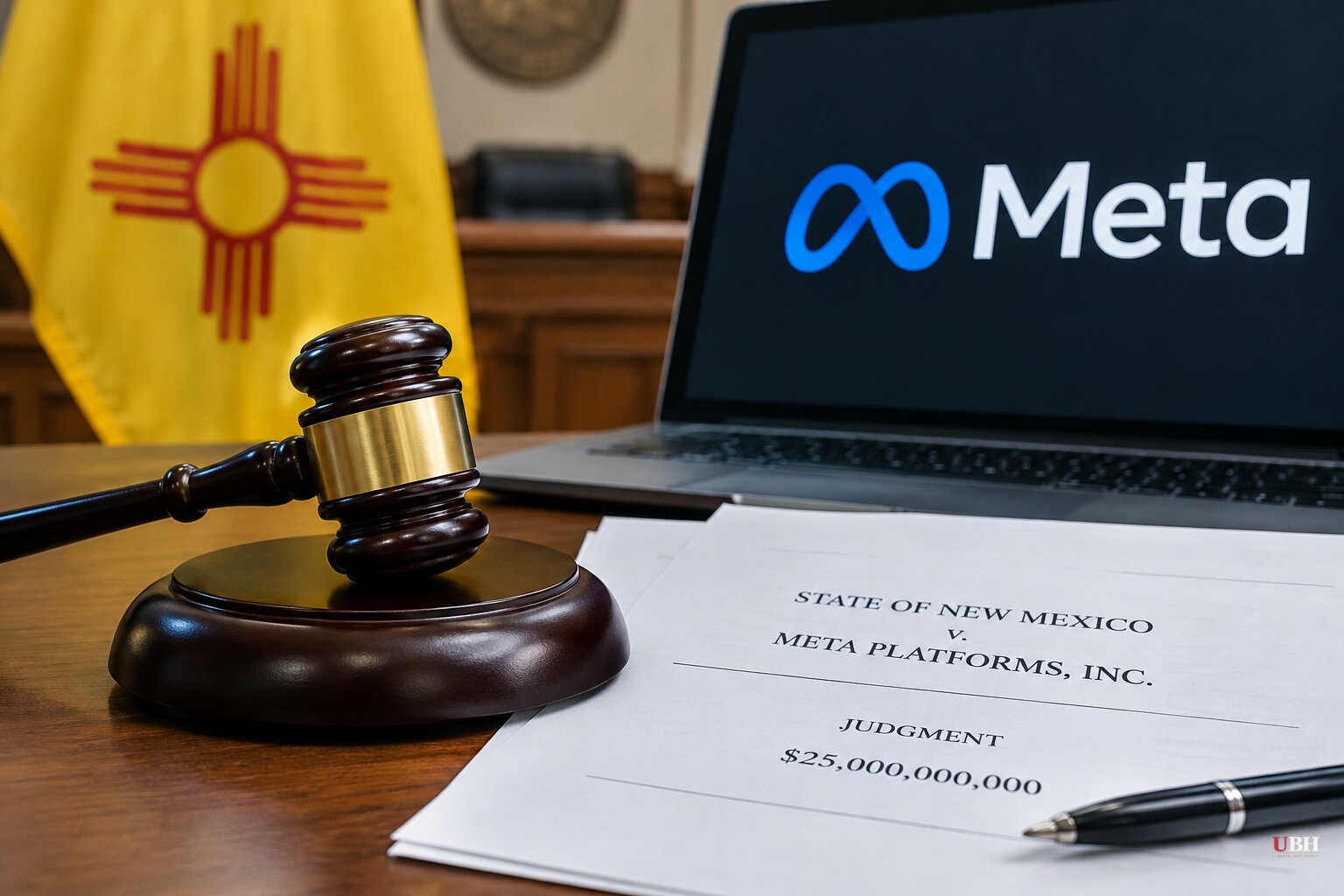
A New Mexico state judge ordered Meta on Wednesday, Oct. 21, to pay $25 billion in civil penalties. A Santa Fe jury had found in September that the company deceived people in the state about privacy and content moderation on Facebook.
Judge Francis Mathew's order is among the largest verdicts ever issued in US legal history, according to Bloomberg Law. Attorney General Raúl Torrez called it "one of the largest, if not the single largest state verdict against a company in American history."
How the number was reached
The jury found more than 43 million violations of New Mexico's Unfair Practices Act. Each carries a maximum civil penalty of $5,000.
Mathew applied that maximum. Multiplied out, it came to $219.5 billion. He then reduced the award to $25 billion.
The state had asked for $35 billion to $40 billion. Its lawyers argued that Meta would only change its behavior if the sum registered in its stock price. Meta's lawyers argued for no more than $3.4 billion.
Mathew wrote that "the extraordinary number of willful violations found by the jury, the duration and repetition of the conduct, the breadth of subjects on which violations occurred, the involvement of senior Facebook leadership, the size of New Mexico audiences reached, and the clear intentional and systematic nature of Facebook's repeated misstatements" supported the highest level of penalty allowed under the Unfair Practices Act, $5,000 per violation.
He also ordered that interest on the penalty accrue at 15% each year until the fine is paid in full.
What the judge found
The case grew out of the Cambridge Analytica episode. A third-party personality quiz harvested data from roughly 87 million profiles, and that data was used by the political consulting firm to build targeted ads for the 2016 election. The now-defunct firm's clients included Donald Trump's 2016 campaign.
The state's claims went beyond the data breach. Prosecutors also said Meta misled the public about content moderation and hate speech enforcement. They pointed to evidence that some high-profile accounts were not held to the same scrutiny as ordinary users. Jurors watched video depositions from CEO Mark Zuckerberg and former COO Sheryl Sandberg.
Mathew wrote that Facebook "did not conduct the comprehensive investigation that it promised" after the Cambridge Analytica revelations. He cited "pressure from senior executives to keep costs down, lack of adequate enforcement resources, inadequate investigative techniques, and a desire not to create precedent for future investigations."
"Facebook's wrongdoing—over the course of years and systematically broadcast to the public—goes to the heart of Facebook's core business practices," the judge wrote. He said it relates to "the way in which Facebook induces people onto the platform and ultimately keeps them there."
Meta's defense
Meta did not immediately respond to requests for comment on the amount. The company has said it plans to appeal the September verdict.
In court, its lawyers argued that the state never proved the privacy statements were misleading. They also argued that Meta's content moderation did not harm New Mexicans. At an Oct. 1 hearing, Meta attorney Matt Nicholson said, "The jury didn't make findings that any New Mexican heard or saw these statements, or was harmed by them."
Meta's lawyers also said a penalty ten times its proposed figure or more would violate due process and be unconstitutional. They said it would not hold up on appeal. Nicholson called a sum as high as $40 billion "shocking to the conscience." At an earlier hearing, Meta's attorneys described any penalty in the tens of billions as a "constitutional violation of epic proportions."
The state's attorney Randi McGinn told the court the opposite. She urged standing up to "tech titans who think they are bulletproof and can do whatever they want." Torrez called the judgment "an unambiguous message to Silicon Valley."
The state's lawyers argued that every New Mexican, not just Facebook users, was exposed to the company's public statements about privacy.
Where the money goes
Under the New Mexico Constitution, fines for consumer-protection violations go to state education spending. Torrez said, "We may have paid for the construction of schools for the next 100 years."
He also acknowledged that the money would be tied up if Meta appeals as expected. Interest would accrue during an appeal, and the number of violations Meta is charged with could be reduced.
For scale, Bloomberg Law put the state's projected general-fund revenue at $14.8 billion in fiscal 2028. The penalty exceeds that figure.
Not New Mexico's only fight with Meta
New Mexico did not join the multistate settlement Meta reached in August, which was reported at roughly $17 billion to $18 billion. That is why this case went to trial. Florida was the only other state that did not sign the settlement.
Meta also paid $725 million in 2022 to settle a class action tied to Cambridge Analytica.
In a separate New Mexico child-safety case, a jury ordered Meta to pay $375 million for violating the state's unfair practices act. A judge later directed the company to put $567 million into a public-nuisance abatement fund. Meta has said it will appeal. During that case, Meta raised the possibility of pulling Facebook, Instagram and WhatsApp out of New Mexico rather than comply with proposed safety measures.
Market reaction and next steps
Meta was scheduled to report quarterly earnings Wednesday afternoon. Its shares were trading 2% higher after the penalty was announced, according to the Associated Press.
The next step is Meta's appeal. It will test whether a penalty set at the statutory maximum per violation and then reduced to $25 billion survives the due process challenge the company has already previewed. It will also test whether the 43 million violation count holds.
Until the appeal is resolved, the $25 billion stays in limbo, and interest keeps running at 15% a year.
Sources used for this briefing
8 links from 8 independent newsrooms (syndicated copies of the same report count once)
These are the sources it draws on, linked so you can verify.


