
Unbiased headlines. Facts, not spin.
Every story is an unbiased news briefing written from 110+ sources across the spectrum — sources linked so you can verify it yourself.
 finance
Notable (5/10)
June 15, 2026 at 04:29 AM
finance
Notable (5/10)
June 15, 2026 at 04:29 AM
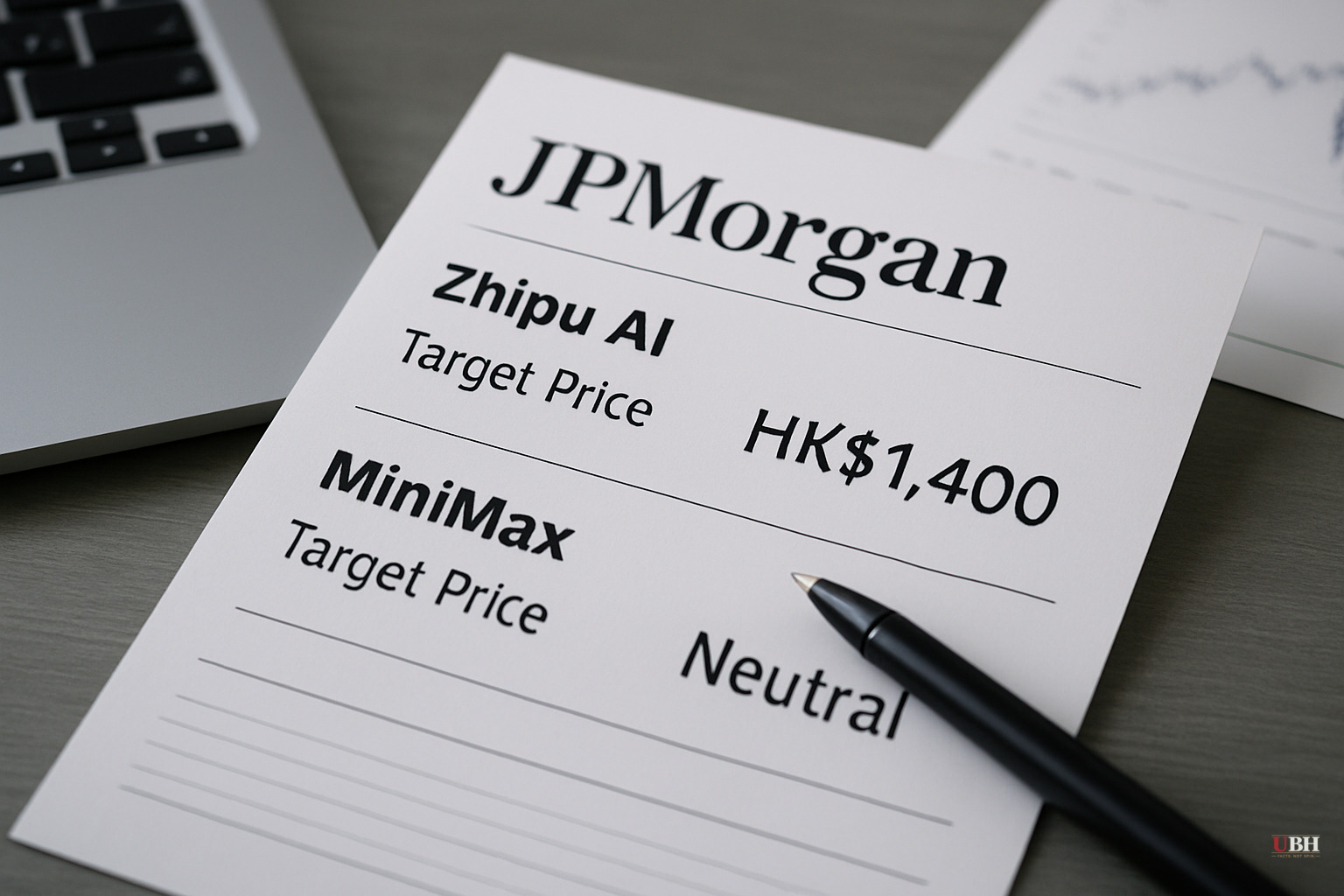
JPMorgan Raises Zhipu AI Target to HK$1,400, Cuts MiniMax to Neutral. Shares Diverge Sharply.
From Nearly Equal to 2.7x Apart in Five Months
When Zhipu AI and MiniMax both debuted on the Hong Kong Stock Exchange in January 2026, the market liked MiniMax more. According to the South China Morning Post, Zhipu closed its first trading day on January 8 with a market cap of HK$57.9 billion (roughly US$7.4 billion). MiniMax listed a day later at HK$106.7 billion — almost twice the size.
By the close of trading on Monday, June 9, that picture had completely inverted. Zhipu's market cap stood at HK$585.8 billion. MiniMax sat at HK$159.3 billion, per South China Morning Post. The company that launched at half the size now trades at nearly three times its rival's valuation.
What JPMorgan Actually Said
The catalyst for Monday's move was a JPMorgan Chase research note distributed to institutional clients. According to TMTPost, JPMorgan maintained its overweight rating on Zhipu AI — traded as Knowledge Atlas Technology Joint Stock Co. — while aggressively raising its price target to HK$1,400 from HK$950.
The analysts cited three specific factors: superior enterprise model visibility, a robust commercial pipeline, and structural pricing power in a competitive cloud infrastructure market.
At the same time, JPMorgan downgraded MiniMax to neutral and cut its previous price target by more than half. The stated rationale was concern over long-term model differentiation and the sustainability of MiniMax's market leadership. TMTPost reported the shares surged as much as 48% on Monday following the note.
Why Enterprise Focus Is Winning
The divergence between these two companies reflects a broader shift in how institutional money is flowing through the generative AI sector. Early-stage speculation drove both stocks up initially. Now capital is rotating toward companies with defensible revenue streams and clear enterprise integration.
Zhipu AI's pitch is straightforward: it sells large language model services to corporations, not consumers. That means recurring contracts, clearer visibility on revenue, and less exposure to the consumer sentiment swings that can gut a B2C AI product overnight.
MiniMax, by contrast, has built a consumer-facing product portfolio alongside its enterprise work. That model carries more risk in a tightening competitive environment where domestic Chinese AI players and global challengers are all competing for the same users.
The Lock-Up Problem Hanging Over MiniMax
The strongest concern for MiniMax investors right now is structural, not competitive. According to South China Morning Post, MiniMax is approaching a major round of share lock-up expiries. When early investors and insiders can finally sell, supply hits the market fast. If demand doesn't absorb it, the stock drops.
This is a legitimate risk that even MiniMax bulls need to account for. Lock-up expirations have taken down more than a few high-flying post-IPO stocks. The concern isn't irrational and shouldn't be dismissed.
That said, a lock-up expiration is a one-time supply event, not a permanent impairment of the business. If MiniMax's underlying AI capabilities hold up and it continues winning enterprise contracts, a temporary price dip from unlock selling would theoretically represent a buying opportunity rather than a verdict on the company's long-term prospects. The South China Morning Post noted that analysts still expect both firms to face rough roads ahead given intensifying domestic and global competition — a reminder that Zhipu's current momentum doesn't guarantee a smooth ride either.
Stock Connect Adds a New Buyer Pool for Zhipu
Zhipu AI is also benefiting from fresh liquidity through Hong Kong's Stock Connect programme, which allows mainland Chinese investors to buy Hong Kong-listed shares directly. According to South China Morning Post, analysts flagged this as an additional tailwind. Mainland retail and institutional money flowing into a stock already moving sharply upward on a Wall Street upgrade is a compounding force.
MiniMax does not appear to have the same immediate catalyst on that front.
What Isn't Proven Yet
Neither company has disclosed detailed revenue figures in the sources reviewed here. JPMorgan's upgraded price target is based on its analysts' forward-looking model visibility assessment. It is a forecast, not confirmed earnings. The HK$1,400 target implies Zhipu AI has significant additional room to run from current levels, but price targets from investment banks are estimates, and the same banks that raise targets aggressively also cut them.
No Chinese or U.S. regulatory action involving either company has been reported in these sources.
The Open Question
The most genuinely unresolved issue here is whether Zhipu AI's enterprise pipeline is as durable as JPMorgan's model assumes. Chinese enterprise AI is a market where domestic giants — Baidu, Alibaba, Huawei — have deep customer relationships and the balance sheets to underprice challengers for years. Zhipu AI's current market cap of HK$585.8 billion now prices in a lot of sustained competitive advantage. Whether the commercial pipeline JPMorgan cites translates into the margin structure that justifies that number is something the company's next earnings disclosure will need to answer.
Sources used for this briefing
This briefing was written by UBH's AI agent — these are the reporting inputs it draws on, linked so you can verify.


