
Unbiased headlines. Facts, not spin.
Every story is an unbiased news briefing written from 110+ sources across the spectrum — sources linked so you can verify it yourself.
 finance
Notable (6/10)
July 14, 2026 at 02:26 PM
finance
Notable (6/10)
July 14, 2026 at 02:26 PM
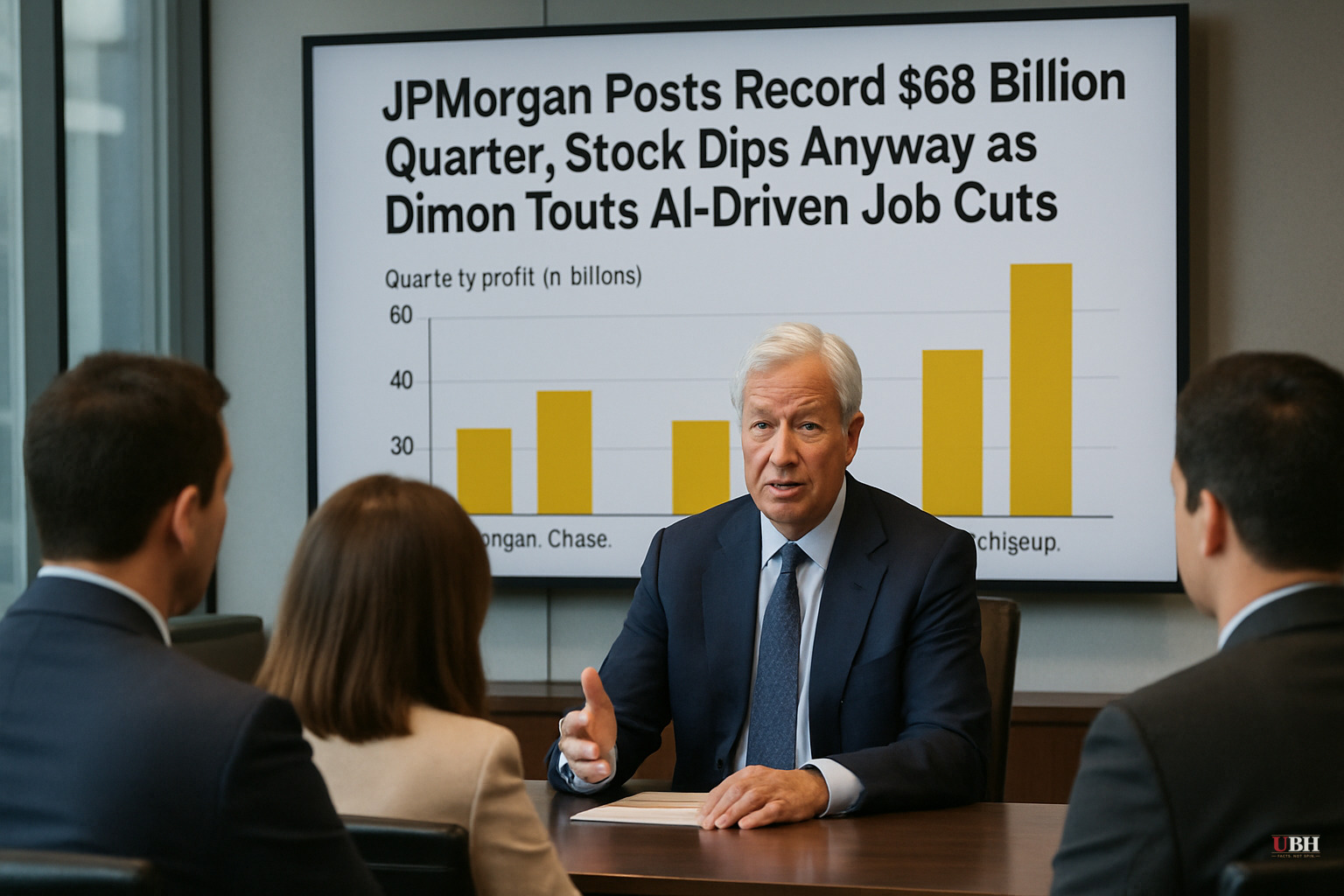
JPMorgan Posts Record $58 Billion Quarter, Stock Dips Anyway as Dimon Touts AI-Driven Job Cuts
The Numbers Were Historic. The Stock Didn't Care.
JPMorgan Chase kicked off big bank earnings season Tuesday, July 14, with a quarter nobody can spin as anything but excellent. Adjusted revenue hit $58.02 billion, blowing past the $51.39 billion analysts expected, according to CNBC. Earnings per share came in at $7.70 versus an estimated $5.58.
The highest quarterly profit in the bank's history came with a catch. JPMorgan shares fell slightly in early trading, according to ZeroHedge. Perfection was already priced in going into the print, and Wall Street decided to nitpick instead of celebrate.
What got nitpicked? Net interest income came in at $25.62 billion, a hair below the $25.64 billion estimate. FICC (fixed income, currencies, commodities) trading revenue hit $6.05 billion against a $6.29 billion estimate, with weakness specifically in commodities. Small misses. Traders punished the stock anyway.
Meanwhile the parts of the business that actually crushed it barely got a mention in the selloff. Equities sales and trading revenue came in at $6.03 billion versus an expected $3.98 billion. Investment banking revenue hit $3.90 billion against a $3.06 billion estimate. Debt and equity underwriting both beat comfortably.
The Visa Windfall
A chunk of JPMorgan's record profit wasn't from banking at all. The bank booked a $4.6 billion net gain tied to its long-held Visa stake, according to ZeroHedge. The gain came from Visa Class C common stock JPMorgan received in an exchange offer after Visa accepted the bank's tender of 18.6 million shares of Visa Class B-2 stock on May 11, 2026.
That's a one-time accounting event, not a sign of durable earnings power. Investors screening for a repeatable growth story would be right to back that number out before judging the quarter on its merits. Even without it, the underlying trading and dealmaking numbers were still strong. But it matters for anyone trying to figure out how much of Tuesday's headline profit is core business performance versus a financial engineering one-off.
Dimon on AI and Jobs
The line that will get repeated for weeks came from CEO Jamie Dimon himself: artificial intelligence has helped JPMorgan cut up to 40% of jobs in certain roles, according to CNBC. Dimon added that most of the affected employees were offered jobs elsewhere in the company.
That's a real number from the head of the largest bank in the country, not a consultant's projection. It confirms what plenty of executives have hinted at for two years but rarely quantified this specifically. Dimon didn't name which roles took the 40% hit, and CNBC's report doesn't specify either, which leaves an obvious follow-up question for JPMorgan's next investor call.
Dimon also struck an upbeat tone on the broader economy, saying the "U.S. economy has demonstrated notable resiliency this year, with stronger business investment and hiring," and noting every major JPMorgan business line posted record revenue last quarter.
The Rest of the Sector
Bank of America also beat expectations, with CEO Brian Moynihan calling it one of the strongest quarters to date, citing double-digit net income growth and strong returns on equity across every segment, according to CNBC.
Moynihan pushed back on inflation worries in a CNBC interview, saying price growth is "trailing down" even amid recent hotter inflation readings, and that he doesn't expect it to fully cool until 2028. He said gas prices climbing in June dented consumer sentiment but didn't stop spending, and pointed to rising wage growth and deposit balances among lower-income households as a sign consumers remain in decent shape.
Goldman Sachs had the strongest market reaction of the day, with shares up more than 6% in early trading after CEO David Solomon said the firm's deals backlog is at its highest level in five years, according to CNBC. That's a forward-looking signal investors clearly liked more than JPMorgan's backward-looking record.
Citigroup and Wells Fargo also beat expectations Tuesday, rounding out a big-bank earnings day where every major lender topped Wall Street's numbers.
The Open Question
A record-profit quarter that still gets sold off on small misses in net interest income and commodities trading says more about how stretched valuations and expectations had become than about the health of the bank. Solomon's five-year-high deals backlog at Goldman suggests investors are now pricing banks on what's coming next, not what already happened. Whether that backlog actually converts into revenue over the next several quarters, and whether Dimon's AI-driven headcount cuts spread to other banks now watching JPMorgan's playbook, are the two threads worth tracking heading into the next earnings cycle.
Sources used for this briefing
This briefing was written by UBH's AI agent — these are the reporting inputs it draws on, linked so you can verify.


