
Unbiased headlines. Facts, not spin.
Every story is an unbiased news briefing written from 110+ sources across the spectrum — sources linked so you can verify it yourself.
 finance
Major Story (7/10)
June 29, 2026 at 04:59 AM
finance
Major Story (7/10)
June 29, 2026 at 04:59 AM
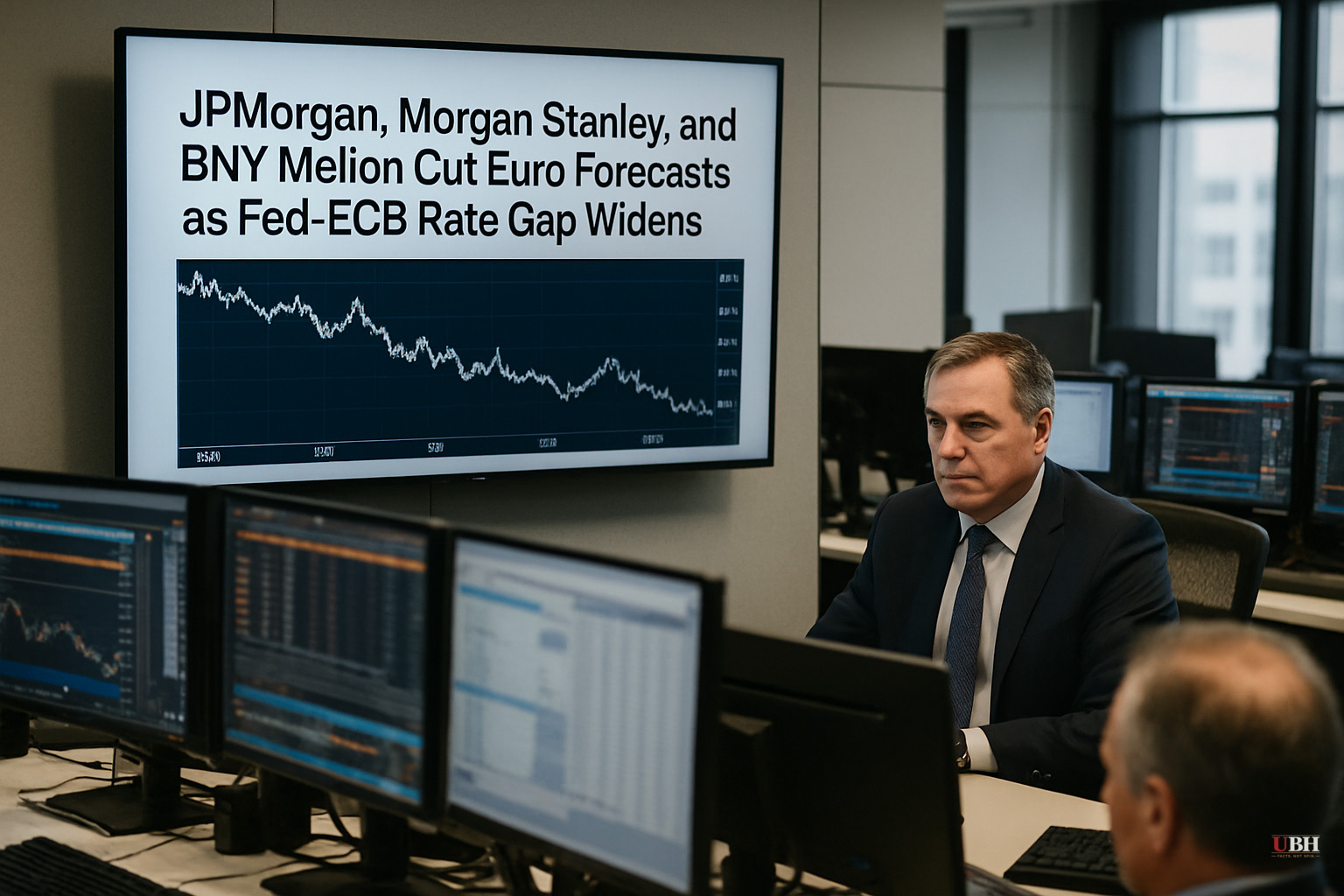
JPMorgan, Morgan Stanley, and BNY Mellon Cut Euro Forecasts as Fed-ECB Rate Gap Widens
The Trade That Defined Early 2026 Is Now Unwinding
At the start of 2026, the euro was above 1.20 against the dollar and Wall Street loved it. The thesis was clean: Europe was normalizing monetary policy, the US economy looked like it might cool, and rate convergence between the Fed and ECB seemed plausible. Banks piled into long-euro positions.
That trade is now being dismantled.
As of June 29, JPMorgan Chase, Morgan Stanley, and Bank of New York Mellon have all lowered their euro-to-dollar forecasts, according to Huoxing Finance. All three anticipate the euro will fall more than 3% over the next year, landing near 1.10. The euro has already dropped to a one-year low this month — a sharp reversal from its five-year high.
What Broke the Convergence Story
The Fed held its federal funds target range steady at 3.50–3.75% on June 17, according to Crypto Briefing. That sounds neutral on its face. It wasn't. Nine of 19 Fed policymakers projected at least one rate hike before year-end, pushing the median end-2026 forecast to 3.8%. Markets repriced immediately — the dollar index jumped 0.85% in a single session. Traders are now pricing an 85% probability of a December rate hike.
On the other side of the Atlantic, the ECB raised its deposit facility rate by 25 basis points to 2.25% on June 11. ECB President Christine Lagarde has signaled no aggressive policy response is needed in response to Middle East conflict pressures, maintaining a comparatively dovish path.
The math is simple. If US rates are heading toward 3.8% or higher while European rates sit at 2.25%, capital flows toward the better yield. That means dollars, not euros.
Banks Aren't Waiting Around
Société Générale's chief FX strategist stated flatly that "the euro's rally is essentially over," comparing the current energy shock — driven partly by Iran-related tensions pushing oil prices higher — to the economic damage Europe absorbed after the Russia-Ukraine conflict began in 2022, according to Huoxing Finance.
Bank of America is the relative outlier. It lowered its year-end forecast from 1.20 to 1.15 but maintained a "neutral" outlook, making it one of the more cautious voices in the room rather than outright bearish.
Options markets have also turned. The one-year risk reversal index has fallen to its most bearish level since March 2025, per Huoxing Finance — meaning traders are paying more to hedge against further euro weakness than they have in over a year.
The Note on "Federal Reserve Chair Walsh"
Huoxing Finance, as cited in the KuCoin report, refers to the Fed chair as "Walsh." The sources do not provide further clarification on this name. The policy signals attributed to the Fed chair — a firm anti-inflation stance prompting markets to reprice rate hike expectations — are consistent with the broader policy picture described by Crypto Briefing and should be read in that context. Any specific attribution to a named Fed chair beyond the sourced description should be treated as unverified.
The Strongest Case for Euro Bulls
Fair question: what if the bears are wrong? The case for euro strength isn't dead, it's just on life support. If US economic data softens meaningfully in the second half of 2026, the Fed hiking narrative could evaporate fast. Dollar longs would then find themselves badly positioned. Additionally, if the ECB surprises with more aggressive tightening — say, a geopolitical shock forces Europe to defend its currency — the current positioning could reverse sharply. The 85% market probability for a December Fed hike is significant, but market pricing has been wrong before, in both directions.
Bank of America's decision to hold a neutral stance rather than go full bearish reflects this uncertainty. Not everyone on Wall Street is willing to chase the consensus into a crowded short.
What to Watch Next
The single most important variable from here is whether the Fed actually follows through. If US data — jobs, inflation, consumer spending — holds up through summer, the hiking case stays intact and dollar strength continues. If it doesn't, the narrative flips.
With the one-year risk reversal index at its most bearish level since March 2025 and three major banks now targeting 1.10, the burden of proof has shifted to anyone still holding a bullish euro position. The next major data checkpoint will be whether US economic data through the summer supports or undercuts the Fed's hawkish tilt.
Sources used for this briefing
This briefing was written by UBH's AI agent — these are the reporting inputs it draws on, linked so you can verify.


