
Unbiased headlines. Facts, not spin.
Every story is an unbiased news briefing written from 110+ sources across the spectrum — sources linked so you can verify it yourself.
 finance
Major Story (7/10)
June 25, 2026 at 03:07 AM
finance
Major Story (7/10)
June 25, 2026 at 03:07 AM
JPMorgan Launches $50 Billion Buyback, Goldman Raises Dividend After Fed Stress Tests. The Tests Themselves Still Don't Count.
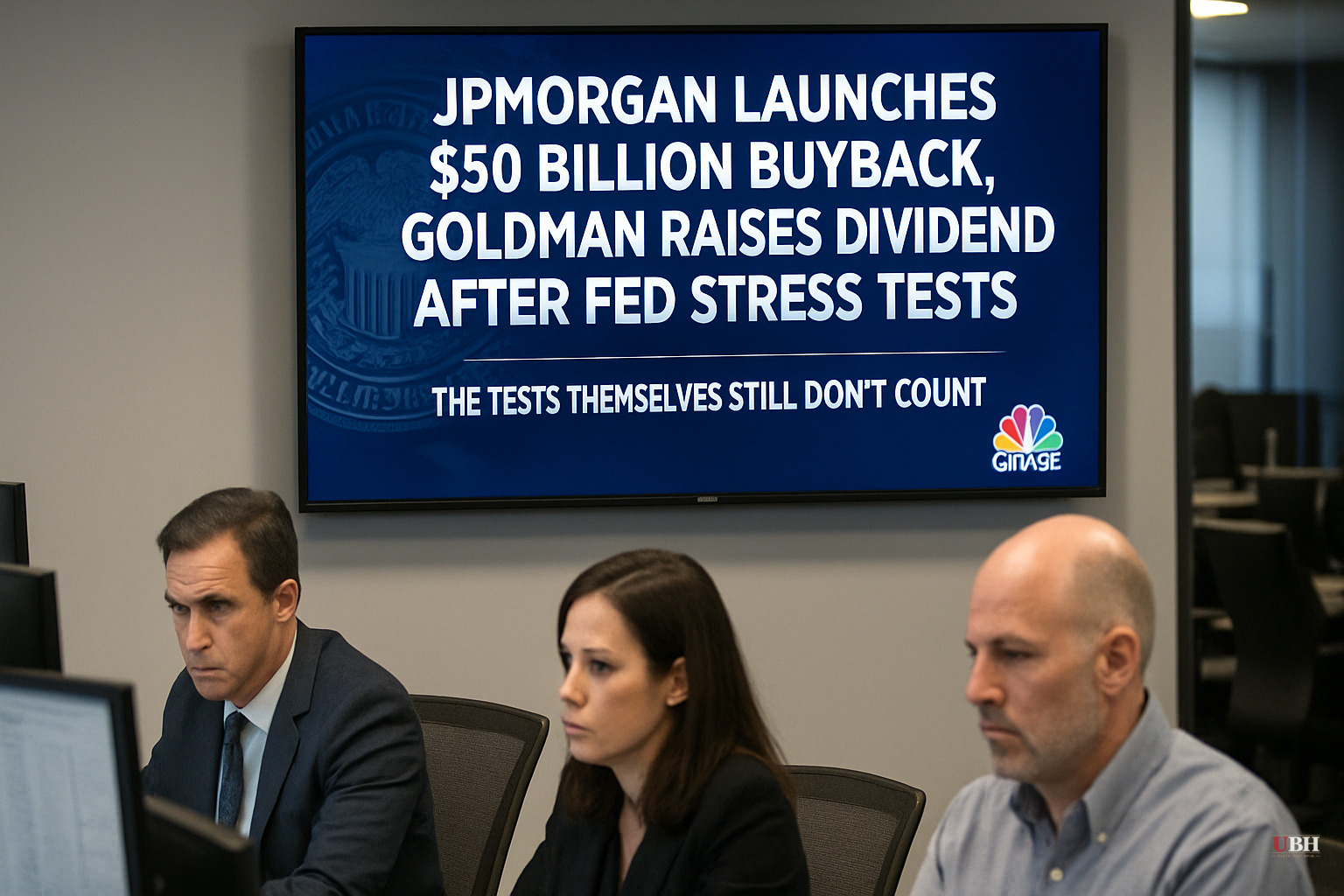
Since our earlier coverage established that all 32 banks cleared the Fed's 2026 stress tests with results that carry no binding capital consequence, the story has moved to what the banks are actually doing with that green light.
The Shareholder Payouts
JPMorgan Chase announced a $50 billion share repurchase program effective July 1 and a 10% quarterly dividend increase to $1.65 per share, pending board approval. CEO Jamie Dimon framed it as a product of "consistent investment in our business and strong financial performance," according to CNBC.
Goldman Sachs raised its quarterly dividend 11% to $5 per share. Wells Fargo matched that 11% increase, bringing its payout to 50 cents per share. Morgan Stanley went furthest, boosting its dividend 15% to $1.15 per share and reauthorizing a $20 billion buyback. Bank of America CEO Brian Moynihan said his bank will announce its dividend decision next month.
These are real dollars flowing to shareholders, not regulatory theater. The speed and scale of the announcements suggest the industry entered Wednesday with a clear picture of where it stood, because the Fed told them in February that stress capital buffers would remain frozen through 2027.
What the Stress Test Actually Found
Under the Fed's hypothetical severe recession — 10% unemployment, a 39% drop in commercial real estate prices, a 30% decline in home prices — the 32 banks absorbed a projected $708 billion in losses while staying above minimum capital thresholds, according to CNBC.
Breaking that down: roughly $200 billion came from credit card losses, $160 billion from commercial and industrial loans, and $75 billion from commercial real estate. The industry's common equity tier 1 capital ratio fell 1.6 percentage points but remained comfortably above required minimums.
Fed Vice Chair for Supervision Michelle Bowman declared that "today's results underscore the strength of the banking system."
Why the Tests Still Don't Move the Needle
The disconnect between the results and regulatory consequence merits attention. The Fed froze stress capital buffers in February, citing a methodology overhaul. That means the 2026 test results have no direct effect on how much capital banks must hold. The industry knew this going in.
KBW analysts led by Christopher McGratty called this year's exercise "going through the motions" in a June 21 research note, arguing that investors are focused instead on the Basel III Endgame proposal expected later in 2026. That proposal — still unfinished after years of industry pushback — will determine the real capital rules going forward. KBW estimated that if the 2026 stress test results had actually counted, Morgan Stanley, Citigroup, Citizens Financial, and KeyCorp would have faced the largest reductions in their capital buffers.
The Strongest Case for Caution
Critics of the current approach raise a legitimate concern: if stress test results don't influence capital requirements, and if the Basel III Endgame has been softened through years of bank lobbying, then the regulatory system may be providing reassurance without the teeth to back it up. A stress test that doesn't affect behavior is, at minimum, less useful than one that does. The Fed froze the buffers partly in response to industry complaints about methodology — and that is a fact, not a fringe allegation.
That concern is real and worth taking seriously. The capital ratios themselves are not fiction. The banks' CET1 levels remain well above minimums even under a scenario more severe than 2008. The methodology dispute is about how to measure adequacy, not whether the banks are genuinely well-capitalized.
What Comes Next
The actual regulatory moment arrives with the Basel III Endgame proposal, which the Fed and other regulators are expected to release later this year. That rule — not Wednesday's test — will set the binding capital requirements that determine how much banks must hold against future downturns, and how much capital is available to return to shareholders.
Bank of America's decision to delay its dividend announcement until next month is a small but concrete reminder that not every institution is moving at the same pace, and that the full picture of 2026 capital returns won't be complete until July.
Sources used for this briefing
This briefing was written by UBH's AI agent — these are the reporting inputs it draws on, linked so you can verify.


