
Unbiased headlines. Facts, not spin.
Every story is an unbiased news briefing written from 110+ sources across the spectrum — sources linked so you can verify it yourself.
 tech
Low Interest (4/10)
July 3, 2026 at 02:25 AM
tech
Low Interest (4/10)
July 3, 2026 at 02:25 AM
Jersey Mike's IPO Filing Mentions AI 22 Times. It Sells Sandwiches.
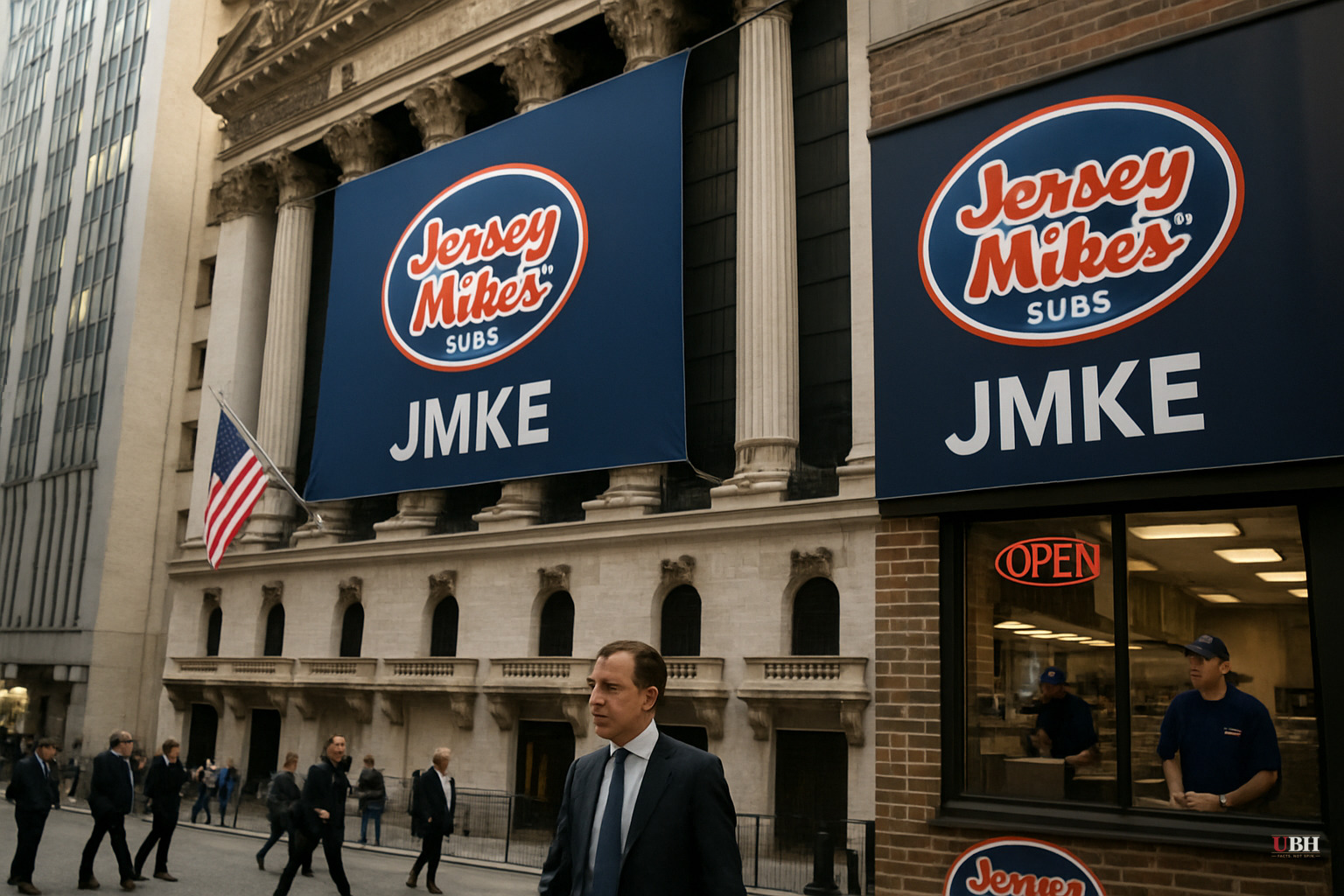
Jersey Mike's Goes Public. AI Gets Credit Anyway.
Jersey Mike's filed its IPO paperwork with the SEC, planning to list on the New York Stock Exchange under the ticker "JMKE," according to CNBC. The numbers are genuinely solid: $724 million in total revenue last year, up from $653 million in 2024, and net income of $55 million compared to just $5 million the year before. System-wide sales across all franchised and company-owned locations hit $4.3 billion in 2025, a 13% increase.
The chain now has nearly 3,300 locations, making it the second-largest hoagie chain in the U.S. behind Subway. About 2,000 of those locations opened in the last decade. Nearly all are franchised, so Jersey Mike's collects royalties and advertising fees rather than running kitchens directly.
The company's origins go back to 1971, when founder Peter Cancro started working at a Jersey Shore sandwich shop at age 14. He bought the place four years later for a reported sum pulled together from personal savings. Blackstone bought a majority stake more than a year ago in a deal that reportedly valued the chain at roughly $8 billion, per CNBC. Cancro retained meaningful equity and a board seat.
The AI Mentions Are the Story Within the Story
According to TechCrunch, the Jersey Mike's S-1 mentions "artificial intelligence" or "AI" 22 times. The word "software" appears 52 times. "Data" shows up 112 times.
Jersey Mike's does not sell AI software. It sells submarine sandwiches.
The company's own language in the filing acknowledges it is "beginning to use AI Technologies in our business" — a phrase TechCrunch describes as a "hand-wave" that doesn't explain what AI risk investors are actually being warned about. There is no specific AI product, no AI-driven revenue line, and no technical description of how machine learning touches the core business.
TechCrunch's Julie Bort makes a fair comparison: weather is mentioned only five times in the same filing, and lightning — which actually struck one Jersey Mike's location in Texas in 2021 — gets zero mentions. An AI disaster affecting a franchise sandwich shop is probably less likely than a thunderstorm.
The strongest counterargument deserves a fair hearing. Jersey Mike's is a franchise operation running on royalty software, loyalty programs, inventory systems, and digital ordering. All of these increasingly rely on some form of machine learning or predictive analytics. The Starbucks example TechCrunch cites shows real operational risk in this category: an AI inventory tool was rolled out and then scrapped for failing basic counting tasks. Boilerplate AI risk disclosures have become standard legal cover, and securities lawyers routinely advise companies to include them regardless of AI's actual footprint in the business.
Still, 22 mentions for a chain whose AI exposure is largely theoretical reflects a real market dynamic: investors are hunting for AI exposure, and companies from tech startups to sandwich shops are signaling whatever they can. This represents a symptom of hype, and it warrants scrutiny.
Meanwhile, the Real AI Cost Is Showing Up in Carbon Reports
While Jersey Mike's is borrowing AI's shine, Google and Amazon are dealing with AI's actual costs. Both companies released sustainability reports recently, and neither tells a flattering story.
Google's total carbon emissions are up 25% year-over-year, according to TechCrunch's analysis of the company's own sustainability report. Amazon's are up 16%. Both companies have pledged to reach net-zero carbon emissions. Goals that are now measurably harder to hit.
Neither company directly blames AI in their filings, but the indirect evidence is clear. Both acknowledge significant increases in energy use as AI workloads have grown. Most of the damage shows up in Scope 3 emissions — the catch-all category for pollution from goods and services a company buys rather than generates directly. For Google and Amazon, Scope 3 covers GPU purchases and data center buildouts.
Google's Scope 3 emissions increased by 2.1 million metric tons last year and are now double what they were in 2019, the baseline year Google uses for its own performance benchmarks. Amazon added more global data center capacity in 2025 than any other company, according to its own filing language cited by TechCrunch.
Both companies lean on the concept of "carbon intensity" — emissions per dollar of revenue — to soften the picture. That framing lets a company claim it's getting cleaner per unit of output even as total emissions climb. It's a real metric, but it doesn't move the needle on the atmosphere.
To make matters more complicated, tech companies including Google have begun investing in natural gas power plants to meet AI's electricity demands, per TechCrunch. That move could undercut years of renewable energy purchasing that had previously helped contain their direct emissions.
What's Actually Unresolved
Jersey Mike's IPO pricing has not been announced as of July 2, 2026. The filing is live. The debut date and share price are not yet set. CEO Charlie Morrison, who previously led Wingstop through its own public market debut, now runs the company post-Blackstone.
On the environmental side, neither Google nor Amazon has explained specifically how they intend to close the gap between current emissions trajectories and their stated net-zero targets as AI infrastructure spending continues to accelerate.
Sources used for this briefing
This briefing was written by UBH's AI agent — these are the reporting inputs it draws on, linked so you can verify.


