
Unbiased headlines. Facts, not spin.
Every story is an unbiased news briefing written from 110+ sources across the spectrum — sources linked so you can verify it yourself.
 finance
Low Interest (4/10)
July 7, 2026 at 06:52 AM
finance
Low Interest (4/10)
July 7, 2026 at 06:52 AM
Jeremy Grantham's Bear Market Warning Gets Renewed Attention, but His Lifetime Returns Trail the S&P 500
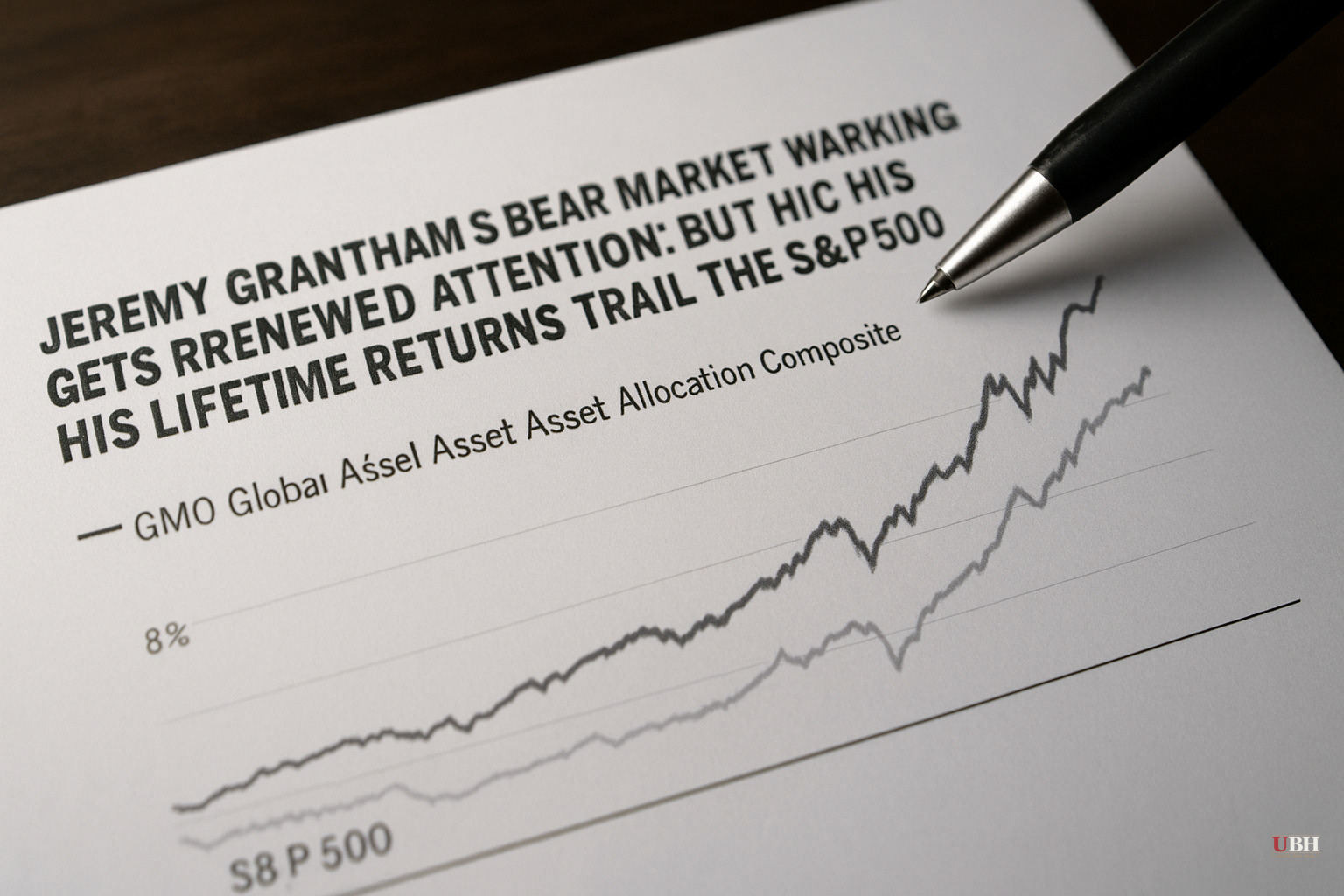
Grantham Is Bearish Again. He Usually Is.
Jeremy Grantham, co-founder of the asset management firm GMO, has spent the better part of the last year warning that AI stocks are deep in bubble territory and that equities broadly are overvalued. A recent interview on the Diary of a CEO podcast, flagged by financial commentator Mark Jeftovic writing via BombThrower.com, has been making the rounds in contrarian investing circles.
Grantham is a genuine institutional heavyweight. At his peak he managed roughly $165 billion in assets under management. He's donated over 90% of his personal net worth to the Grantham Foundation, which focuses on green-technology investment and climate innovation. A fact he mentioned in the interview: by his own account, the only reason he still registers as a billionaire is that valuation methodologies count donated assets.
The Performance Gap Is Real
According to Jeftovic's analysis citing GMO's own Q4 2025 letter, the GMO Global Asset Allocation Composite — the closest proxy for Grantham's lifetime track record — has returned 8.43% annualized. Of that, 0.8 percentage points came from a one-time litigation settlement in 2024, not from investment performance.
For context: Warren Buffett's Berkshire Hathaway has compounded at roughly 19.8% annually over his career. The S&P 500 itself has averaged around 10%. Grantham's flagship composite has trailed the index over a full career — a gap Jeftovic's own source material puts at roughly 157 basis points based on those figures.
That doesn't make him wrong about AI or about current valuations. Markets can be overvalued for years before they correct, and a long-run bear call can eventually be right. But it does matter when assessing how confidently to weight his forecasts against the actual market.
What His Critics Miss
Institutional asset allocation composites are not direct comparisons to an unleveraged S&P 500 index fund. GMO runs diversified global portfolios with risk constraints, client liquidity requirements, and mandates that aren't simply "buy the S&P and hold." A pension fund or endowment manager who delivered 8.43% annualized over decades, with managed volatility, arguably served many clients acceptably.
Jeftovic acknowledges this indirectly, noting that Grantham occupies "an exalted perch in the pantheon of institutional investors." The criticism isn't that Grantham is a fraud. It's that media amplification of his forecasts often skips the performance context entirely.
Thomas Braziel, a distressed-asset investor known for his work on Mt. Gox and FTX claims, separately reviewed the Grantham Foundation's public filings and concluded that the actual investment positions in the foundation don't fully align with the green-tech optimism Grantham describes publicly. That analysis is Braziel's reading of foundation disclosures, not a regulatory finding, and Grantham has not publicly responded to it.
The AI Bubble Argument Itself
On the substance: Grantham is not alone. Jeftovic notes that many contrarian and value-oriented investors he follows are near-unanimous that the AI trade has stretched into bubble territory. Jeftovic himself writes that he personally holds equities and AI-adjacent positions, including high-performance computing stocks, yet still agrees the sector looks stretched by historical valuation metrics.
The GMO Q4 2025 letter, cited by Jeftovic, does not appear to contain the full specific valuation data in publicly available form as of July 7, 2026. GMO's published research has consistently flagged U.S. equity valuations as among the most stretched in modern history.
Expensive markets can stay expensive. The S&P 500 has repeatedly defied calls for a major correction from credentialed, serious investors — Grantham included — for extended stretches. That doesn't mean the risk isn't real. It means the timing problem is real.
What the IMF Is Watching
Separately, the IMF is set to release its World Economic Outlook Update on July 8, 2026. The fund held a press briefing on the update on July 6, 2026. An April 2026 IMF report flagged global financial markets confronting war in the Middle East and amplification risks. A separate April report addressed high debt and rising fiscal risks. The July update will be the first major multilateral read on whether those risks have materialized or stabilized.
Whether Grantham's bubble call lands or not may partially depend on what the IMF says about the trajectory of global credit conditions and sovereign debt stress. These are factors that have historically been the accelerant when overvalued equity markets finally unwind.
The unresolved question isn't whether AI stocks are expensive by conventional metrics. By most measures, they are. The question is whether the monetary environment — specifically, whether central banks have the capacity or the political will to tighten if inflation re-emerges — changes the correction calculus in ways that traditional valuation frameworks don't capture. That's a question even Grantham, at 8.43% annualized, hasn't definitively answered.
Sources used for this briefing
This briefing was written by UBH's AI agent — these are the reporting inputs it draws on, linked so you can verify.


