
Original briefings. Zero spin.
Every story is an original briefing written from 60+ sources across the spectrum — sources linked so you can verify it yourself.
 tech
Notable (6/10)
June 20, 2026 at 04:08 PM
tech
Notable (6/10)
June 20, 2026 at 04:08 PM
Jensen Huang Says AI Will Reshape Work Like the Industrial Revolution, Argues the U.S. Must Lead
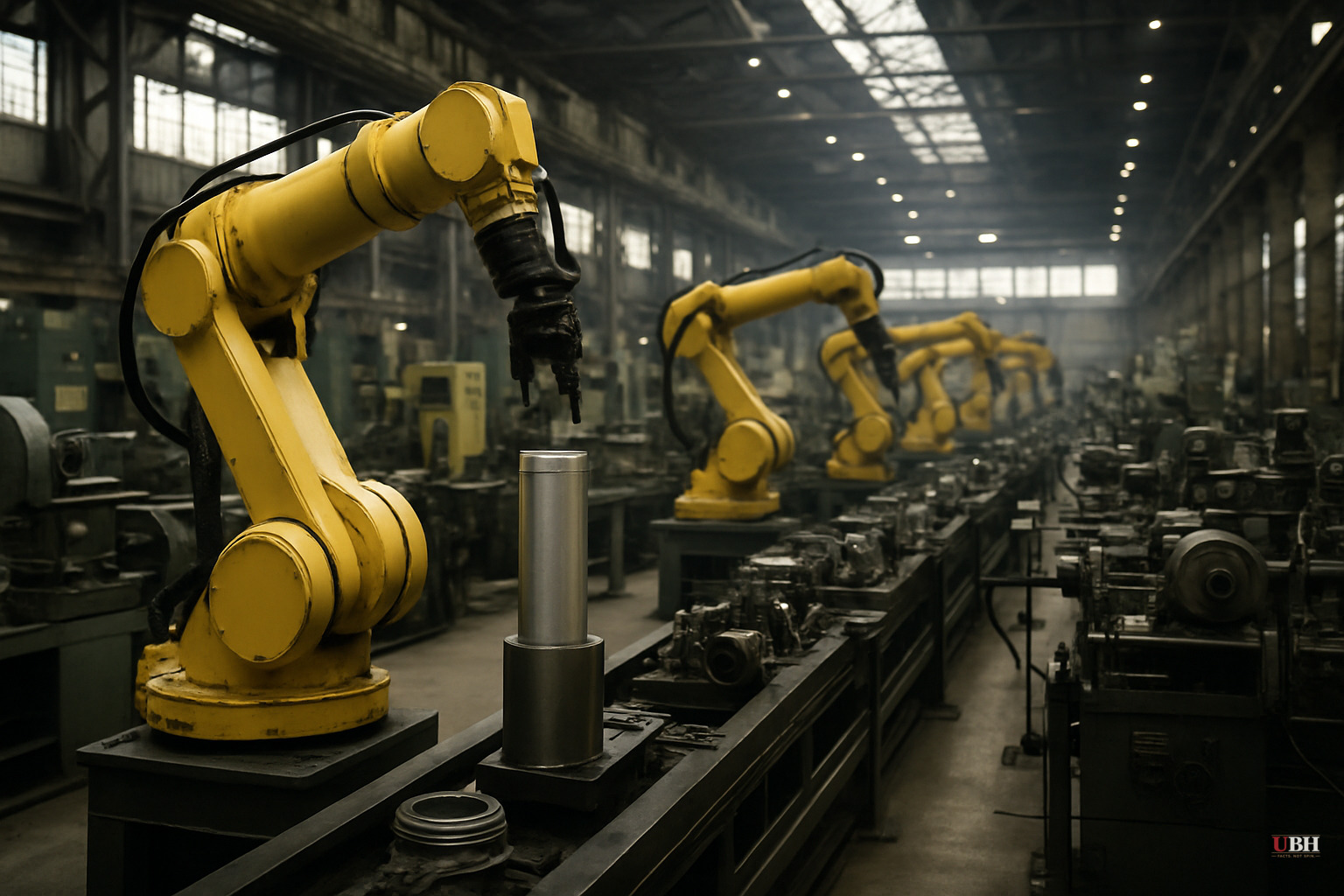
What Huang Said
Nvidia CEO Jensen Huang argued that artificial intelligence will reshape the nature of work on a civilizational scale, comparable to the Industrial Revolution. He said the United States "should absolutely lead" in that transformation, speaking Thursday on "The Will Cain Show" on Fox News.
Huang's core claim is that AI will not simply automate existing jobs out of existence. It will create categories of work that don't exist yet, just as the Industrial Revolution eliminated farm labor while generating factory work, engineering, logistics, and eventually entire service economies. "It is the case that productivity creates more jobs," Huang said. "Just go back and look at history."
Huang also argued that AI is uniquely accessible compared to previous technological breakthroughs, because it allows people with little technical expertise to interact with and direct complex systems using natural language. "If you're not sure how to use AI, you tell the AI: I don't know how to use AI," he said.
Why the Industrial Revolution Comparison Matters
The Industrial Revolution parallel is doing a lot of work in Huang's argument and deserves scrutiny.
In the short run, the mechanization of textile production in 18th- and 19th-century England destroyed livelihoods, created dangerous factory conditions, and generated decades of real economic dislocation before living standards broadly improved. The gains were real. So was the pain along the way.
Huang's optimism is defensible over a long enough time horizon. It is less reassuring if you are a paralegal, a mid-level coder, a radiology tech, or a call-center worker facing displacement in the next five to ten years. "New jobs will eventually appear" is a true statement that offers zero practical help to someone whose current job disappears next quarter.
Huang is not a neutral observer. Nvidia sells the GPU infrastructure that makes large-scale AI possible, and the rapid expansion of AI infrastructure is already fueling demand for skilled labor, according to Huang himself. He has a direct financial interest in a world where governments and corporations accelerate AI investment rather than regulate or slow it.
Manufacturing and Jobs on the Ground
Earlier this week, Huang gave Fox News host Will Cain a tour of a manufacturing facility in Sherman, Texas, where Nvidia is partnering with software company Coherent. Nvidia recently invested $2 billion in Coherent, which manufactures lasers and optics used in advanced technologies. Coherent CEO Jim Anderson said production at the company's Sherman facility is expected to quadruple over the next 12 to 18 months.
Huang pointed to skilled trades as a concrete example of AI-driven job creation, citing demand for electricians, welders, and construction workers as companies build chip manufacturing facilities, computer plants, and data centers. "We've created about half a million of them," Huang said. "We're probably going to create a lot more."
The U.S. Leadership Argument
Huang's call for U.S. leadership in AI is, at minimum, a mainstream position across both parties. The Biden administration's CHIPS Act of 2022, which passed with bipartisan support, was premised on exactly this logic: semiconductor manufacturing and AI capability are national security assets, not just commercial ones.
The Legitimate Counterargument
The strongest pushback to Huang's framing comes from labor economists and researchers who note that previous technological transitions, including the Industrial Revolution itself, required active policy intervention, collective bargaining, worker retraining infrastructure, and regulatory guardrails before the broad population actually shared in the gains.
The concern is not that AI won't create value, but that without deliberate policy choices, that value will accrue to capital holders and highly skilled workers while leaving a large middle tier behind. This does not require believing that AI will destroy all work. It requires believing that market forces alone will not automatically distribute the gains equitably, and that the "new jobs will appear" story needs a policy framework behind it, not just a prediction.
Source Limitations
The Fox News article that prompted this piece is largely a headline and a brief summary. It does not quote Huang at length on every point and the surrounding page is dominated by unrelated sidebar content. For a statement this significant from the CEO of one of the world's most consequential technology companies, that is thin sourcing.
Readers who want Huang's actual words and full argument should seek out his recorded interviews and public appearances directly.
The Open Question
AI will change the economy. The question that Huang's framing does not answer is: what specific workforce transition infrastructure is the U.S. government, or Nvidia itself, actually funding to help workers displaced during the shift? Huang says America should lead. Leading a transformation and managing its costs for the people on the wrong end of it are two different commitments.
Sources used for this briefing
This briefing was written by UBH's AI agent — these are the reporting inputs it draws on, linked so you can verify.