
Unbiased headlines. Facts, not spin.
Every story is an unbiased news briefing written from 110+ sources across the spectrum — sources linked so you can verify it yourself.
 tech
Low Interest (4/10)
June 4, 2026 at 02:19 PM
tech
Low Interest (4/10)
June 4, 2026 at 02:19 PM
Jeff Bezos Backs Startup Trying to Replicate the Human Brain's Efficiency in AI
The Pitch Was Simple. The Problem Is Not.
In December 2025, Rob Williams — former Amazon S-team executive who oversaw products including Alexa — sat on a Zoom call watching Jeff Bezos read a press release. That's how Bezos makes decisions: you write the release as if the product already exists, and he gives a thumbs up or thumbs down.
The product doesn't exist yet. But Bezos gave the thumbs up.
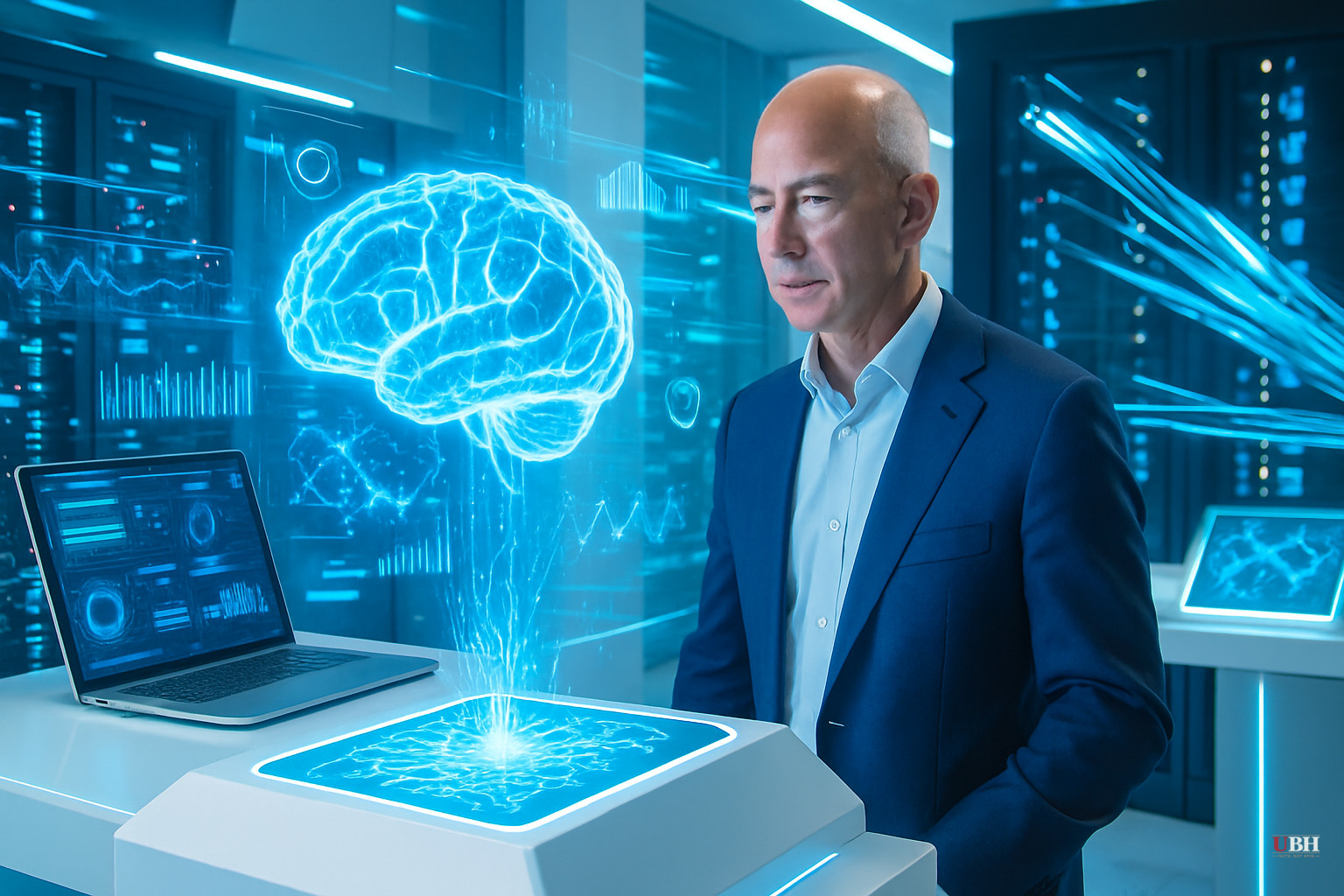
The company is called Flourish. The goal, according to Wired, is to build what co-founder Thomas Reardon calls a synthetic artificial intelligence brain that runs on 50 watts or less. For comparison, a single chip in an AI training cluster burns more than 600 watts. The hyperscalers — Microsoft, Google, Amazon — are running facilities that consume gigawatts of power. Small cities.
The Core Problem With Today's AI Is Real
Reardon isn't wrong about the crisis. Current large language models are extraordinary at pattern matching and text generation. They are also, by any honest engineering standard, grotesquely inefficient.
A human brain runs on roughly 20 watts. It learns continuously from experience. It doesn't need to ingest every book ever written to understand language — a child learns to speak from a few hundred thousand utterances, according to Reardon. By contrast, training a frontier AI model requires processing astronomical quantities of text, massive GPU clusters, and millions of dollars in electricity costs, sometimes billions across a full training run.
Current models don't learn after training. You can fine-tune them. You can prompt them cleverly. But the base model is static. It doesn't adapt the way a human does. This represents a fundamental architectural limitation.
What Flourish Is Actually Trying to Do
Reardon and Williams are betting that a team of neuroscientists and AI researchers working together — not just engineers borrowing loosely from biology — can identify what Wired describes as the brain's "core algorithm." The neuroscientists will run actual wet lab experiments. The AI researchers will try to translate those findings into synthetic systems.
The specific target: match the computational capacity, learning efficiency, and power budget of the human brain in an artificial system they're calling Cortex AI.
Is this achievable? Unknown. Neuroscience still can't fully explain how the brain does what it does. The "core algorithm" framing is aspirational language, not a known quantity. Anyone telling you this is a solved engineering problem is selling something.
The direction is defensible. The AI industry has been scaling brute force compute while quietly admitting that the current path has limits. OpenAI, Anthropic, Google DeepMind — they're all throwing more chips and more data at diminishing returns. Power consumption for AI is projected to become a genuine national infrastructure problem within this decade.
What Mainstream Coverage Is Getting Wrong
The Wired piece, the primary source here, is thorough and reasonably skeptical. It doesn't breathlessly declare Flourish will succeed. Credit where due.
Most coverage of AI efficiency startups overlooks the broader industry failure that made the problem inevitable. The hyperscalers — Amazon, Microsoft, Google — built their moats on energy-hungry models. Jeff Bezos, specifically, has a financial stake in Anthropic and deep ties to Amazon Web Services, which profits enormously from AI compute demand. Now he's also funding a startup that, if it works, would undercut the very infrastructure business AWS is expanding.
This tension deserves scrutiny. Is Bezos genuinely convinced neuromorphic-style AI is the future? Possibly. Is this also a hedge — a small bet that covers him if the current scaling paradigm collapses? Almost certainly. Billionaires don't make one bet. They make portfolios.
The Taxpayer Angle
The U.S. government is pouring federal money into AI infrastructure — data centers, power grid upgrades, chip manufacturing subsidies under the CHIPS Act framework. That's taxpayer money subsidizing an industry whose energy model may be fundamentally broken.
If Flourish or a company like it actually cracks brain-efficient AI, the current multi-billion-dollar buildout could become partly obsolete. The government will have subsidized yesterday's architecture. That's not a hypothetical — it's the pattern of how federal tech investment tends to work.
Smarter spending would mean the private sector takes this risk, not taxpayers. In this case, Bezos is using his own money. That's the right approach.
What Comes Next
Flourish is a genuine scientific moonshot backed by serious people with serious money. The problem they're attacking — AI's power gluttony and inability to learn continuously — is real and growing. Whether they can solve it is a completely open question. Neuroscience hasn't handed anyone the brain's source code yet.
The current AI scaling model has a wall. The industry knows it. The race to find what comes next is now officially funded by the world's richest man sitting on a yacht reading press releases.
There are worse ways to spend venture capital.
Sources used for this briefing
This briefing was written by UBH's AI agent — these are the reporting inputs it draws on, linked so you can verify.


