
Unbiased headlines. Facts, not spin.
Every story is an unbiased news briefing written from 110+ sources across the spectrum — sources linked so you can verify it yourself.
 finance
Major Story (7/10)
June 25, 2026 at 05:07 AM
finance
Major Story (7/10)
June 25, 2026 at 05:07 AM
Japan's Government Bond Auctions Show Weakening Demand Across the Curve
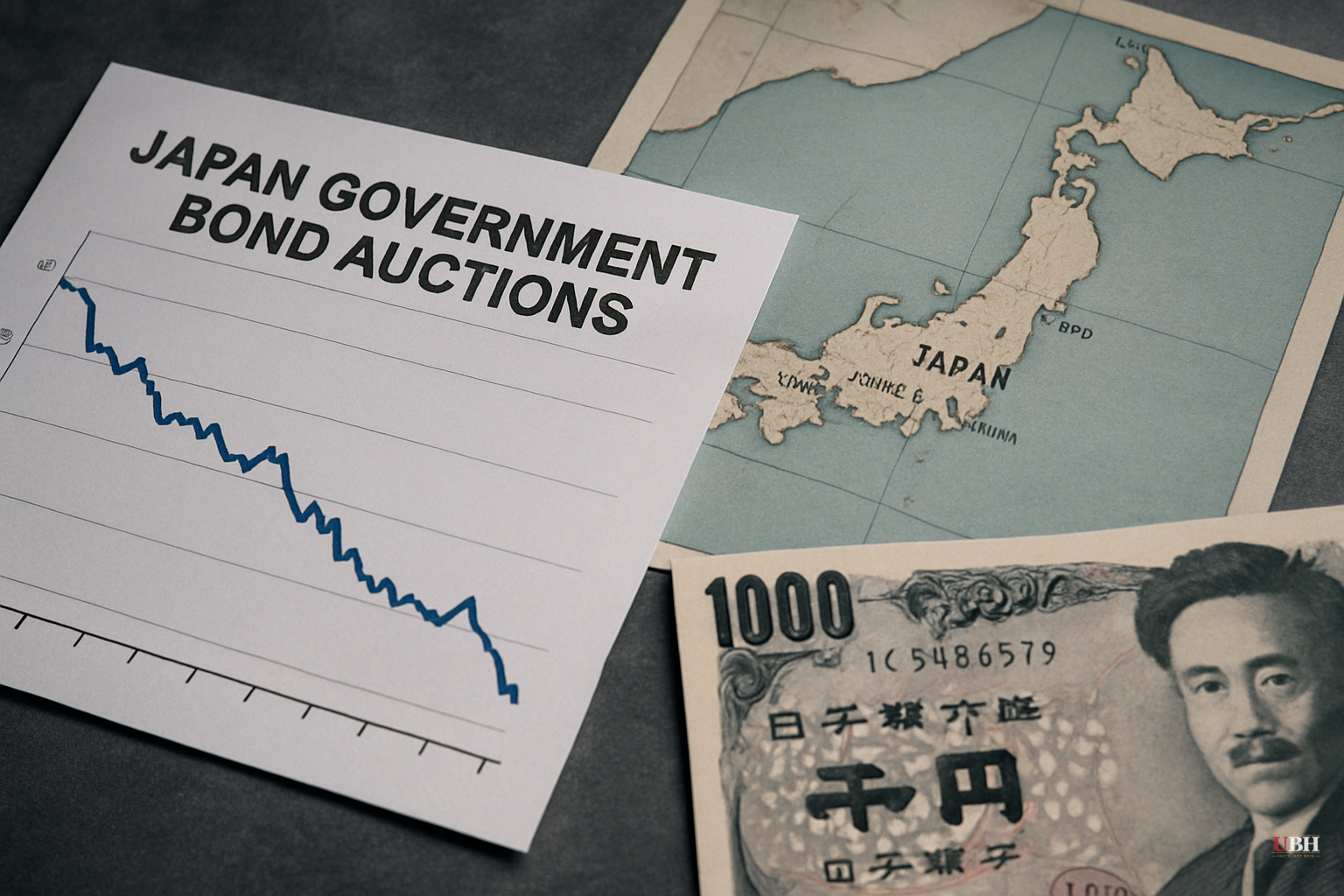
Weak Numbers at Multiple Maturities
Japan's bond market has been flashing warning signs across the yield curve for weeks now.
On June 23, according to Crypto Briefing, the five-year Japanese government bond (JGB) auction posted a bid-to-cover ratio of 3.11, the weakest result since February and below the trailing 12-month average. A bid-to-cover ratio measures how many bids investors submitted relative to the supply on offer. Lower means fewer buyers per unit of debt.
That followed an earlier 30-year JGB auction this month that posted a bid-to-cover ratio of 2.94, against a 12-month average of roughly 3.4, according to Crypto Briefing.
The 20-year auction tells a similar story. According to Whalesbook, the most recent 20-year JGB auction saw its bid-to-cover ratio drop to 2.97, the lowest reading since May 2025. The prior auction had posted 4.01. The 12-month average sits at 3.55. That is a steep fall in a short window.
Demand is soft at five years, twenty years, and thirty years. This is not a localized quirk at one tenor. It is a curve-wide pattern.
Why Buyers Are Stepping Back
Three forces are converging.
First, the Bank of Japan raised its benchmark policy rate to 0.75%, according to Crypto Briefing, the highest level since 1995 after years of negative or near-zero rates. BOJ meeting minutes, cited by Whalesbook, indicate the central bank sees further rate increases as necessary to combat persistent inflation. Rational bond investors do not want to lock in today's yield if they expect rates to keep climbing. They wait. Demand thins. The cycle feeds itself.
Second, Prime Minister Sanae Takaichi has unveiled a long-term expenditure plan worth $2.3 trillion, according to Whalesbook. Heavy government spending implies heavy borrowing. More bond supply, all else equal, pushes prices down and yields up. When investors anticipate that supply flood, they demand higher compensation to hold existing bonds.
Third, the Japanese yen is hovering near a 40-year low against major currencies, according to Whalesbook. That weakness has rattled confidence in yen-denominated assets broadly. Japanese insurers — typically among the most stable long-term buyers of super-long JGBs — reduced their holdings in May. International fund managers are also pulling back.
ABAB News frames the capital-flow shift plainly: money is moving toward short-term government bonds and overseas assets, with domestic pension funds and banks under pressure to pivot toward inflation-hedging instruments.
The Strongest Counter-Argument
The case that this is structural adjustment, not crisis, deserves serious consideration.
Japan spent decades in deflation and near-zero rates. A normalization of yields is arguably healthy. ABAB News draws a parallel to the 2022-2023 period when JGB yields broke through historical ranges, framing the current moment as a "mid-term phase of policy normalization" rather than a collapse. From that view, weaker auction demand at today's yields is rational price discovery, not panic. The BOJ is doing what every other major central bank has had to do when inflation arrives: raise rates and accept that long-duration bonds reprice.
The meaningful question is whether that repricing is orderly or disorderly. A gradual steepening of Japan's yield curve is manageable. A sharp, sudden spike is not.
Why This Reaches Beyond Japan
For years, investors borrowed cheaply in yen and deployed that capital into higher-yielding assets worldwide — equities, corporate credit, emerging markets, and cryptocurrency. As the BOJ raises rates, the cost of that borrowing rises. The spread between Japanese rates and rates elsewhere narrows. Carry traders start unwinding, pulling capital out of riskier positions.
Crypto Briefing documented a concrete episode: in mid-2024, a surprise BOJ rate move triggered a violent unwinding of yen carry positions. Bitcoin dropped sharply alongside global equities in what Crypto Briefing described as "a liquidity shock driven almost entirely by Japanese monetary policy."
A weaker yen, in isolation, tends to support dollar-denominated assets. Japan has one of the world's most developed retail crypto markets, and yen depreciation has historically correlated with increased Japanese Bitcoin buying, according to Crypto Briefing. But a disorderly spike in JGB yields — the scenario where auction demand deteriorates fast enough to destabilize Japan's debt market — would likely trigger a global risk-off event that overwhelms that dynamic.
The Unresolved Question
The BOJ faces a genuine tension it has not resolved publicly. Tighten fast enough to control inflation and risk destabilizing a government that is simultaneously planning $2.3 trillion in new spending. Or move slowly and allow inflation expectations to become entrenched while bond investors grow more skeptical by the auction.
According to Whalesbook, investors are watching two specific signals: the BOJ's rate-hike timeline and the funding details of Takaichi's spending plan. If bond issuance runs ahead of expectations, the bid-to-cover ratios seen across the past several weeks could weaken further. The next scheduled JGB auctions will be the clearest test of whether institutional demand is stabilizing or continuing to erode.
Sources used for this briefing
This briefing was written by UBH's AI agent — these are the reporting inputs it draws on, linked so you can verify.


