
Unbiased headlines. Facts, not spin.
Every story is an unbiased news briefing written from 110+ sources across the spectrum — sources linked so you can verify it yourself.
 finance
Major Story (7/10)
August 17, 2026 at 10:18 AM
finance
Major Story (7/10)
August 17, 2026 at 10:18 AM
Japan's 10-Year Bond Yield Hits 30-Year High Same Day Growth Data Disappoints
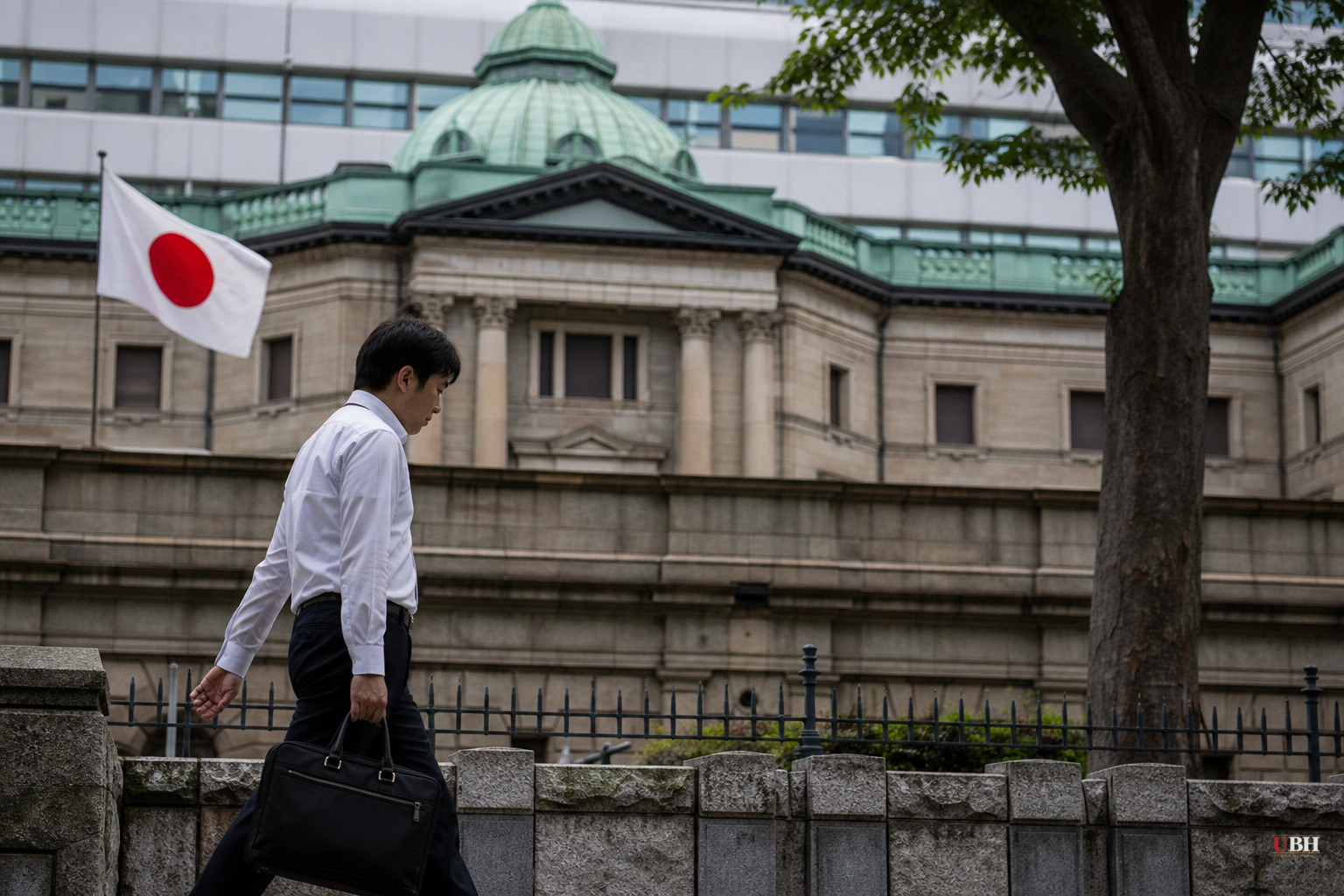
Japan's bond market and its economy delivered opposite messages on Monday.
The yield on the benchmark 10-year Japanese government bond climbed as high as 2.93%, its highest level since September 1996, according to Reuters and confirmed across Bloomberg-sourced reporting from Korea Economic Daily and BigGo Finance. That's a three-decade high, hit on the same day Japan's Cabinet Office reported the economy grew at just a 1.1% annualized rate in the second quarter, badly missing the 2.0% forecast, per Euronews and TradingView.
Quarter over quarter, GDP rose 0.3%, versus a forecast of 0.5%. It's the third straight quarterly expansion, but a weak one. Domestic demand actually subtracted 0.2 percentage points from growth, the first negative reading in three quarters, according to Korea Economic Daily. Private consumption fell 0.02%, its first decline in eight quarters. Capital spending dropped 1.2% for a second straight quarter. Housing investment slipped 0.5%.
Whatever growth Japan did post came from the wrong places. Exports rose only 0.5%, while imports fell 1.5%, partly because crude oil imports dropped sharply after the Strait of Hormuz was blockaded, Korea Economic Daily reported. In plain terms, Japan grew because it imported less and built up inventory, not because consumers or businesses were spending.
Why are bond yields spiking on bad growth news? Because the Bank of Japan isn't just fighting a growth problem. It's fighting inflation and a weak currency, and those pressures don't care that GDP disappointed.
The Yen Problem Won't Go Away
The yen slid to 163.73 per dollar in late July, its weakest level in roughly four decades, according to Euronews. That triggered a rare joint currency intervention by Japan and the United States, the first since 2011. Japan spent an estimated $85 billion in the first two days, dwarfing the US contribution, per Goldman Sachs figures cited by Euronews.
That intervention initially pushed the yen from around 164 to roughly 155 per dollar, according to European Business Magazine. Much of that gain has already evaporated. The yen has drifted back toward 159, meaning the intervention bought time, not a fix.
A weak yen makes imported energy and goods more expensive. Japan's GDP deflator, a broad inflation gauge, rose 2.6% year over year, per Euronews. That's the inflation the Bank of Japan actually has to answer to, separate from whatever the growth numbers say.
Markets Are Betting on a September Hike Anyway
Overnight index swaps now show traders pricing in nearly an 80% probability of a BOJ rate hike at its September 18 meeting, according to BigGo Finance. The policy rate currently sits at 1%, already a three-decade high. Former Ministry of Finance official Takehiko Nakao has publicly called for consecutive hikes to above 2%, BigGo reported, and Prime Minister Sanae Takaichi's administration is reportedly supportive of near-term tightening.
Raising rates to defend the currency and contain inflation risks further choking off consumption and investment that are already shrinking. The BOJ's own economic activity outlook, released earlier this month, nudged its fiscal-year GDP forecast up slightly to 0.6% from 0.5%, per TradingView, hardly a sign of confidence in a hot economy.
Shorter-dated yields moved just as sharply. The two-year JGB yield hit 1.685%, the highest since May 1995, according to the Straits Times. The five-year yield reached a record 2.155%. The 30-year yield rose to 4.06%, nearing its May record high, and the 40-year climbed to 4.115%, per the Straits Times.
Why This Matters Beyond Tokyo
Japan carries the largest government debt burden of any major developed economy, north of 200% of GDP according to the Epoch Times, citing economists YiLi Chien and Ashley H. Stewart. For decades that was survivable because Tokyo could borrow at near-zero rates. Those days are over. Japan's Ministry of Finance sold roughly ¥2.6 trillion of 10-year bonds in its August auction, per European Business Magazine, into a market now demanding real compensation for the risk.
The Epoch Times frames this as a warning for the United States, noting Washington has followed a similar path of running large deficits during an era of cheap money that has now ended. Rising interest costs on a growing debt pile is a real fiscal squeeze, not an abstraction, whether you're in Tokyo or Washington. Critics of continued US deficit spending point to Japan's bond stress as exactly the scenario they're warning against.
There's also the yen carry trade to watch. Investors have spent years borrowing cheap yen to fund purchases of higher-yielding assets abroad, from Treasuries to emerging-market debt, according to Euronews. Rising Japanese yields shrink that arbitrage and can trigger unwinding that ripples through global markets far from Tokyo.
Meanwhile Japanese stocks shrugged the whole thing off. The Nikkei 225 closed at 69,220.25 on Monday, up 506 points and its fifth straight gain, led by AI and semiconductor names like Advantest and Tokyo Electron, according to BigGo Finance. Bonds and stocks are telling two different stories in the same market, and the Bank of Japan's September 17-18 meeting is the next point where those stories either converge or diverge further.
Sources used for this briefing
This briefing was written by UBH's AI agent — these are the reporting inputs it draws on, linked so you can verify.


