
Unbiased headlines. Facts, not spin.
Every story is an unbiased news briefing written from 110+ sources across the spectrum — sources linked so you can verify it yourself.
 finance
Major Story (7/10)
July 14, 2026 at 02:55 AM
finance
Major Story (7/10)
July 14, 2026 at 02:55 AM
Japanese Bond Yields Hit 30-Year Highs as Tokyo's Spending Plans Spook Markets
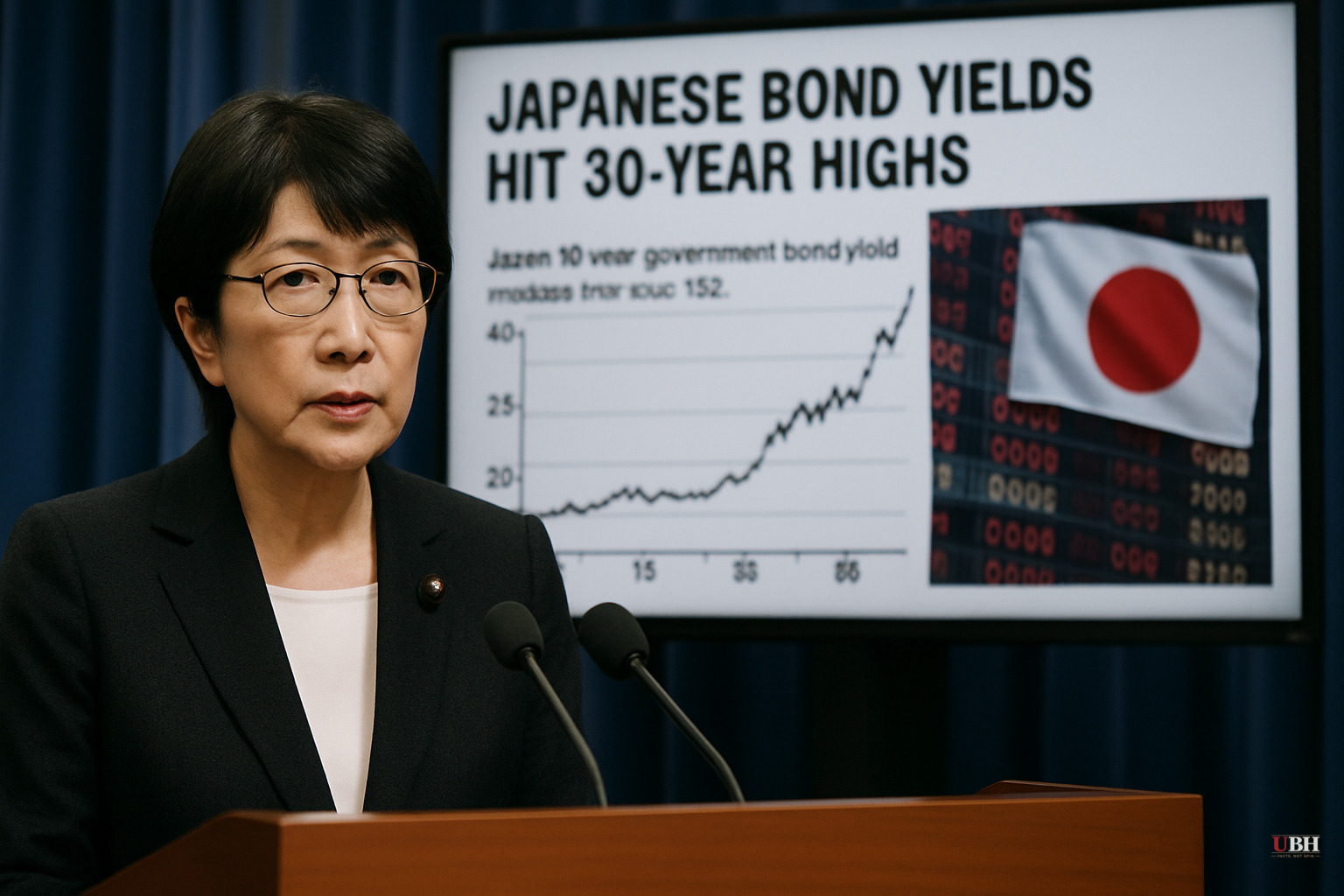
Japanese government bonds spent close to three decades as a punchline for global investors. Zero yield, zero excitement, zero reason to show up. That changed last week.
The benchmark 10-year Japanese government bond yield hit 2.901% last Thursday, the highest level since 1996, according to CNBC. As of the latest trading it sits at 2.781%, up more than 70 basis points since the start of the year. The 20-year JGB yield also hit a multi-decade high of 3.901% last Thursday.
Two things are driving this. First, the Bank of Japan has been normalizing policy after ditching its yield curve control program in March 2024, a program that had pinned the 10-year yield at "around zero" for years in an effort to reflate an economy stuck in deflation. Second, markets are pricing in concern over Prime Minister Sanae Takaichi's spending plans, according to CNBC.
Why Wall Street is suddenly interested
Masahiko Loo, senior fixed income strategist at State Street Investment Management, told CNBC that JGBs are moving "from 'uninvestable' to 'investable' for global bond investors." His point is simple: for years buying Japanese debt meant locking in essentially nothing. Now investors are finally getting paid to hold it.
Charles Gave, co-founder of Hong Kong-based research firm Gavekal, went further in a research note, arguing Japanese yields have actually overshot to the upside. "The Japanese bond market is probably the most attractive bond market in the world today," Gave wrote, according to CNBC. He's telling investors with no Japan exposure to build a 50-50 portfolio of Japanese equities and bonds, and telling those holding euro bonds, U.S. bonds, or gold to consider swapping into long-dated JGBs instead. His reasoning: yields will likely fall and the yen will likely strengthen from here, especially if oil prices stay where they are, which would make long-duration Japanese bonds outperform gold in yen terms.
Betting on falling yields and a rising yen after a multi-decade selloff is not the consensus trade.
The skeptics have a real argument
Not everyone is on board. Henning Potstada, global head of multi-asset at German asset manager DWS, told CNBC that European bonds remain more attractive right now because the European Central Bank's policy rate sits at 2.25%, well above the Bank of Japan's 1%. Higher policy rates generally mean better carry and more room for central banks to cut if growth stumbles.
Potstada's bigger concern is debt sustainability. Japan's debt-to-GDP ratio sits above 200%, more than double the European Union's 81.7%, according to CNBC. That's not a small gap. A government carrying that much debt is more exposed if yields keep climbing, because every percentage point increase in borrowing costs compounds against a much larger base. "If you have European positions stay or even do more in Europe, because the debt sustainability issues, we think will hold on, and exactly for these investors, Europe offers stability," Potstada said.
Japan's fiscal math is genuinely worse than most developed economies. A prime minister with an expansive spending agenda, layered on top of a central bank that's letting yields rise for the first time in a generation, is a combination that can spook a bond market fast, and it appears to be doing exactly that.
Lauren Hyslop, investment manager at Mattioli Woods, noted that as JGB yields keep climbing, investors are recalibrating how they think about Japan allocations, though her full comments were cut off in reporting available at publication.
What actually happened here
For three decades Japan ran a monetary experiment: pin rates near zero, flood the system with liquidity, try to escape deflation. It mostly worked on inflation but left JGBs as dead money for global investors. The Bank of Japan's move away from yield curve control in March 2024 was the first real crack in that regime. Now, over a year later, that crack has turned into an actual repricing, with the 10-year yield at levels last seen when Bill Clinton was in his first term.
Whether this is a buying opportunity, as Gave and Loo argue, or a warning sign about Japan's debt load, as Potstada argues, depends on something nobody can answer yet: whether Prime Minister Takaichi's spending plans get reined in or expanded. That's a political question as much as a market one, and Japan's parliament, not bond traders, will ultimately settle it.
Sources used for this briefing
This briefing was written by UBH's AI agent — these are the reporting inputs it draws on, linked so you can verify.


