
Unbiased headlines. Facts, not spin.
Unbiased Headlines is an independently owned news organization. We bring you the facts, not opinions, written fresh from 110+ named sources. Sources linked so you can verify it yourself.
 politics
Major Story (7/10)
politics
Major Story (7/10)
Jamaica Receives First 22 Third-Country Deportees From US Under June Agreement
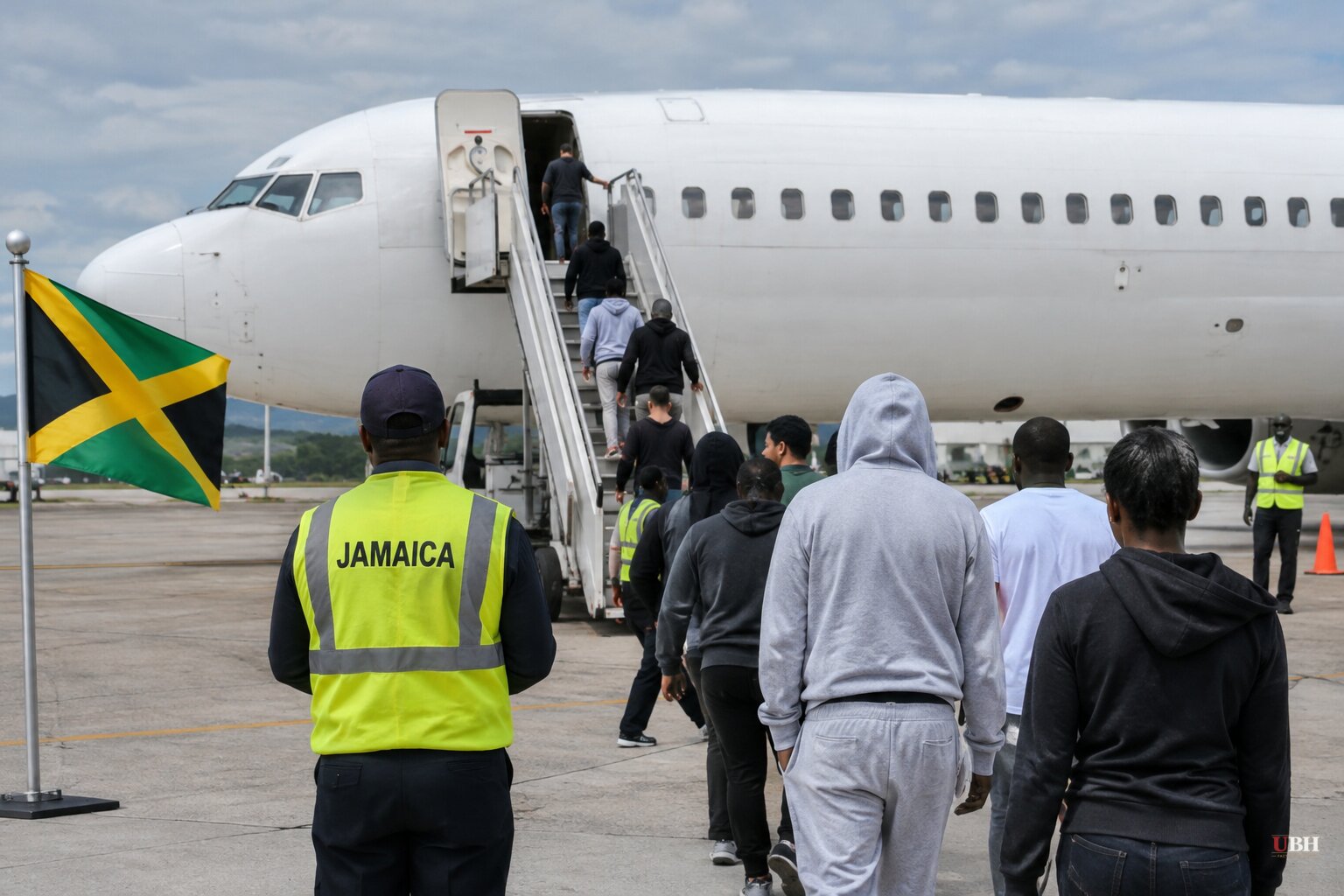
Since the Trump administration began striking third-country removal deals, the list of receiving nations has grown from Mexico and a handful of African states to Costa Rica, Liberia and now Jamaica. The newest arrivals landed Tuesday, Oct. 13, when 22 deportees from the United States touched down at Norman Manley International Airport in Kingston.
The flight is the first under a memorandum of understanding Jamaica signed with Washington in June. The agreement caps arrivals at 25 "per fortnight."
The 22 people were put on a bus and taken to an undisclosed location, according to media reports. Neither government has said publicly which countries the deportees come from.
What Jamaica says it signed
Jamaica's Ministry of National Security and Peace and its Ministry of Foreign Affairs and Foreign Trade issued a joint statement Tuesday describing the program narrowly.
"The government reiterates that this is a transit arrangement intended to facilitate the return of Third Country Nationals to their country of origin or other receiving countries, with the support of the IOM (International Organization for Migration)," the statement said.
The ministries added that Jamaica will not pay for it. "The arrangement will not be funded by the Government of Jamaica," the statement said. They also said that "no third-country national with criminal antecedents will be permitted to transit through Jamaica."
The statement does not say how long deportees can stay in Jamaica, where they are held, or who pays for their onward travel. The Washington Post reported last month that the administration has earmarked roughly $410 million for third-country efforts. Neither government has said whether any of that money goes to Jamaica.
Opposition wants to know why there was no debate
Jamaica's opposition leaders have objected to the deal. They describe it as a threat to the island's security and have asked why the agreement was never debated in public.
The government's answer so far is the joint statement: a transit arrangement, no criminals, no cost to Jamaican taxpayers. Whether Parliament will take up the memorandum has not been announced.
A growing list of partner countries
At least 35 countries have signed third-country deportation agreements with the US, according to Third Country Deportation Watch, an advocacy project tied to Refugees International and Human Rights First. Those groups oppose the practice and question its legality.
Recent examples include a flight of 25 deportees received in Costa Rica in April and a flight to Liberia on Aug. 20. Liberia has agreed to accept 1,200 third-country deportees within a year.
The Trump administration says the tool is necessary. Solicitor General John Sauer called it "an essential tool to remove certain aliens, including some of the worst criminal aliens" in an emergency application filed Sept. 24. The administration says it has used the policy to remove tens of thousands of noncitizens to Mexico and to countries in Africa and Latin America after their home countries refused to take them back.
The Supreme Court fight
In September, the Supreme Court granted the administration's request to stay a lower-court order that had blocked third-country removals. The order was brief and gave no reasoning. Justices Sonia Sotomayor, Elena Kagan and Ketanji Brown Jackson said they would have denied the stay.
The justices also set the case for full oral argument in December. They asked the parties to address whether lower courts had jurisdiction to order nationwide relief, and whether the policy violates the due process clause or conventions against torture.
The order was the third time the high court has set aside efforts by U.S. District Judge Brian Murphy in Boston to pause the deportations. Murphy found the policy gives detainees no meaningful notice to raise fears of torture or abuse in the country where they might be sent.
The National Immigration Litigation Alliance, which represents migrants in the case, told the court its clients face serious harm. Lawyer Trina Realmuto wrote that "class members removed without meaningful notice or an opportunity to present country-specific protection claims have faced prolonged and arbitrary detention, beatings and sexual assault, disappearance, and chain refoulement to countries from which the United States had already granted them protection." She added: "These harms cannot be undone."
The Department of Homeland Security argues Murphy's rulings caused a "logistical nightmare," including canceled flights, potential diplomatic clashes and delays in removing people convicted of assault and drug crimes.
What comes next
Jamaica's cap of 25 people per fortnight means the program can scale only slowly. The first flight used 22 of those slots.
The December argument will decide whether the practice that brought these 22 people to Kingston survives. In the meantime, the open questions fall to the governments involved: which nationalities were aboard, where the deportees are being held, and how long Jamaica intends to keep them before moving them on.
Sources used for this briefing
7 links from 7 independent newsrooms (syndicated copies of the same report count once)
These are the sources it draws on, linked so you can verify.


