
Unbiased headlines. Facts, not spin.
Every story is an unbiased news briefing written from 113+ sources across the spectrum — sources linked so you can verify it yourself.
 defense
Notable (6/10)
September 26, 2026 at 11:54 PM
defense
Notable (6/10)
September 26, 2026 at 11:54 PM
Jaishankar Tells UN 'No Dilution' on Terrorism as India-Pakistan Clash Dominates UNGA Week
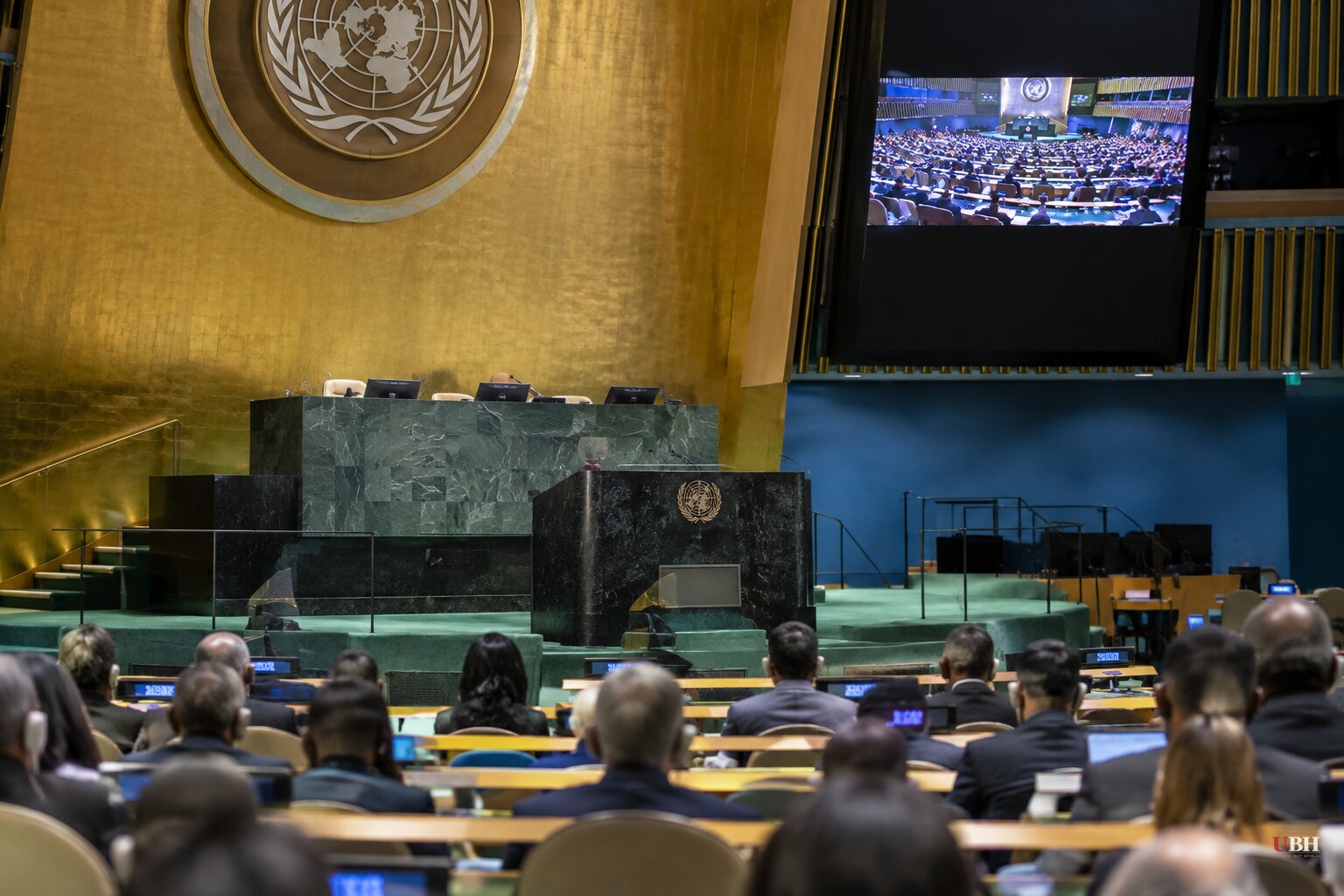
External Affairs Minister S. Jaishankar delivered India's National Statement at the UN General Assembly on Saturday, September 26, using the podium to directly rebut Pakistan Prime Minister Shehbaz Sharif's address from the day before.
"Yesterday, a serial practitioner of terrorism misrepresented facts before this Assembly," Jaishankar said, according to The Hindu. "Arguments were invoked to normalise terrorism and claim immunity from its consequences." He did not name Pakistan directly, but the reference was unmistakable given Sharif's Friday remarks.
Sharif had called Kashmir Pakistan's "jugular vein," accused India of human rights violations there, and claimed the ruling Bharatiya Janata Party has waged a "reign of terror" against religious minorities inside India. Sharif also accused India of "weaponising water" by suspending the Indus Waters Treaty.
Jaishankar rejected that framing outright. "Friendship and goodwill cannot co-exist with terrorism," he said. "Understandings premised on that will naturally be called into question." India suspended the 1960 Indus Waters Treaty after Operation Sindoor last year, a military response Sharif had criticized in his own speech.
Earlier the same day, India formally exercised its right of reply. First Secretary Petal Gahlot of India's UN mission told the Assembly that "Pakistan's terrorism, deceit and duplicity will neither benefit it nor the world," and accused Islamabad of a "long-standing practice of cross-border terrorism," according to Hindustan Times.
Pakistan disputes India's account of Kashmir and its own record on terrorism, and frames its objections as rooted in decades-old territorial and human-rights grievances. Neither government's claims about the other's conduct were independently verified in the reporting reviewed here; both sides' statements are presented as competing positions rather than settled fact.
Jaishankar's speech went beyond the bilateral spat. He told the Assembly that countries far from the wars in Ukraine and West Asia are being "penalised for no fault of theirs," citing disruptions to what he called the "Four Fs": food, fuel, fertilizer and finance. He noted that 18 Indian seafarers have been killed in attacks tied to the two conflicts and said India has joined Liberia and 23 other countries in a push to rally opinion against targeting merchant sailors.
On Gaza, Jaishankar reiterated India's support for a two-state solution and said New Delhi continues sending humanitarian aid to Palestinians. He also renewed India's long-standing push for UN Security Council reform, arguing a multipolar world requires the post-1945 order to "give way to new realities."
Jaishankar's Saturday remarks capped a General Assembly high-level week that produced several other flashpoints. On the opening day, President Trump told the Assembly a deal with Iran remains possible after the U.S. midterm elections but that his alternative is to "annihilate the Islamic Republic," according to CNN. Trump also outlined plans for a "large military presence" on Greenland and vowed Cuba's communist government "will fall," prompting the Cuban delegation to walk out.
Iranian President Masoud Pezeshkian addressed the Assembly on Thursday, telling Fox News in a separate interview that Tehran was willing to dilute its stockpile of 60%-enriched uranium and calling concerns over the material "not a big deal." He denied Iran seeks a nuclear weapon, citing what he described as a religious decree from Iran's late supreme leader against weapons of mass destruction. Outside the hall, roughly a thousand protesters, including former New York Mayor Rudy Giuliani, called Pezeshkian a terrorist and demanded the regime's ouster.
On the sidelines, Venezuela's acting president Delcy Rodríguez met Trump for the first time since the U.S. captured former president Nicolás Maduro in January, calling the meeting "historic" in a post on X reviewed by CNN. Maduro is now jailed in New York awaiting trial on drug trafficking and corruption charges. Opposition leader María Corina Machado, who has vowed to return home, was turned away three separate times when she tried to enter Venezuela this week by air and sea, her adviser David Smolansky told CNN.
Haiti's Prime Minister Alix Didier Fils-Aimé used his Friday address to call for "shared responsibility" on migration, citing a UN International Organization for Migration report that found nearly 1.5 million Haitians have been displaced by gang violence, with roughly 80% of Port-au-Prince's population having fled. Fils-Aimé said Haiti has trained over 1,500 new soldiers toward a goal of 15,000 and more than 2,000 police officers, but said the UN-authorized Gang Suppression Force still has not reached its planned 5,500-troop deployment.
What's left unresolved from India's exchange with Pakistan is whether either government will alter its posture. Jaishankar said it is "for the perpetrator of terrorism to change its ways" before the Indus Waters Treaty could be revisited. Islamabad has not indicated it will do so, and no timeline for reviving the treaty has been set by either side.
Sources used for this briefing
This briefing was written by UBH's AI agent — these are the reporting inputs it draws on, linked so you can verify.


