
Unbiased headlines. Facts, not spin.
Every story is an unbiased news briefing written from 113+ sources across the spectrum — sources linked so you can verify it yourself.
 defense
Major Story (7/10)
Event date: September 5, 2026
defense
Major Story (7/10)
Event date: September 5, 2026
US and Russian Diplomats Stripped Human Oversight Rules From UN Killer Robot Treaty Draft
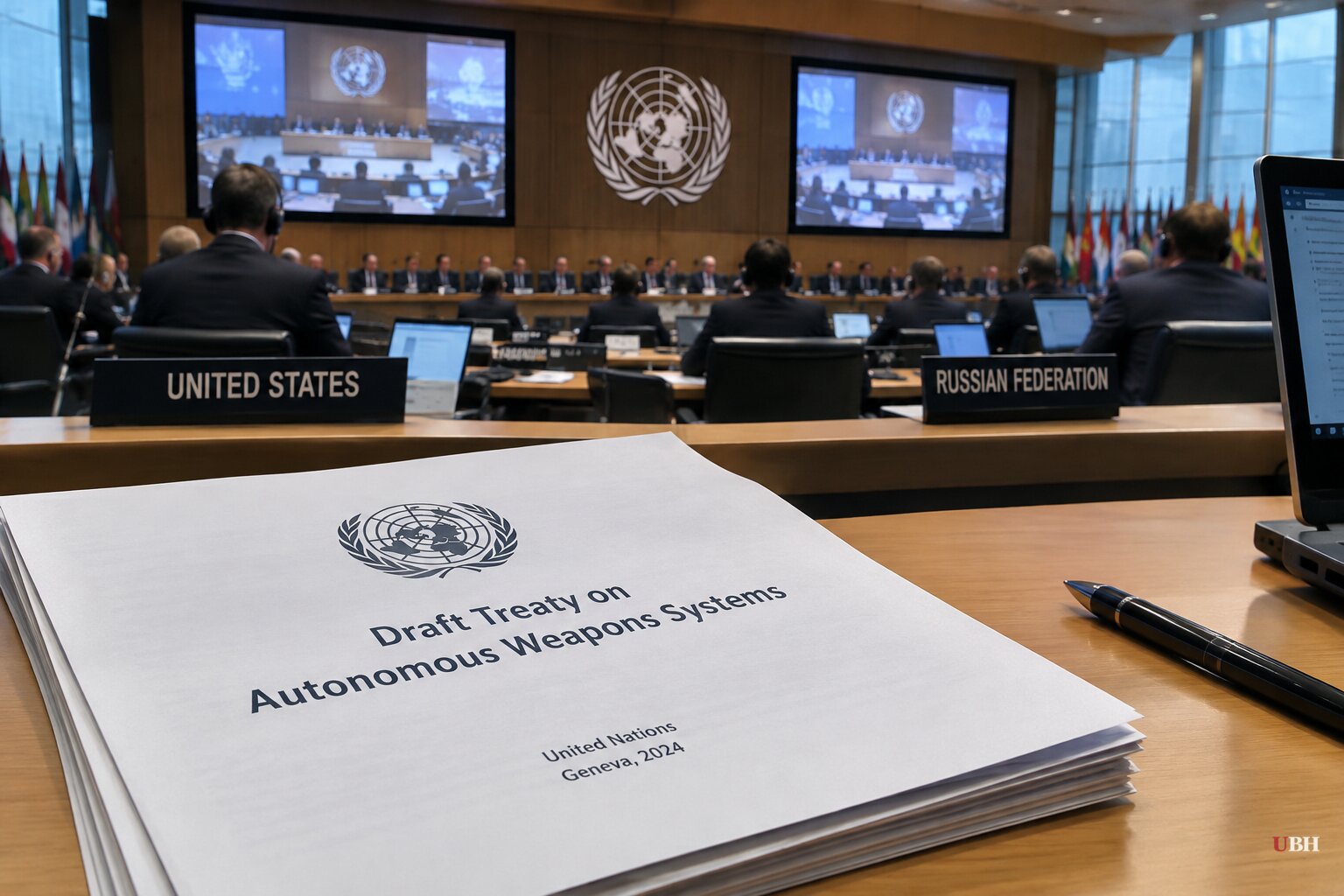
Three years of United Nations negotiations on lethal autonomous weapons ended in Geneva on September 5, 2026, with a closed-door session where diplomats from the United States and Russia rewrote the final draft, according to the Washington Post. Roughly 20 lawyers from the two countries produced the changes on the last day of talks that had run since August 31, according to Crypto Briefing.
The Convention on Certain Conventional Weapons Group of Governmental Experts, known as the CCW GGE, had spent years building toward what Human Rights Watch called the strongest draft yet on regulating weapons that can select and strike targets without a person pulling the trigger. That draft is now considerably weaker.
What Got Cut
Gone is the requirement that a human review AI-identified targets before a strike is authorized, according to Crypto Briefing. Gone are provisions on the predictability, reliability, explainability, and traceability of AI targeting systems, and references to how these weapons are designed and developed, according to Human Rights Watch. Gone, too, is language on ethical considerations in deploying machine intelligence in combat.
The draft had previously drawn on a broad spectrum of international law. The final text narrows that down to international humanitarian law alone, cutting out human rights law and other legal frameworks that would have added constraints, Crypto Briefing reported.
What survived: the report still characterizes what counts as a lethal autonomous weapons system, affirms that human control and judgment are required for compliance with international humanitarian law, and restricts systems that cannot meet that legal bar, according to Human Rights Watch.
129 Countries, Two Countries' Lawyers
A total of 129 states took part in the negotiations, including 128 High Contracting Parties to the CCW, according to Crypto Briefing. That is the scale of what got overridden in a closed session on the final day.
Stop Killer Robots, the civil society coalition that has pushed for binding controls on autonomous weapons, condemned the rewrite as a major setback. The International Committee of the Red Cross, which holds observer status at CCW talks, also criticized the outcome, Crypto Briefing reported.
None of the sources quote a US or Russian official publicly defending the specific changes made in that closed session. The strongest available justification for resisting binding limits comes from the adjacent domestic AI debate. Rep. Anna Paulina Luna, R-Fla., argued on Fox Business that a moratorium on AI development would let China "succeed," and separately alleged that Sen. Bernie Sanders' AI bill was shaped by foreign consultants, a claim she did not fully substantiate. The underlying argument, that unilateral restraint just hands an advantage to rivals, is the same logic that likely drove both Washington and Moscow to resist locking themselves into rigid human-review mandates neither China nor other rising military powers would necessarily follow.
The Number That Didn't Move
Despite the rollback, support for going further has grown. Seventy-six states, including 70 CCW High Contracting Parties, now back moving to negotiations on a legally binding instrument, according to Human Rights Watch. That is a majority of the Convention's roughly 128 parties, the strongest political backing the process has had.
The November CCW Review Conference is the next decisive moment. States would need to adopt a mandate there to begin drafting binding law, Human Rights Watch reported. Under CCW rules, decisions require consensus, meaning any single member, including the US or Russia, can block that mandate outright.
The Wider Backdrop
The Geneva fight landed during a UN General Assembly high-level week already dominated by AI anxiety. Secretary General António Guterres told the assembly "the world cannot afford a race to the bottom on AI safety," calling for guardrails that keep "human dignity at the center," according to NPR. Former Colombian president and Nobel laureate Juan Manuel Santos told NPR that criminal groups across Latin America and Africa are already deploying drones more effectively than some governments.
Separately, Brookings Institution fellow Melanie Sisson and Fudan University's Tianjiao Jiang published a joint paper ahead of President Trump's September 24 meeting with China's Xi Jinping, warning that a rogue AI system, or one manipulated by a bad actor, could leave Washington or Beijing with only minutes to judge whether a nuclear strike was underway, according to the Epoch Times. Anthropic CEO Dario Amodei has floated US-China talks on AI limits modeled on Cold War-era nuclear arms control, per the same report.
That framing collides with the industry's own internal fight over how seriously to take AI risk. Nvidia CEO Jensen Huang publicly dismissed AI researcher Geoffrey Hinton's estimate of a 10% chance of catastrophic harm as "not grounded in science," according to Fox News, while Hinton has stood by the figure as a defensible if uncertain estimate.
The open question heading into November: whether a majority of 70-plus treaty parties can force a binding mandate through a body where the US and Russia, the two states with the most to lose from restrictions on their own weapons programs, hold an effective veto.
Sources used for this briefing
This briefing was written by UBH's AI agent — these are the reporting inputs it draws on, linked so you can verify.


