
Unbiased headlines. Facts, not spin.
Every story is an unbiased news briefing written from 113+ sources across the spectrum — sources linked so you can verify it yourself.
 defense
Major Story (7/10)
September 26, 2026 at 11:58 AM
defense
Major Story (7/10)
September 26, 2026 at 11:58 AM
Teardown of Russia's New Geran-4 Attack Drone Finds Texas Instruments Chips, Chinese Engine, Taiwanese Camera
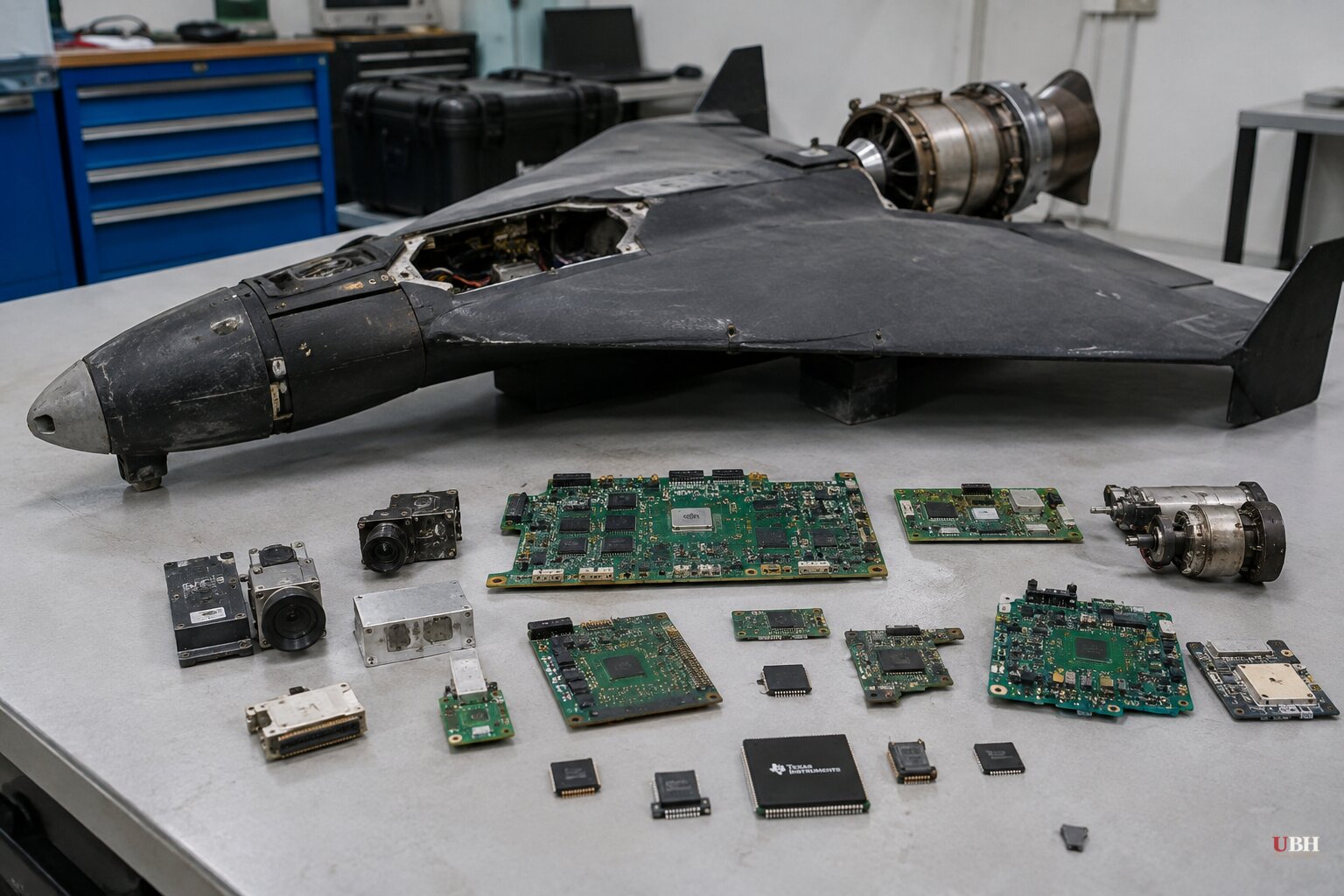
Radio Free Europe/Radio Liberty, the US government-funded international broadcaster, published a four-minute teardown video on September 24 showing its Ukrainian Service experts dismantling a Russian Geran-4 "Seeker" drone recovered in Ukraine. What they pulled apart is a jet-powered strike weapon running on American chips, Chinese engines, and Taiwanese electronics, despite years of Western sanctions aimed at cutting Russia off from exactly this kind of hardware.
The Geran-4 is the newest evolution of the Shahed one-way attack drone family, originally designed in Iran by HESA and Shahed Aviation Industries and now mass-produced by Russia at the Alabuga special economic zone in Tatarstan, according to Dealroom's reporting on the RFE/RL investigation. Ukraine's Defence Intelligence, or DIU, says combat deployment of the Geran-4 began in May 2026 after mass production was completed by January 2026, following test launches from the Primorsk droneport in Russia's Oryol region and from the former Donetsk Airport, according to a report from globaldefensecorp on DIU's War&Sanctions portal.
What's inside
RFE/RL's teardown found the drone's onboard "brain" running on Texas Instruments chips, with markings scraped off but logos still legible. Also found: a Chinese mesh modem capable of relaying live video and radio signal roughly 300 km, letting one Geran-4 hand off the link to the next so operators sitting in Bryansk, Oryol, or Crimea can fly the drone deep into Ukrainian territory. The drone also carries two GSM modems loaded with SIM cards from Ukrainian, Russian, Belarusian, Kazakh, and European carriers to ping its location over cellular networks, plus a 16-channel CRPA antenna built to blunt Ukrainian jamming.
DIU's own findings, reported separately by globaldefensecorp, add more foreign parts to the list: a Chinese Telefly TF-TJ2000A turbojet engine generating 1,960 newtons of thrust, pushing the drone to 450-500 km/h at altitudes up to 8 km, a Taiwan-made GSM modem and camera, a Texas Instruments gyroscope, and a Taiwan-made motherboard. DIU says the drone can carry either a 50 kg high-explosive or thermobaric warhead, or a 90 kg thermobaric warhead, with a range up to 450 km. An earlier, discontinued Telefly engine, the LX-WP-160, has also turned up on some units.
The Geran-4 is one data point in a much larger pattern. Vladyslav Vlasiuk, Ukraine's presidential commissioner for sanctions policy, said Ukrainian specialists recovered nearly 100 foreign-made parts from jet-powered drones alone, sourced from the United States, China, Taiwan, Germany, and Japan, according to Unian's reporting carried by United24 Media. Vlasiuk said examination of wreckage from a July 2 overnight assault on Kyiv and other regions, in which Russia launched hundreds of drones and dozens of missiles, turned up roughly 35,000 foreign-manufactured components total.
Those components trace back to Texas Instruments, Analog Devices, Intel, AMD, STMicroelectronics, Infineon, NXP, Murata, Bosch, Toshiba, and Raspberry Pi, along with unnamed Chinese producers, per United24 Media. Vlasiuk said Ukraine catalogs every recovered part by serial number to build tracking databases and identify supply routes, then shares that evidence with foreign governments to push for tighter export controls.
This is not a new problem. The Organized Crime and Corruption Reporting Project published an investigation on February 18, 2026 finding that Russia's older Geran-2 drones were built almost entirely from foreign parts despite sanctions, identifying hundreds of Western and Eastern components against only a few dozen of Russian origin. European manufacturers named in that reporting said they comply with export restrictions and that their parts likely reached Russia through third-party brokers, leftover pre-sanction inventory, or smuggling networks, not direct sales. That defense is worth taking seriously: a chipmaker selling a microcontroller to a distributor in Hong Kong or Shenzhen has no direct line of sight into where that part ends up, and export-control enforcement depends on catching diversion after the fact, not before it happens.
Still, the volume is the problem. Trade data cited by OCCRP showed hundreds of shipments of sanctioned components reaching Russia through Chinese and Hong Kong intermediaries even after direct exports were banned. Whether that reflects lax enforcement, deliberate evasion by named brokers, or simply the scale of global electronics trade outrunning any government's ability to police it is an open question none of these reports resolve.
Ukraine's DIU has now published an interactive 3D model of the Geran-4 and its full component list on the War&Sanctions portal, aimed at giving allied governments and manufacturers a target list for tightening controls. Whether Washington, Brussels, Taipei, or Beijing act on that catalog, and whether Chinese suppliers of engines and modems face any consequence, remains to be seen.
Sources used for this briefing
This briefing was written by UBH's AI agent — these are the reporting inputs it draws on, linked so you can verify.


