
Unbiased headlines. Facts, not spin.
Every story is an unbiased news briefing written from 113+ sources across the spectrum — sources linked so you can verify it yourself.
 defense
Low Interest (4/10)
Event date: September 11, 2026
defense
Low Interest (4/10)
Event date: September 11, 2026
Russia Sends 14th-Century Prince's Bone Fragment to Ukraine Front to Boost Troop Morale
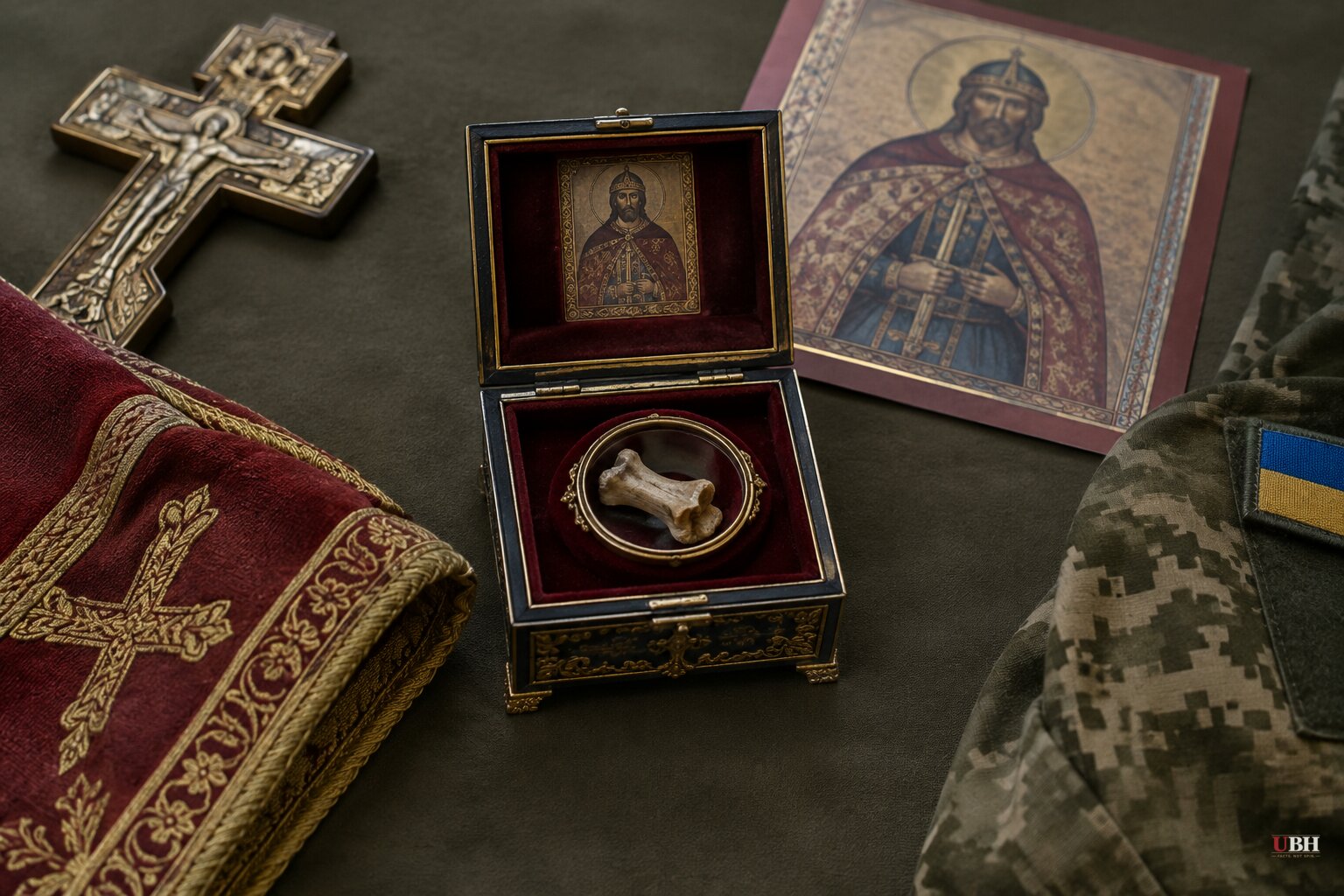
Russian troops digging in for another winter in eastern Ukraine got an unusual delivery in early September: a fragment of the right hand of Grand Prince Dmitry Donskoy, a Moscow ruler who died in 1389.
The bones were uncovered this past July during restoration work at the Cathedral of the Archangel inside the Kremlin, according to Defense News. Vladimir Putin personally inspected the remains in August, calling the find "an absolutely unique and marvellous discovery," per Defense News. He attended the unearthing ceremony himself.
Donskoy is revered in Russia for defeating the Mongol Golden Horde at the Battle of Kulikovo in 1380. He was canonized by the Russian Orthodox Church in 1988, but the church never opened his tomb after canonization, until now, according to The Guardian.
From the Kremlin to the trenches
The relic, held in an ornate casket under glass, was first brought to the Savur-Mohyla war memorial in Russian-occupied Donetsk, where senior clergy held a prayer service alongside Russian military officials, The Guardian reported. Sergei Kiriyenko, Putin's first deputy chief of staff, joined military commanders in kissing the relic at a ceremony Defense News described as taking place at that same memorial.
The Moscow Patriarchate's military department said the "holy commander" would "invisibly take his place in the same battle ranks as our defenders," according to The Guardian. Metropolitan Vladimir of Donetsk and Mariupol, a Moscow-appointed cleric, said the relic would help troops and civilians "mobilize both their spiritual and physical strength" and "triumph over the enemy," per CNN.
This isn't the church's first rodeo with battlefield relics. CNN reported that fragments of Prince Alexander Nevsky, another medieval warrior-turned-national symbol, were sent to troops earlier this year. RFE/RL reported that Defense Ministry video from September 8 showed cadets venerating Donskoy relics at a newly built chapel in Novosibirsk, thousands of miles from the front.
"The church has practically merged with the state"
Sergei Chapnin, a religious scholar and director of communications at Fordham University's Orthodox Christian Studies Center, told CNN the Russian Orthodox Church and the Kremlin are now "indistinguishable." He called Donskoy's legacy a "mobilizing myth" designed to link Russia's medieval past to its current war narrative, framing Donskoy as "a defender of the fatherland" rather than an aggressor, which conveniently supports Moscow's line that it's defending itself, not invading Ukraine.
Alexander Zanemonets, an Orthodox priest and historian writing for the Carnegie think tank, argued the timing was no accident. "By the fifth year of war, the church leadership in Moscow began to wonder what else it could do to show its support," he wrote, according to The Guardian.
Lucy Ash, author of a 2024 book on the Russian church, told RFE/RL the practice "may smack slightly of desperation." Given the context RFE/RL laid out, Russia has suffered more casualties in this war than in every conflict Moscow has fought since 1945 combined, and it still hasn't achieved its original 2022 goals, including keeping Ukraine out of NATO or seizing all of Donbas.
The strongest case for taking this at face value, rather than pure cynicism, is that dispatching sacred relics to soldiers is a genuinely old Orthodox tradition, not something invented for this war. CNN noted the practice predates the conflict by centuries, and roughly two-thirds of Russians identify as Orthodox Christians, according to state pollster VCIOM. For believers in the ranks, veneration of a warrior-saint's remains may carry real spiritual weight independent of any Kremlin messaging strategy.
But that reading gets harder to sustain alongside Patriarch Kirill's own rhetoric. Premier Christian News reported that Kirill has called the invasion a "holy war" and, in a 2024 document, framed it as Christian Russia against a "satanic" West. He has also claimed Russian soldiers killed in the war are cleansed of their sins, per Premier Christian News, and reportedly told a wounded bishop that "demons" were responsible for his injuries during a hospital visit to occupied Donbas.
Ukraine's National Security and Defence Council did not mince words in response, telling Premier Christian News: "Today's Russian Orthodox Church has nothing in common with Christian faith or spirituality. It has turned into an ideological subdivision of the regime, which justifies the war of aggression, glorifies Putin, and blesses the killing of Ukrainians." The council also accused the church of enabling the housing of abducted Ukrainian children in church-run homes, an allegation Russian authorities deny, according to Premier Christian News.
What's actually unresolved
Whether venerating a 600-year-old bone fragment moves the needle on a modern battlefield is unknowable and unfalsifiable, and no source claims to have measured any battlefield effect. What is documented is the scale of the production: state television coverage, a procession through Moscow, a presidential inspection, and now a rolling tour of front-line units and military bases across occupied Donetsk, according to CNN and Defense News.
Defense News also reported the tour coincided with a Russian parliamentary election cycle, tying the relic's public rollout to domestic politics as much as to the front. Whether Donskoy's remains keep touring bases through the winter, and whether Russian state media credits any battlefield outcome to the relic, remains to be seen.
Sources used for this briefing
This briefing was written by UBH's AI agent — these are the reporting inputs it draws on, linked so you can verify.


