
Unbiased headlines. Facts, not spin.
Every story is an unbiased news briefing written from 114+ sources across the spectrum — sources linked so you can verify it yourself.
 energy
Major Story (7/10)
Event date: September 30, 2026
energy
Major Story (7/10)
Event date: September 30, 2026
Italy and Czech Republic Lead Push to Delay EU Carbon Rules Days Before Brussels Summit
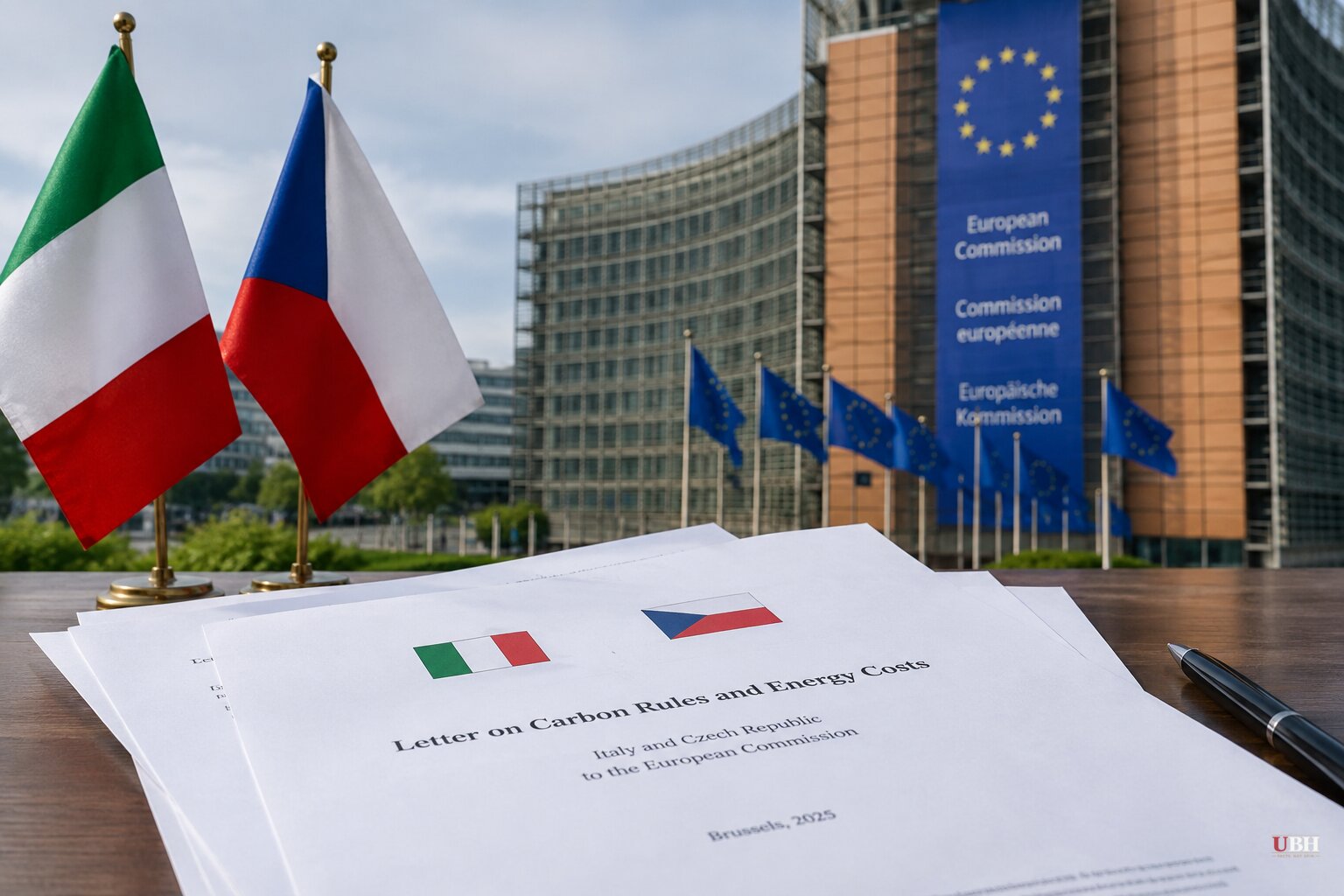
Giorgia Meloni and Andrej Babiš met in Prague last week to finalize a joint letter to Brussels. The message: ease up on carbon rules or watch European factories leave.
The Italian and Czech prime ministers, according to a letter seen by Euronews, warned that "some of the world's highest energy prices, high carbon costs and exceptional fuel prices" risk "further weakening European manufacturing and accelerating the relocation of production and investment." That letter lands ahead of an EU leaders summit scheduled for October 15-16 in Brussels, where industrial competitiveness is set to be a headline topic.
Their ask is specific. Extend free carbon allowances for heavy industry under the EU's Emissions Trading System. Freeze the phase-out of free allocations for sectors hit by the carbon border tax. Lean harder on the Market Stability Reserve, the mechanism that can release allowances back into the market to cool off price spikes, with roughly 190.5 million allowances scheduled to enter that reserve between September 2026 and August 2027, according to Carbon Herald, citing the European Commission.
Rome and Prague also want the January 2027 rollout of new methane monitoring, reporting and verification requirements on imported oil, gas and coal suspended, according to Carbon Herald. A report from GMK Center, citing Reuters, put that deadline at January 2026, which conflicts with the 2027 start date cited elsewhere and appears to be an error.
And they want the 2028 launch of ETS2, the carbon pricing scheme that would extend to road transport and building heating, pushed back further. Auctions under that system are currently due to start in 2027, according to Carbon Herald.
A Bigger Coalition, A Bigger Fight
Italy and the Czech Republic aren't alone. Austria, Hungary, Slovakia and Poland have raised similar objections through the EU's Competitiveness Council, according to Bull Source. Austrian Industry and Energy Minister Wolfgang Hattmannsdorfer told reporters Thursday that his country needs an "export discount," a mechanism to strip carbon costs off goods sold outside the EU so domestic producers aren't undercut by foreign competitors who don't pay for emissions at all.
Italian Defence Minister Guido Crosetto went further than the official letter, arguing the entire ETS should be suspended until the economy improves. "A tax like the ETS today is unjust, absurd, unsustainable in international competition, and creates inequalities," he said, according to a letter cited by Euronews.
This isn't the first concession Brussels has made. EU member states already agreed in mid-September to hand out an extra 121 million free CO2 allowances to industrial sectors between 2026 and 2030, a move the Council of the EU says will save businesses around €8.25 billion ($9.52 billion), according to GMK Center.
The Competing Priority: COP31
While Meloni and Babiš push for slower carbon pricing, the EU's own negotiating position for next month's COP31 summit in Turkey goes the other direction. A Council document dated October 5 and seen by Euronews frames the energy transition as the answer to the exact crisis Rome and Prague are complaining about: dependence on foreign energy. The EU has leaned harder on U.S. liquefied natural gas since losing Russian supply, and the war in the Middle East has disrupted Gulf oil and gas flows.
"We don't do climate policy only for the climate, but also for economic reasons and for geopolitical reasons. It's basically an economic modernisation and liberation agenda," a senior Commission official told Euronews on condition of anonymity.
European industry pays real money per ton of carbon that competitors in China, India or the U.S. simply don't. Steel, cement and chemical plants operating on thin margins in a global market are being asked to absorb costs their rivals never see. That's a competitiveness problem, and it's why five separate governments are raising it at the same time.
The counter-argument, implicit in Brussels' own COP31 draft, is that cheap fossil energy dependence is exactly what triggered this crisis in the first place, through reliance on Russian gas and now U.S. LNG. The EU also notes it has already granted €8.25 billion in allowance relief and built an €86.7 billion ($98 billion) Social Climate Fund for 2026-2032 to cushion vulnerable households from ETS2's eventual rollout.
Neither side has won this argument yet. The EU leaders summit on October 15-16 will show whether the Commission bends on the ETS timeline, the methane rules or the MSR, or whether it holds the line heading into COP31 the following month. With parliamentary elections due next year in Italy, France and Spain, the political pressure behind Rome and Prague's letter isn't going away before then.
Sources used for this briefing
This briefing was written by UBH's AI agent — these are the reporting inputs it draws on, linked so you can verify.


