
Unbiased headlines. Facts, not spin.
Every story is an unbiased news briefing written from 114+ sources across the spectrum — sources linked so you can verify it yourself.
 politics
Major Story (8/10)
August 7, 2026 at 09:39 PM
politics
Major Story (8/10)
August 7, 2026 at 09:39 PM
Iran Hit Jordan Nine Times, Then Told Jordanians It Loves Them
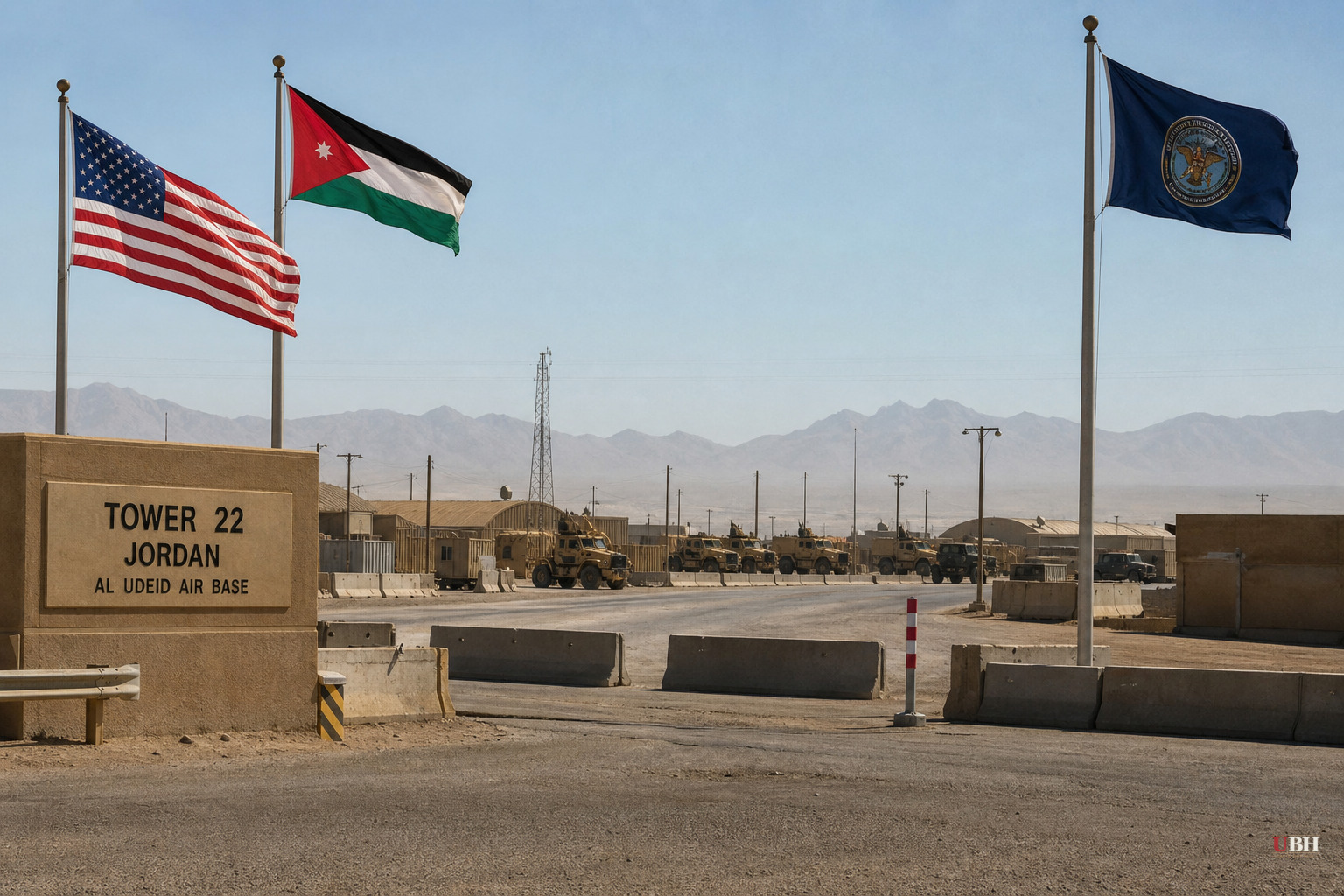
Iran spent late July bombing Jordan, then spent early August telling Jordanians it loves them. It's a strategy from Tehran's perspective.
Since a ceasefire broke down on July 8, Iran has struck targets in Jordan on nine separate occasions, according to the Los Angeles Times. Ballistic missiles and drones hit U.S. assets across multiple Jordanian bases, putting roughly 4,000 American service members at risk. One strike, on July 17, hit a housing unit at the Muwaffaq Al-Salti base in eastern Jordan, killing three U.S. service members and wounding at least four more. Iran's Islamic Revolutionary Guard Corps also claimed hits on King Faisal Airbase, Prince Hassan Airbase, and the airport in Aqaba.
Then came the charm offensive. The IRGC published statements through Iran's Fars News Agency thanking "honorable people" in Jordan for "sincere cooperation and precise information" that supposedly helped Iran kill American personnel, according to the Los Angeles Times. One statement urged Jordanians to "seize every opportunity to dismantle American institutions and expel the American occupation army from Jordan." The Atlantic reported additional IRGC messaging insisting Iran has "no hostility" toward Jordan, calling its people "noble" for understanding Palestinian suffering "more than any other nation," and framing the United States, not Iran, as the party that violated Jordanian sovereignty.
The Atlantic notes Iran has tried to separate Arab publics from their governments' alliances with Washington since the Islamic Republic's founding in 1979. What's different now, per the Atlantic, is Tehran's confidence following what Iranian officials call a "new equation of power" in the region, including leverage over the Strait of Hormuz.
Why Jordan, specifically
Jordan doesn't have the sectarian makeup Iran typically exploits elsewhere. Unlike Iraq, Lebanon, Bahrain, Kuwait, or Saudi Arabia, it has no significant Shiite population to serve as a natural audience for Iranian influence, according to the Atlantic. But it has two things Iran wants: geography and grievance.
Geographically, Jordan hosts radar and anti-missile systems that help Israel detect incoming Iranian fire, the Atlantic reported, and Jordan has no meaningful capacity to retaliate against Iranian strikes on its own soil. Unlike the United Arab Emirates, which reportedly has enough economic leverage with Tehran to have negotiated a tacit nonaggression understanding, Jordan doesn't have that kind of bargaining chip.
The grievance is demographic and political. About 60% of Jordan's population is of Palestinian origin, according to the Atlantic, and the country has seen regular street protests since the Gaza war began in 2023. Some Jordanians have called outright for expelling U.S. forces. Sean Yom, a political scientist at Temple University and author of a book on Jordanian politics, told the Los Angeles Times that Jordanians are "trapped in a dilemma," caught in a war they didn't choose because of an alliance that was supposed to protect them.
The government's problem
Jordan's government has spent years deliberately keeping its U.S. military relationship low-profile, the Los Angeles Times reported, precisely because the public is overwhelmingly pro-Palestinian and wary of any government seen as too close to Washington while it backs Israel. That strategy of quiet cooperation is now colliding with a war that keeps landing missiles on Jordanian soil in full public view.
After the string of strikes, Jordanian officials and members of parliament moved into what the Los Angeles Times called damage control, publicly pushing back against the narrative that Jordanians were feeding Iran targeting data.
That claim deserves real scrutiny before anyone treats it as fact. Iran's assertion that unnamed Jordanians provided "precise information" enabling lethal strikes on American troops is, as of now, an unproven allegation made by the IRGC itself, an interested party with every incentive to sow division. No independent investigation confirming Jordanian civilian collusion has been reported. Whether any such claim can ever be verified, given how covert intelligence-gathering works, is itself an open question worth taking seriously rather than dismissing outright.
What's not in question is the physical toll: three dead American service members, dozens wounded, and nine missile and drone strikes on a country that isn't even a formal combatant in the U.S.-Iran conflict. Jordan is a longtime U.S. security partner that, per the Los Angeles Times, has quietly hosted American and Western forces for decades specifically to avoid becoming a headline. That arrangement isn't quiet anymore.
The open question is whether Iran's public courtship of ordinary Jordanians gains real traction, or whether it reads as exactly what it looks like: an adversary trying to turn a wartime tragedy into a propaganda win against a government that has no easy way to answer it. Jordan's leadership hasn't signaled any intention of ending its U.S. partnership. Whether its public will keep tolerating the cost of that partnership is the harder question, and neither source indicates it has been answered yet.
Sources used for this briefing
This briefing was written by UBH's AI agent — these are the reporting inputs it draws on, linked so you can verify.


