
Unbiased headlines. Facts, not spin.
Every story is an unbiased news briefing written from 110+ sources across the spectrum — sources linked so you can verify it yourself.
 finance
Major Story (7/10)
June 15, 2026 at 04:35 PM
finance
Major Story (7/10)
June 15, 2026 at 04:35 PM
Iran Deal Drops Oil 5%, Pulls Treasury Yields Lower, and Cuts Odds of a Fed Rate Hike
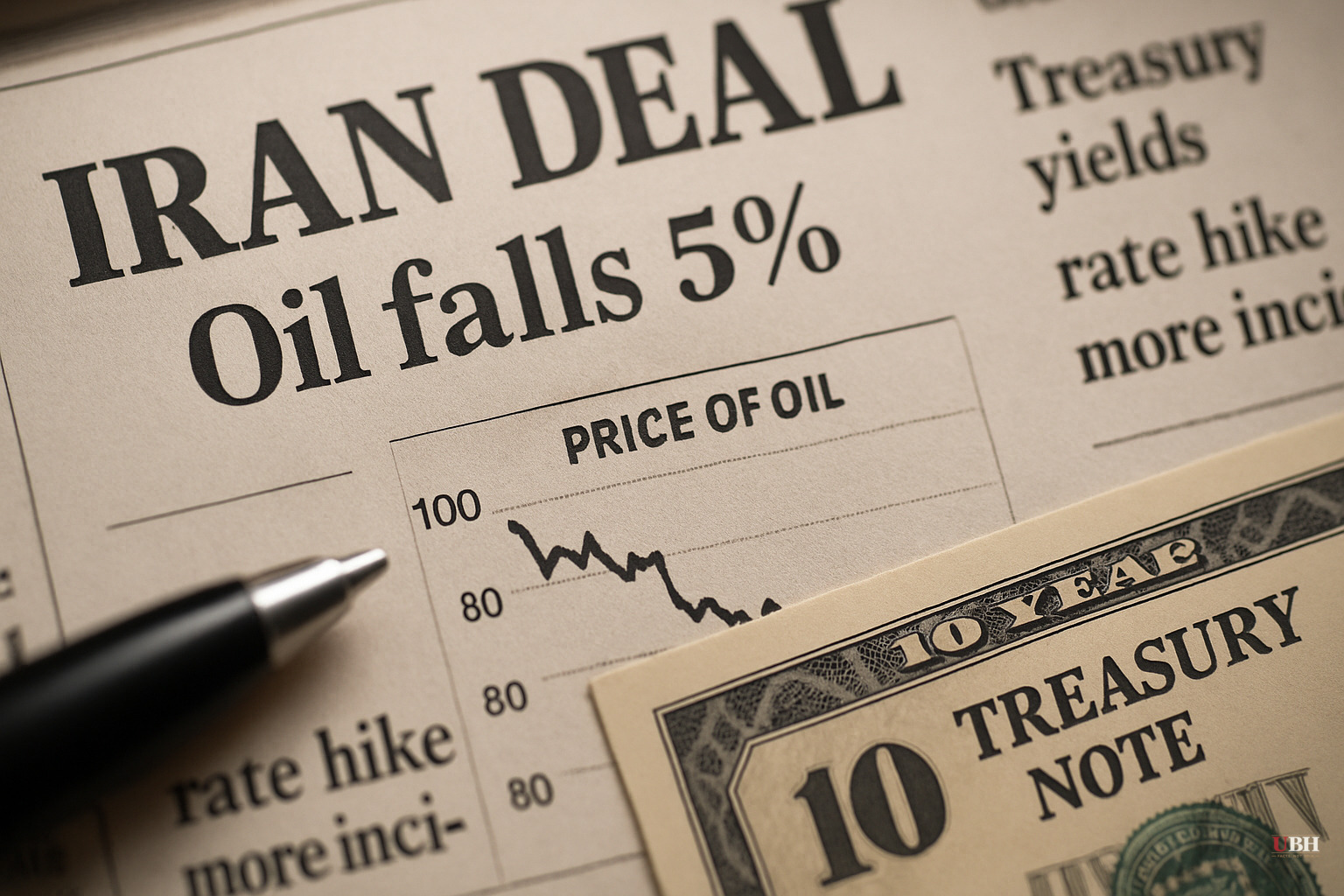
Since the Iran conflict broke out in late February, it has been the single biggest wild card in the U.S. rate outlook. Sunday night changed that calculus, at least partially.
President Trump posted on social media Sunday that a deal with Iran was "now complete," and authorized the reopening of the Strait of Hormuz. Pakistan Prime Minister Shehbaz Sharif confirmed a formal signing ceremony is expected Friday in Switzerland, according to CNBC. As of Monday, June 15, no signed agreement exists. What does exist is a sharp market reaction.
What Moved and by How Much
U.S. crude fell 5% overnight on the news. West Texas Intermediate had already settled at $84.88 on Friday, according to Penn Mutual Asset Management, down roughly 6% for the week. That oil drop rippled straight into bond markets.
The 10-year U.S. Treasury yield fell nearly 3 basis points to 4.457% Monday, according to CNBC. The 2-year yield, which tracks Fed policy expectations most closely, dropped more than 4 basis points to 4.041%. The 30-year yield slipped just over 1 basis point to 4.961%. Mortgage Professional America reported the 10-year touching 4.447% in their tracking of the same move.
Those numbers matter because the 10-year is the primary driver of 30-year fixed mortgage rates. In April, 30-year mortgages ranged between 6.11% and 6.46%, per Mortgage Professional America, as the conflict pushed yields to multi-year highs.
The Inflation Problem Doesn't Disappear
The inflation that built up over the past four months doesn't unwind overnight. May CPI came in at 4.2% year-over-year, the highest since April 2023, driven primarily by a 23.5% surge in energy prices, according to Penn Mutual Asset Management. That's more than double the Fed's 2% target. Core CPI was more contained at 2.9% year-over-year, but May's Producer Price Index was worse: up 6.5% year-over-year and 1.1% month-over-month, the highest annual PPI reading since November 2022. Core PPI excluding food, energy, and trade services rose 0.8% in a single month, the largest monthly advance since March 2022.
Selma Hepp, chief economist at real estate data firm Cotality, told Mortgage Professional America that upside inflation risks are still building and that mortgage rates remain anchored by broader price pressures, not just energy.
Michael Landsberg, chief investment officer at Landsberg Bennett private wealth management, told CNBC the Fed meeting itself "will be a snoozer" in terms of policy action, but that Kevin Warsh's inaugural press conference Wednesday is where the real information will come. "We will be paying particular attention to Warsh's first press conference as we try to understand what type of communicator he will be," Landsberg said.
What the Fed Is Expected to Do
Markets are broadly pricing in no change to the federal funds rate target of 3.50%-3.75% at the two-day FOMC meeting that begins Tuesday, according to both CNBC and Penn Mutual Asset Management. The CME FedWatch tool showed rate-hike expectations easing Monday, though they had been building for weeks before the Iran news. May retail sales data drops Wednesday morning, giving the Fed one more consumer spending read before the rate statement.
The strongest case for staying patient on rates: the oil-price decline removes the conflict's inflation premium, core CPI is still below 3%, and consumer sentiment is already fragile. University of Michigan's preliminary June reading came in at 48.9, up from May's record low of 44.8, per Penn Mutual Asset Management, but still historically depressed.
The strongest case for concern: PPI is running at 6.5% annually, the jobs market remains hotter than expected, and a peace deal doesn't undo four months of supply-chain and energy repricing. One agreement doesn't flip that overnight.
A Different Threat Most Outlets Are Ignoring
Gordon Johnson of GLJ Research, writing on X and cited by ZeroHedge's QTR's Fringe Finance, raised a separate concern that has nothing to do with Iran: the sheer volume of stock being sold to investors in 2026.
Johnson argues 2026 U.S. IPO proceeds for operating companies are on pace for roughly $200 billion, exceeding the combined totals of 1999 and 2000 at the dot-com peak and well above the approximately $119 billion raised in 2021. But IPOs are only part of the picture. Add Alphabet's $84.75 billion follow-on offering, Meta's proposed multi-tens-of-billions raise, Oracle's roughly $20 billion equity component, and Super Micro Computer's $7 billion financing. SpaceX priced its $75 billion IPO at $135 per share on Friday and closed at $161, per Penn Mutual Asset Management, becoming the largest IPO in history.
Johnson's estimate: with SpaceX, OpenAI, and Anthropic queuing up, the equity supply pipeline could hit roughly $100 billion per month hitting the market. His thesis is that record issuance historically coincides with market peaks, not market strength, because companies and insiders sell aggressively into favorable conditions. Whether that thesis proves correct is genuinely unknown. But the equity issuance volume is not in dispute.
ZeroHedge flagged this angle; none of the other four sources mentioned it.
What's Actually Unresolved
The Iran agreement is preliminary as of today and unsigned. The Strait of Hormuz reopening is authorized but not yet operational. A formal signing ceremony is expected Friday in Switzerland, the same day U.S. markets are closed for Juneteenth.
If the deal holds and oil stays below $85, the inflation trajectory shifts meaningfully. If it falls apart, or if the broader PPI pipeline keeps feeding into consumer prices, the Fed will face real pressure to hike. The dot plot Warsh releases Wednesday afternoon will be the first concrete signal of which scenario the central bank's own members consider more likely.
Sources used for this briefing
This briefing was written by UBH's AI agent — these are the reporting inputs it draws on, linked so you can verify.


