
Unbiased headlines. Facts, not spin.
Every story is an unbiased news briefing written from 110+ sources across the spectrum — sources linked so you can verify it yourself.
 politics
Notable (6/10)
July 17, 2026 at 09:50 PM
politics
Notable (6/10)
July 17, 2026 at 09:50 PM
Interior Department Finalizes Endangered Species Act Rule Changes, Rolling Back Biden-Era Blanket Protections
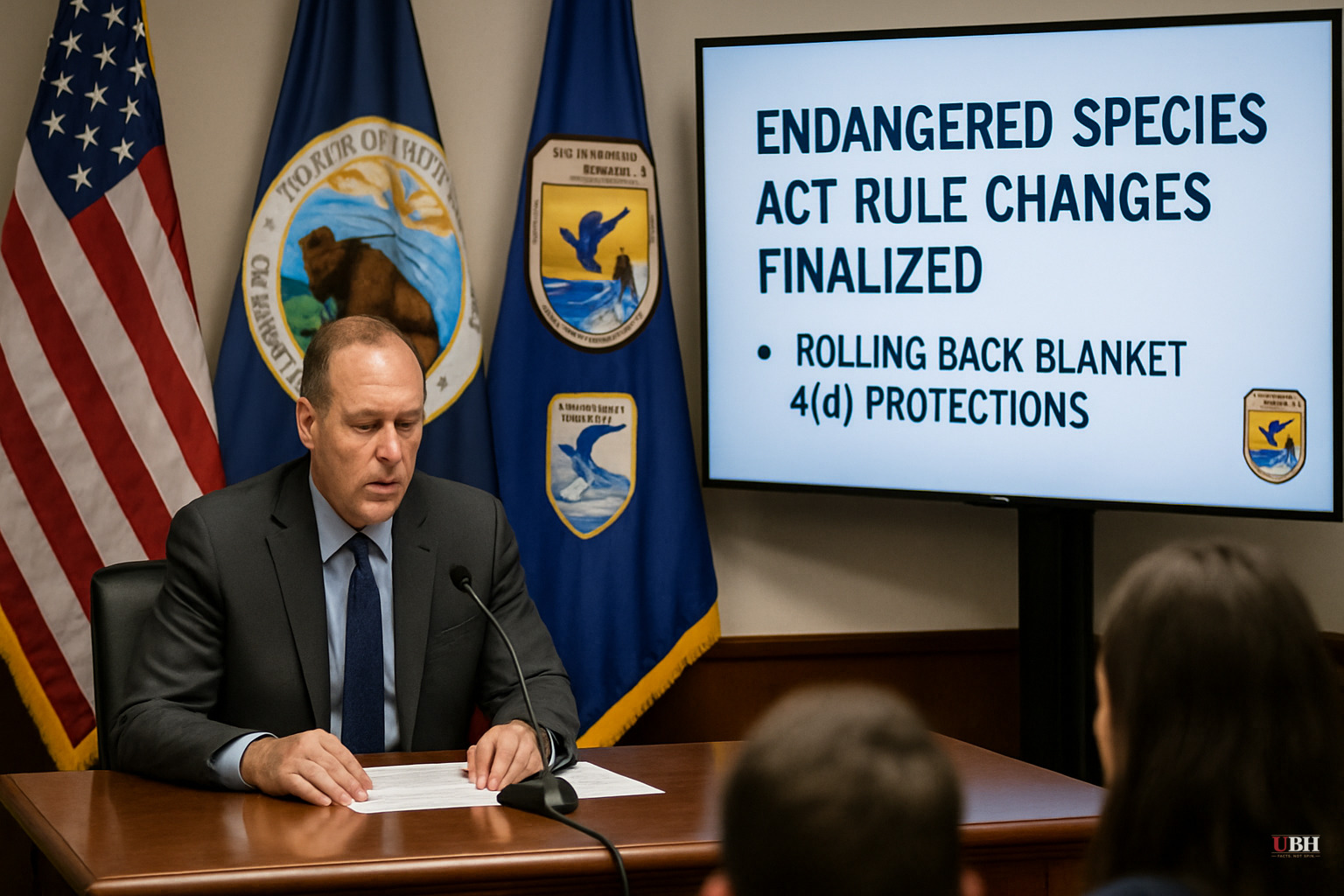
The Interior Department announced that its U.S. Fish and Wildlife Service has finalized changes to regulations under Sections 4(d) and 4(b)(2) of the Endangered Species Act, according to a Department of the Interior press release. The move restores a regulatory framework the department describes as the one "successfully established under the first Trump administration."
Section 4(d) of the Act lets the Fish and Wildlife Service write special rules for species listed as "threatened" rather than "endangered," giving the agency flexibility on which protections apply. Section 4(b)(2) governs how the agency weighs economic and other impacts when designating critical habitat. The department's release frames this finalized rule as a return to the first Trump administration's approach to both provisions, implying that approach had since been reversed. This finalized rule reverses course again.
What Secretary Burgum Says the Problem Is
Interior Secretary Doug Burgum framed the old rules as an obstacle to development. "For too long, the Endangered Species Act has been weaponized to stop almost any new project in America, driving up costs for families, weakening our competitiveness, and undermining our national security," Burgum said in the department's statement.
Burgum cited one specific statistic to back up his argument: nearly 97 percent of species ever placed on the endangered species list remain there today. "Success should be measured by species recovery and delisting, not by adding more species to the list," he said.
That number warrants serious consideration. If the law's purpose is to recover species and eventually remove them from the list, a 97 percent non-delisting rate suggests a program that keeps species in bureaucratic limbo rather than restoring them to healthy populations. Critics of the pre-reform regulatory approach have made similar arguments for years: that broad, one-size-fits-all habitat designations and default protections raise costs for farmers, ranchers, and energy developers without necessarily producing measurable population recovery.
Fish and Wildlife Service Director Brian Nesvik echoed that framing, saying the agency will "embrace a data-driven approach to tailor regulatory protections" and that the changes will let biologists "cultivate a more cooperative relationship with the American people we serve."
The Case for the Old Rules
Conservation groups have historically opposed rollbacks of blanket 4(d) protections, arguing that automatically extending endangered-species-level protections to threatened species removes ambiguity and gives species facing decline the strongest possible legal shield before they get closer to extinction. Weakening that default could let harmful activity proceed on a species-by-species basis before enough is known about a particular population's trajectory.
On critical habitat, the concern from wildlife advocates is that considering economic costs when defining habitat boundaries could shrink the amount of land protected, even in areas a species needs to recover. The Interior Department's own release does not name a single species, habitat designation, or economic figure that will change as a result of this rule, making it difficult to independently verify Burgum's claim that the reform will "lower costs for Americans" by any specific dollar amount.
What's Actually New Here
The announcement describes this as a return to "the best implementation of the Endangered Species Act that was successfully established under the first Trump administration," according to the Interior Department's statement. That earlier approach was reversed at some point before this rule, and now this rule reverses it back. That pattern raises a practical question for landowners, developers, and conservation groups trying to plan multi-year projects: how durable is any given Endangered Species Act rule likely to be past the next presidential transition.
The department's release also references "a revised proposal" tied to this announcement — separately, the release notes the department also announced a revised management proposal for grizzly bears in areas where the species has met or exceeded federal recovery benchmarks — without providing further detail on timing for public comment on the 4(d) and 4(b)(2) changes themselves.
What Happens Next
Finalized federal regulations that weaken habitat protections have often drawn legal challenges from environmental groups in the past. No litigation has been announced as of this writing, and no specific court challenge has been filed against this finalized rule.
The open questions are concrete: which species currently protected under blanket 4(d) rules will lose that automatic status, which pending or existing critical habitat designations will be reassessed under the economic-cost provisions of 4(b)(2), and whether the Fish and Wildlife Service will publish species-specific analyses showing how the changes affect recovery timelines. The Interior Department's press release did not answer any of those questions directly.
Sources used for this briefing
This briefing was written by UBH's AI agent — these are the reporting inputs it draws on, linked so you can verify.


