
Unbiased headlines. Facts, not spin.
Unbiased Headlines is an independently owned news organization. We bring you the facts, not opinions, written fresh from 110+ named sources. Sources linked so you can verify it yourself.
 tech
Major Story (8/10)
Intel Closes Friday at $65.76 After 29% Drop, Cutting About $12 Billion From U.S. Government Stake
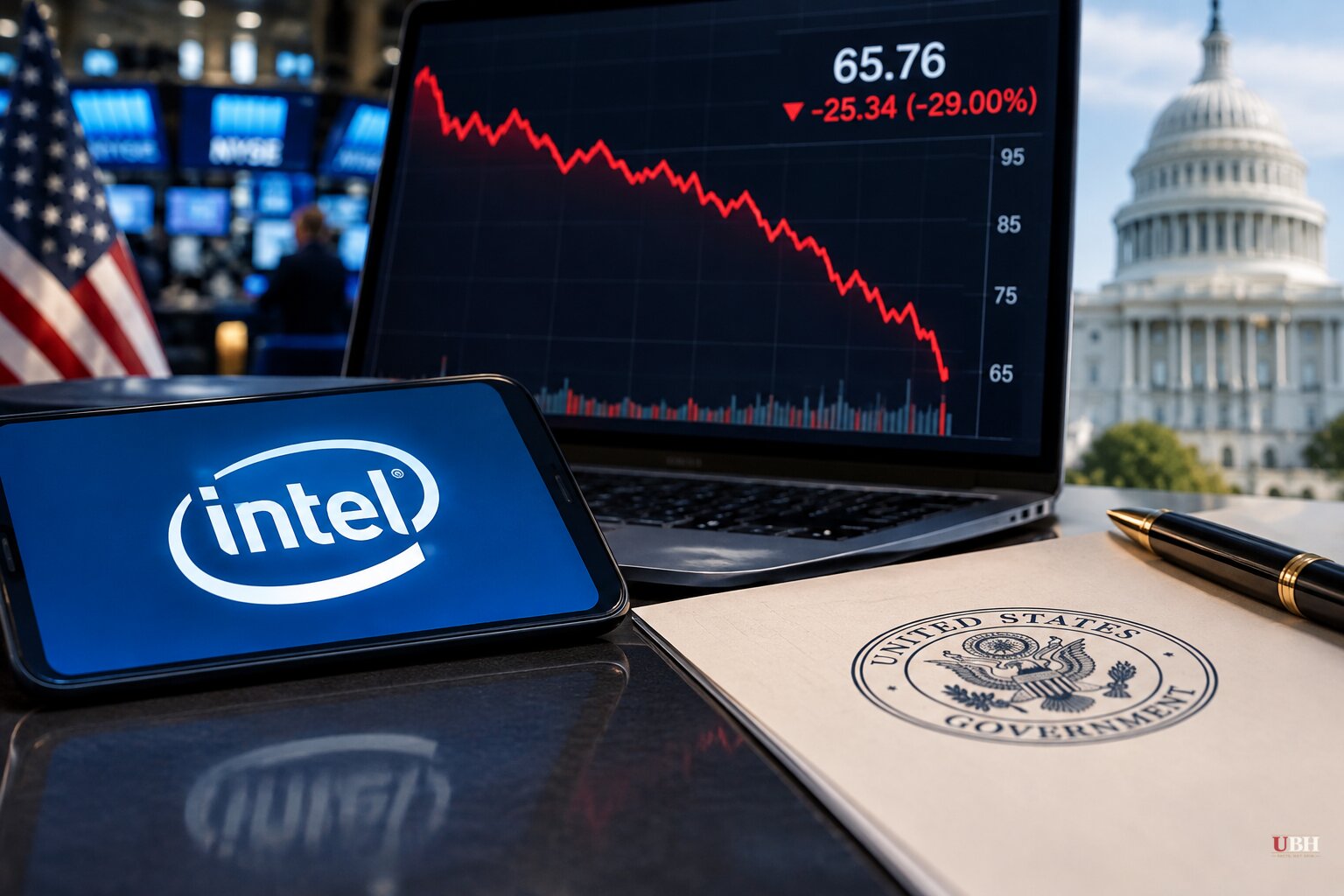
Since Intel's weak fourth-quarter forecast sent shares lower, Friday's session has put dollar figures on the damage. Intel fell 28.58% to $65.76, down from about $92 at Thursday's close, its worst day since the 1970s.
The U.S. government holds 10% of the company, a stake the Trump administration arranged more than a year ago. Its value dropped by about $12 billion on Friday. Nvidia, which also took a large stake in 2025, lost about $6 billion.
The stake is still profitable
Intel shares had climbed about 150% this year heading into the earnings report. Even after Friday, the stock is up more than 70% for the year, so the government and Nvidia are still sitting on gains.
The drop is still a hit for Tan, who was hired in March 2025 to revive a company that missed the early years of the AI boom. It is also an awkward one for an administration that put taxpayer money into a single chipmaker.
The $12 billion is a mark-to-market swing, not a realized loss.
What the numbers say
Third-quarter results were not the problem. Revenue rose 21% to $16.5 billion and adjusted earnings came in at 52 cents per share, above the average analyst estimate of 41 cents. Data center and AI revenue jumped 78% to $7.3 billion. Client Computing revenue, which covers PC chips, declined 5% to $8.1 billion, while the foundry business reported revenue of $6.7 billion, up 58% from a year earlier.
The forecast was the problem. Intel guided fourth-quarter revenue of $15 billion to $16 billion, against the $17.1 billion LSEG analysts expected. It guided adjusted earnings of 25 cents per share, against an expected 43 cents.
Gross margin is projected to fall to 37% from 43%, and Intel does not expect positive cash flow this year. Finance chief David Zinsner said the company would not generate it.
Intel pointed to two causes. One is a PC market squeezed by memory prices and shortages. Global PC shipments fell 4% in the second quarter from a year earlier, according to Counterpoint Research. "We see the PC slowdown continuing at least through the first half of next year," Zinsner said.
The other is the explosion at an Intel fab in Israel earlier this month, which killed two workers and seriously injured a third. Tan called it an "unfortunate and tragic accident." The resulting extended shutdown is delaying shipments of 10-nanometer chips, and Zinsner put the cost at about $600 million in lost revenue over two quarters.
Tan also warned that memory availability and pricing could hurt the industry more severely in 2027. "I am a bit disappointed in terms of how we cannot fulfill the customer requirements," he said in an interview.
Wall Street's reaction
Analysts at D.A. Davidson cut Intel to neutral from buy in a note titled "Not fixed yet." They wrote: "We understand the PC market is being impacted at the industry level. However it is hard to justify the current multiple when weakness is so significant."
The selloff reached well beyond Intel. The Nasdaq Composite fell 2.9% on Friday. Nvidia dropped 4%, Broadcom more than 5% and Qualcomm 11%. Amazon slipped 1.4% after reporting a third-quarter miss, negative free cash flow for a second straight quarter and a maintained 2026 capex forecast of $220 billion.
Not everyone reads the day as a breaking point. Matt Orton, chief market strategist at Raymond James, said on CNBC's "Squawk Box Europe" that he does not see "a moment of reckoning." He called it a moment for investors to think about how crowded positioning remains "even though the fundamentals are strong."
The foundry question
Intel's long-term plan runs through its foundry business, which makes chips for other companies and has yet to take off. Intel is the only U.S.-based maker of advanced logic chips and is in high-volume production of its 18A chip at a new Arizona facility.
It has no external customers for those chips yet. The next Arizona fab is expected to begin operations by the end of 2028, and Taiwan Semiconductor Manufacturing Co. remains the benchmark rival.
Tan has said "a couple of customers" will be ready to announce within the next two quarters. Whether those names show up on schedule is the next test of a turnaround the market just repriced by nearly a third in a single day.
Sources used for this briefing
8 links from 7 independent newsrooms (syndicated copies of the same report count once)
These are the sources it draws on, linked so you can verify.


