
Unbiased headlines. Facts, not spin.
Unbiased Headlines is an independently owned news organization. We bring you the facts, not opinions, written fresh from 110+ named sources. Sources linked so you can verify it yourself.
 tech
Notable (6/10)
Event date: October 28, 2026 ·
SpaceX Finishes Static Fires for Starship Flight 15; FAA Approval for Double Tower Catch Still Pending
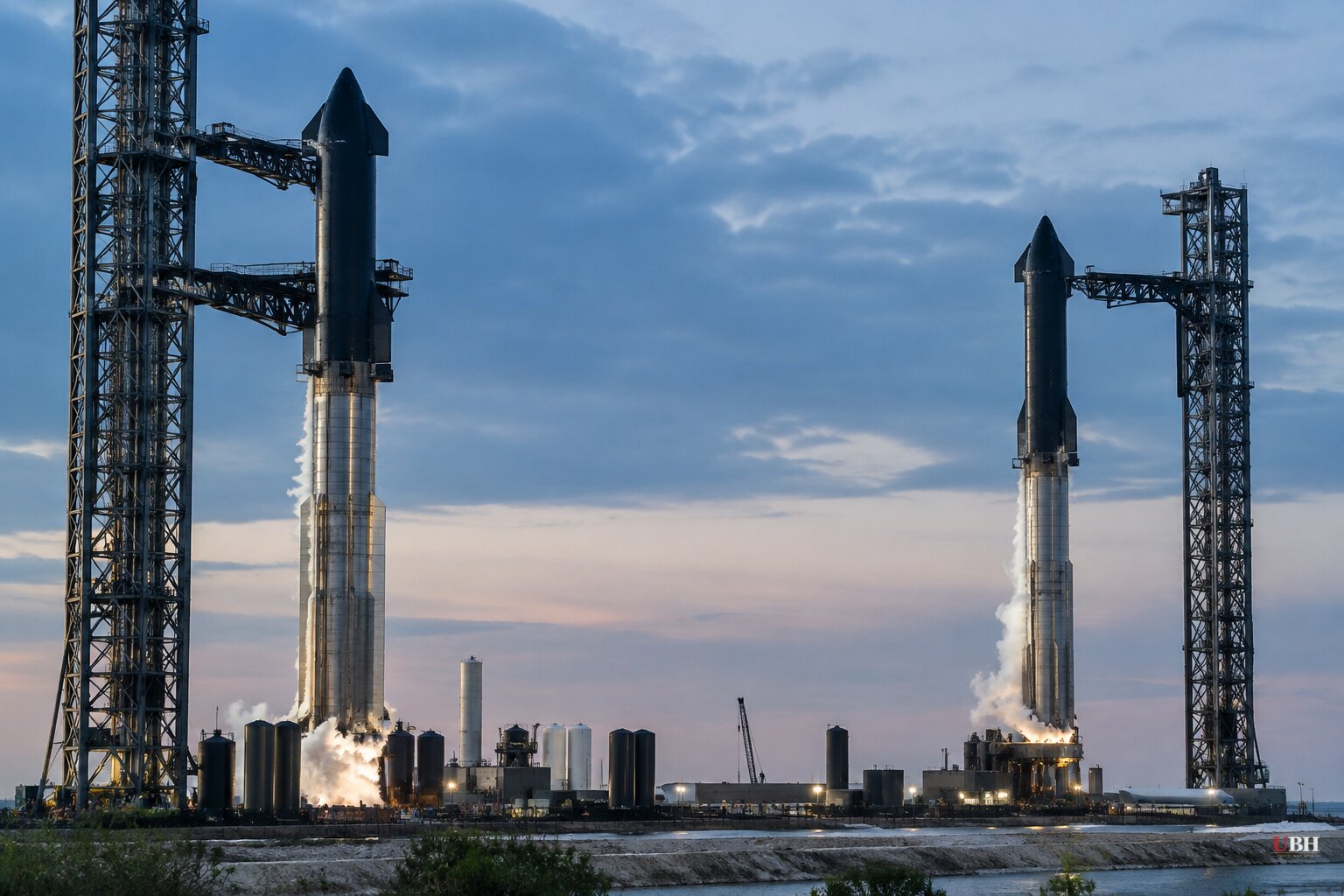
SpaceX has now static-fired both stages of the Starship vehicle set to fly Flight 15. The remaining gate is regulatory.
The company wants to catch the Super Heavy booster and the Starship upper stage with the launch tower's "chopstick" arms on the same mission. It has never tried to catch an upper stage.
The hardware checks are done
Booster 22 completed a full-duration static fire of all 33 Raptor engines at Pad 2 in Starbase, Texas, on Oct. 25, SpaceX confirmed.
Ship 42 followed. In an Oct. 28 post on X, SpaceX said: "Ship 42 static fires complete. The Starship preparing for Flight 15 performed a full duration, six-engine static fire, and fired a single Raptor engine to simulate a deorbit burn."
That deorbit-burn rehearsal matters because the ship has to survive reentry and fly back to the tower before any catch is possible.
SpaceX also ran a catch drill. While Ship 42 sat on the test stand at Massey's, the tower arms lifted and lowered Ship 43, the vehicle assigned to Flight 16. Ship 43 was also moved to Pad 2 at Starbase for fit checks and lifting tests.
The launch date is not fixed
SpaceX has not announced an official launch date. Musk has said Flight 15 is targeted for sometime in November.
FAA information puts the current target date at Nov. 12, pending regulatory approval. Unofficial air traffic planning data pointed earlier to a launch no earlier than Nov. 8. Those are planning placeholders, not a SpaceX commitment.
The approval is the real hold-up. Musk said on SpaceX's Oct. 20 earnings call that Flight 15 would attempt to catch both stages, provided the company gets regulatory approval. SpaceX President Gwynne Shotwell said this month she expects the license to include "a return to the launch site and tower catch for both stages."
SpaceX has already obtained environmental clearance from the FAA for Starship catches at Starbase, according to reporting on the preparations. A flight license covering the ship catch is a separate piece.
What Flight 15 follows
Flight 14 flew on Sept. 28 and put Starship into a stable low Earth orbit for the first time. After separating from the booster, the upper stage reached roughly 170 miles (275 kilometers) and deployed 26 Starlink V3 satellites.
SpaceX has caught the Super Heavy booster on three flights, starting with Flight 5 in October 2024. The upper stage has never been caught.
SpaceX says catching both stages will become routine on operational flights because it cuts the turnaround time to refly them. Starship is designed to be fully reusable, unlike the Falcon 9 and Falcon Heavy, whose upper stages are expended.
The paperwork behind the ambition
The regulatory ask is about to get much bigger. SpaceX has told the FAA it wants to fly 456 Starship launches and 912 landings a year from Starbase. It is currently approved for 25 launches a year from Texas and twice that many landings.
In a document submitted to the FAA, the company said it wants to launch 10,000 Starships per year by 2035. Musk said on X that those flights would come from Starbase Louisiana, a planned $100 billion spaceport, and that it would handle 30 Starships a day. The first launch from that site is expected in 2028 or 2029.
Musk's figures are targets, not approvals or built infrastructure.
Closer in time, SpaceX is building a Starship pad at Kennedy Space Center in Florida. Julianna Scheiman, SpaceX's director of NASA science and Dragon programs, said preparations are going "super well." Two more pads are under construction at Cape Canaveral. Flight 16 is likely to launch from the Kennedy pad.
SpaceX also plans on-orbit refueling missions next year, a capability needed for lunar missions, along with a reflight of an upper stage.
What comes next
The hardware is ready on SpaceX's account. The open question is whether the FAA issues a license that authorizes catching both stages, and when. If it authorizes only the booster catch, the ship's return leg would be the part left in question.
SpaceX has not said what it would do in that case.
Sources used for this briefing
7 links from 7 independent newsrooms (syndicated copies of the same report count once)
These are the sources it draws on, linked so you can verify.


