
Unbiased headlines. Facts, not spin.
Unbiased Headlines is an independently owned news organization. We bring you the facts, not opinions, written fresh from 110+ named sources. Sources linked so you can verify it yourself.
 tech
Notable (5/10)
Fujifilm to Spend ¥10 Billion to Quintuple Magnetic Tape Capacity, Citing AI Data Demand
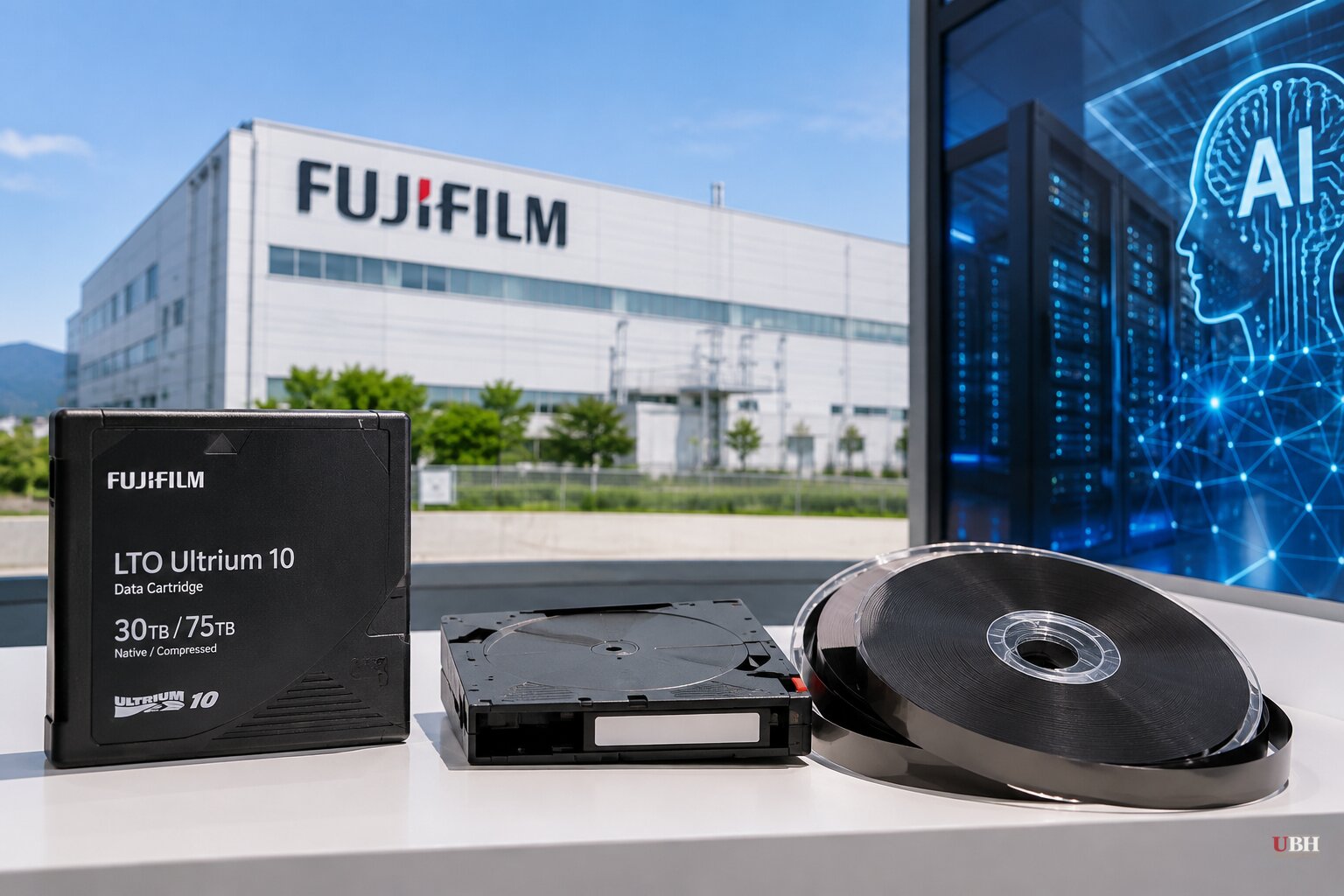
Fujifilm is betting that old-school magnetic tape has a long future. On Thursday, Oct. 29, the company announced it will invest approximately ¥10 billion, about $63 million, to raise data storage tape production capacity roughly fivefold at its Kanagawa Factory, Odawara Site.
The spending runs from fiscal 2026 through fiscal 2028. It will pay for new manufacturing facilities and more personnel, primarily to build the latest-generation FUJIFILM LTO Ultrium10 cartridge. The fivefold figure is measured against fiscal 2025 production levels.
This is not a quick switch. The expansion is spread over three fiscal years.
What Fujifilm says is driving it
The company's statement says the "rapid spread of generative AI and cloud services is driving exponential growth in the volume of data generated worldwide." It argues that the data piling up from AI training and inference, plus the digitization of business, has to be stored "securely and efficiently."
Fujifilm also says major cloud providers and data center operators have been expanding their tape use. Tape holds large volumes for long periods at low cost, and cartridges can be physically disconnected from networks. Given the sophistication of cyberattacks, the company says, that air gap is drawing attention as protection against ransomware.
Fujifilm says it holds the top global share of the magnetic tape market. That is the company's own claim.
The product
LTO is an open-standard tape format managed by a consortium that includes HPE, IBM and Quantum Corp. Fujifilm launched its first LTO tape in 2000 and began magnetic tape research in the 1950s. In 2025 it introduced Ultrium10, which uses what it calls "fine hybrid magnetic particles," combining barium ferrite and strontium ferrite.
LTO-10 cartridges come in 30TB and 40TB native capacities and transfer data at 400 MB/s. With compression, a 40TB cartridge can reach up to 100TB. A 30TB cartridge holds up to 75TB compressed and lists at £297.99 excluding VAT in the UK.
The LTO roadmap calls for LTO-11 around 2029 at 70TB native, then 120TB, 210TB and 365TB for LTO-12 through LTO-14.
The Nikkei Asia reported that the Fujifilm investment is the company's largest in tape in about 20 years. Fujifilm's own release does not make that claim.
Tape's limits and a soft 2025
Tape is cheap per terabyte, but it is slow. Access times are not its strength, and users generally treat it as offline or nearline archive storage. LTO-10 drives can also read only the current generation of cartridges, ending the long-running backward-compatibility practice.
The demand picture is also less one-directional than the announcement suggests. Buyers purchased 160.3 exabytes of LTO in 2025, down from a record 176.5 exabytes in 2024. The LTO Program, run by HPE, IBM and Quantum, blamed difficult macroeconomic conditions. It said sales picked up strongly in the second half of 2025 and predicted record sales in 2026.
The argument for a fivefold expansion rests on a forecast of record 2026 sales and the company's reading of AI data growth. The 2026 record has not been reported yet. Fujifilm's statement does not give a demand forecast or a revenue target for the added capacity.
A wider storage crunch
Tape is not the only storage business scaling up. Toshiba announced earlier this month that it plans to double hard disk production capacity amid shortages. Kioxia and SanDisk detailed 332-layer 3D NAND in August, aimed at higher-capacity data center SSDs.
The AI data center buildout has helped drive a global storage shortage, with prices climbing and manufacturers shifting resources from consumer products to the more lucrative enterprise market. That is the backdrop for Fujifilm's decision to put its own capital into cartridges that sit on a shelf.
What to watch
The next test is the LTO Program's 2026 shipment figures. If the predicted record materializes, Fujifilm's five-times capacity target looks like a reasoned bet. If shipments stay near 2025's 160.3 exabytes, the company will have spent ¥10 billion building supply that the market has not yet asked for.
Fujifilm's capital plan runs through fiscal 2028, which means the answer arrives well before the spending ends.
Sources used for this briefing
7 links from 7 independent newsrooms (syndicated copies of the same report count once)
These are the sources it draws on, linked so you can verify.


