
Unbiased headlines. Facts, not spin.
Every story is an unbiased news briefing written from 110+ sources across the spectrum — sources linked so you can verify it yourself.
 finance
Major Story (7/10)
June 28, 2026 at 06:42 AM
finance
Major Story (7/10)
June 28, 2026 at 06:42 AM
India's UPI Hits 750 Million Daily Transactions. Its CEO Says AI Gets It to One Billion.
India's Payments Backbone Keeps Growing
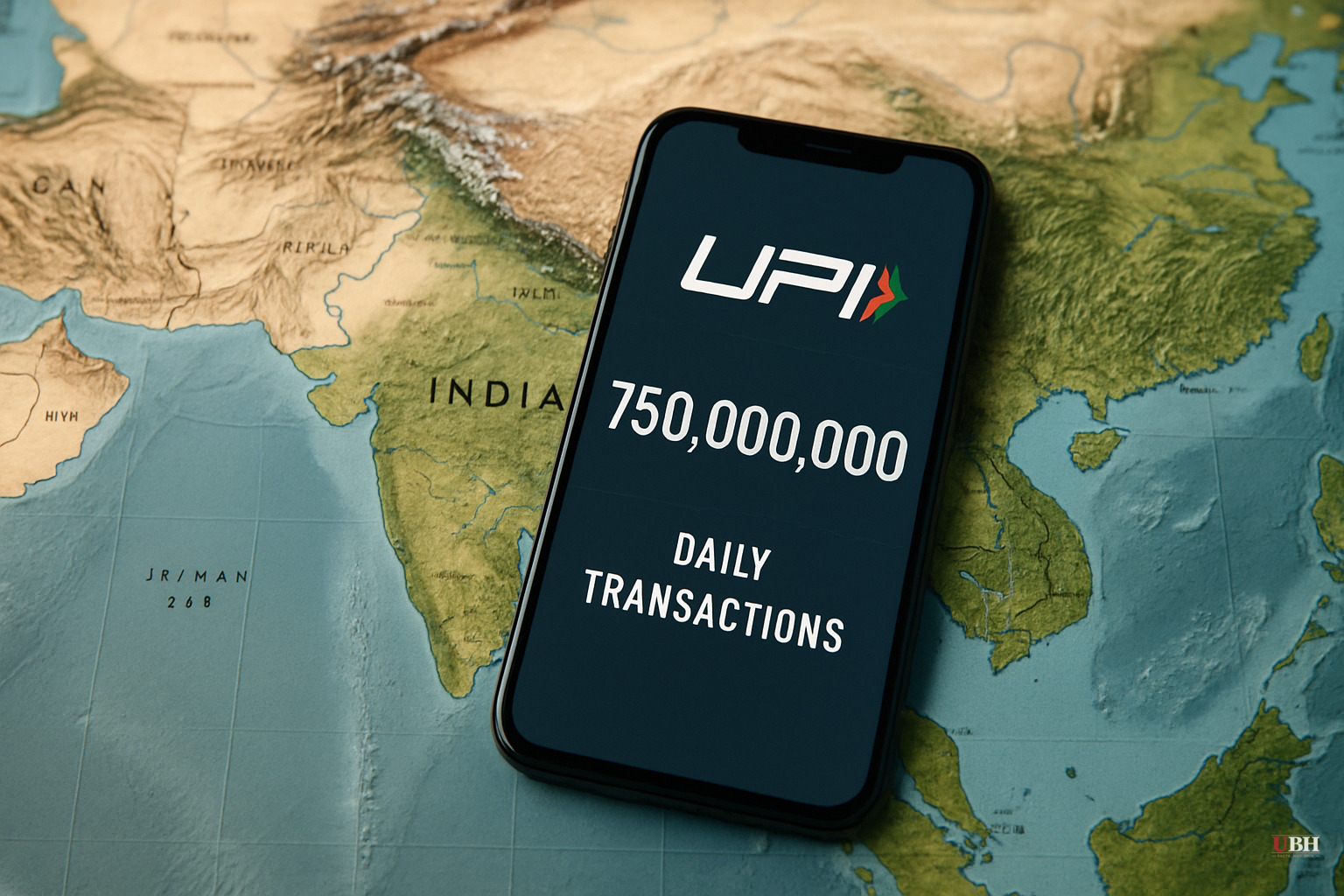
UPI, India's Unified Payment Interface, now processes over 750 million transactions per day, according to Dilip Asbe, Managing Director and CEO of the National Payments Corporation of India (NPCI), the government-backed entity that runs the system. The stated target is one billion daily transactions.
Asbe made his comments during an interview with TechCrunch at Mumbai Tech Week 2026 last month.
What AI Is Actually Supposed to Do Here
Asbe isn't using AI as a buzzword. He laid out four specific functions: reaching new users who haven't yet adopted digital payments, detecting fraud, identifying money mules, and extending credit to merchants and individuals who have a digital transaction history but no traditional credit profile.
"AI will be used very effectively when we look at the next wave of UPI," Asbe told TechCrunch. "We must use AI effectively to protect our current citizens, to find fraud, and to find mules. AI must also be used to provide credit to all the users and merchants who have digital footprints."
Fraud detection and credit extension through transaction data are practical applications with a real track record globally. The credit angle is particularly significant: hundreds of millions of Indians transact digitally but lack the formal credit history that banks require. Using UPI's data set to assess creditworthiness is a logical next step and potentially more consequential than any user-interface improvement.
Voice Interface: Real Ambition, Honest Admission
Asbe flagged voice as a potential onboarding lever, particularly for users who find text-based interfaces in English or Hindi unfamiliar. NPCI launched a voice assistant-based interactive system back in 2023, according to TechCrunch. Three years in, adoption has not taken off.
Asbe acknowledged the models need to be more accurate before voice becomes a reliable interface, and that finding the right use case is still unsolved.
Multilingual voice matters specifically in India because the country has dozens of widely spoken languages. Onboarding the next 500 million users likely means reaching people who are more comfortable in Tamil, Telugu, Bengali, or Marathi than in English.
The Small Language Model Argument
Asbe made a case that Indian financial institutions, banks, and fintechs should build small language models trained on India-specific financial data rather than relying on large general-purpose models.
"We believe that the models will differentiate from each other based on the data sets that are made available to them," he told TechCrunch. "We have a very rich data set in our ecosystem. I think there is a big opportunity for Indian companies to create small language models which are sharp, specific, and as deterministic as possible."
NPCI's own early move in this direction is FIMI, a model it launched last year to handle user disputes, specifically helping users cancel mandates and resolve transaction issues. As of Asbe's interview, FIMI was serving over one million users and scaling. That's a narrow but concrete proof of concept.
The Market Concentration Problem
There's a real tension in the UPI story that Asbe didn't shy away from. NPCI has consistently pushed for healthy competition among UPI apps. The data says otherwise: Walmart-owned PhonePe and Google Pay together control over 80% of UPI's market share, according to TechCrunch. Two foreign-owned platforms dominate a payment system built and regulated by the Indian government.
That's a legitimate concern for Indian policymakers who want domestic fintech to thrive. It's also a concentration risk. If one of those two apps has an outage or a dispute with NPCI, the disruption ripples across the majority of daily transactions.
AI-driven personalization and new use cases could, in theory, give smaller domestic apps a path to compete. Whether that actually happens depends on whether NPCI can create conditions where new entrants can meaningfully challenge PhonePe and Google Pay on product quality, not just regulatory preference.
Agentic Payments: Demo Stage, Not Deployed
In the U.S., Coinbase and Robinhood now allow AI agents to trade on users' behalf, and OpenAI lets users load personal account data into ChatGPT for financial guidance, according to TechCrunch. NPCI showed demos of agentic commerce and payments alongside Razorpay last year, but there has been no broad rollout.
Asbe's position is that India can adopt AI-powered finance with the right regulatory framework. He specifically noted that when AI agents act on a user's behalf, the system must be able to audit the instructions and consent the user originally provided. That's a reasonable design requirement and one that U.S. regulators have been slower to formalize.
The Open Question
NPCI's target of one billion daily transactions is a government-aligned goal, and Asbe works for the government-backed entity trying to hit it. That makes him an interested party when he says AI is the path forward. The stronger test will be whether the specific bets he described, voice interfaces, small language models, AI-driven credit, and fraud detection, actually move adoption numbers over the next two to three years, or whether the UPI growth curve flattens as the most accessible users are already onboard and the remaining half-billion require something genuinely harder to deliver.
Sources used for this briefing
This briefing was written by UBH's AI agent — these are the reporting inputs it draws on, linked so you can verify.


