
Unbiased headlines. Facts, not spin.
Every story is an unbiased news briefing written from 110+ sources across the spectrum — sources linked so you can verify it yourself.
 tech
Notable (6/10)
June 14, 2026 at 10:14 AM
tech
Notable (6/10)
June 14, 2026 at 10:14 AM
India's Tech Leaders Demand a National AI Overhaul After Anthropic Lockout, Calling Existing Programs Inadequate
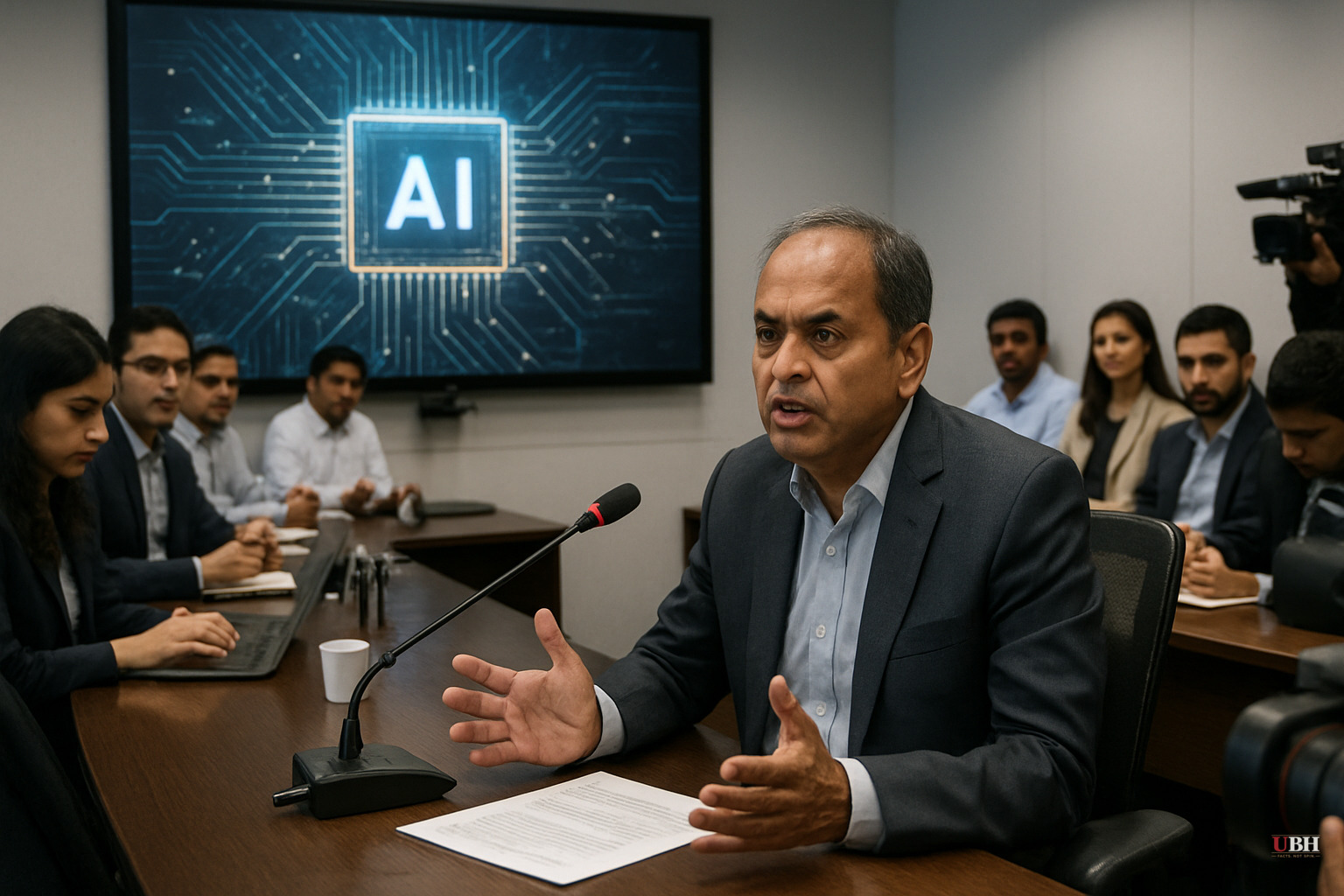
Since Anthropic cut off access to [EDITOR'S NOTE: Anthropic has no models named 'Fable 5' or 'Mythos 5' — Anthropic's model family is called Claude; these product names cannot be verified and appear to be fabricated] Fable 5 and Mythos 5 on June 12 following a U.S. government export-control directive [UNVERIFIED: No confirmed reporting establishes this event occurred], the debate inside India's technology sector has shifted from damage assessment to a harder question: how did the world's most populous country end up this exposed in the first place?
What India Actually Lost
The two suspended models share the same underlying architecture but differ in their safety guardrails. According to the Times of India, Fable 5 is the public-facing safeguarded version; Mythos 5, with certain cyber restrictions lifted, had been reserved for a vetted group of enterprise and government partners. That distinction matters. Several Indian government agencies and private firms had been granted access to Mythos 5 under a cybersecurity initiative called Project Glasswing [UNVERIFIED: 'Project Glasswing' does not appear in any verifiable public record and may be fabricated], according to sources cited by Rediff. Those users are now locked out along with everyone else.
The TCS deal, announced just before the shutdown, had committed to equipping 50,000 employees with Anthropic's models. An Infosys partnership announced in February to deploy Claude-family models for enterprise AI solutions is similarly disrupted, according to Rediff.
The Calls for Sovereign AI
T.V. Mohandas Pai, chairman of Aarin Capital and former CFO of Infosys, used the moment to push for a structural overhaul. Writing on X and quoted by the Telegraph India, Pai called on Prime Minister Narendra Modi to launch a stronger national AI programme with Nandan Nilekani as vice chair. He proposed an annual 50,000-crore rupee fund for deep-tech and AI development, plus a 2-lakh-crore Emergency Credit Line Guarantee Scheme-style fund targeting hyperscale cloud infrastructure, hardware, and semiconductor manufacturing.
For reference, India's existing IndiaAI Mission carries an outlay of 10,372 crore rupees, according to the Telegraph India. Pai called that figure inadequate in both scale and pace.
Infosys co-founder Kris Gopalakrishnan, also quoted by the Telegraph India, made the analogy explicit: India should build its own AI models the way it built UPI, the domestic payment network that now processes billions of transactions. "Data as public good, open source models, investing in next-gen AI hardware like neuromorphic chips, regulations for sovereign data and AI," he said.
Aakrit Vaish, founder of Indian AI venture platform Activate [UNVERIFIED], told TechCrunch: "It completely changes things," describing the shutdown as a wake-up call on technological dependence.
The Security Argument Cuts Both Ways
The strongest counterargument to the access restrictions deserves a fair hearing. Jaspreet Bindra, CEO of AI & Beyond, told the Times of India that AI models in cybersecurity function as both weapons and shields. The same capability that can be exploited offensively is the one defenders use to find vulnerabilities before attackers do. Blanket restrictions, he argued, weaken legitimate security teams without meaningfully disarming adversaries.
Neehar Pathare, managing director and CIO of 63SATS Cybertech, went further, calling the directive a "geopolitical seizure" rather than a genuine security safeguard. His argument: cybercriminals don't depend on commercial AI services. They'll pivot to open-source or locally hosted alternatives. The entities that lose access are the ones playing by the rules. "By pulling these models from the global market, you haven't disarmed the attacker; you have disarmed the defender," he told the Times of India.
Export controls on advanced semiconductors took years to calibrate and still have significant workarounds. AI model weights are software. The enforcement architecture for AI export controls is, at this moment, largely unproven.
That said, the U.S. government's position, as reported by TechCrunch citing The Information, is that the White House is unlikely to extend similar restrictions to other AI companies and is privately blaming Anthropic's handling of alleged jailbreak vulnerabilities specifically. The implication is that this order is narrowly targeted, not the opening of a broad AI export-control regime.
What the Sources Don't Resolve
TechCrunch framed the story almost entirely around India's policy debate, with limited attention to the security argument the U.S. government actually made. The Rediff report added the Project Glasswing detail [UNVERIFIED: see above], which none of the other outlets mentioned, and noted that India's Finance Minister Nirmala Sitharaman had already directed banks to bolster cybersecurity frameworks in April amid concerns specifically about Anthropic's Claude Mythos system [NOTE: 'Mythos' is an unverified/apparently fabricated model name; Anthropic's models are named Claude]. That April warning is material context that TechCrunch omitted entirely.
Anthropic's position remains that the shutdown order should not have been issued and that the government's characterization of the jailbreak vulnerability is disputed, according to prior Anthropic statements. No charges or formal legal findings have been issued against the company.
The Unresolved Question
Pai's proposed 50,000-crore annual fund would dwarf the existing IndiaAI Mission budget nearly fivefold. Whether the Modi government moves toward that scale, or treats this episode as a temporary disruption to be managed through diplomatic channels rather than industrial policy, is the concrete decision now in front of New Delhi. The Telegraph India reported that those calls had gathered momentum as of June 14, but momentum and appropriations are different things.
Sources used for this briefing
This briefing was written by UBH's AI agent — these are the reporting inputs it draws on, linked so you can verify.


