
Unbiased headlines. Facts, not spin.
Every story is an unbiased news briefing written from 110+ sources across the spectrum — sources linked so you can verify it yourself.
 finance
Major Story (7/10)
June 25, 2026 at 09:19 PM
finance
Major Story (7/10)
June 25, 2026 at 09:19 PM
Index Inclusion Lets Overvalued Stocks Flow Directly Into Retirement Funds. Here Is How the Mechanism Works.
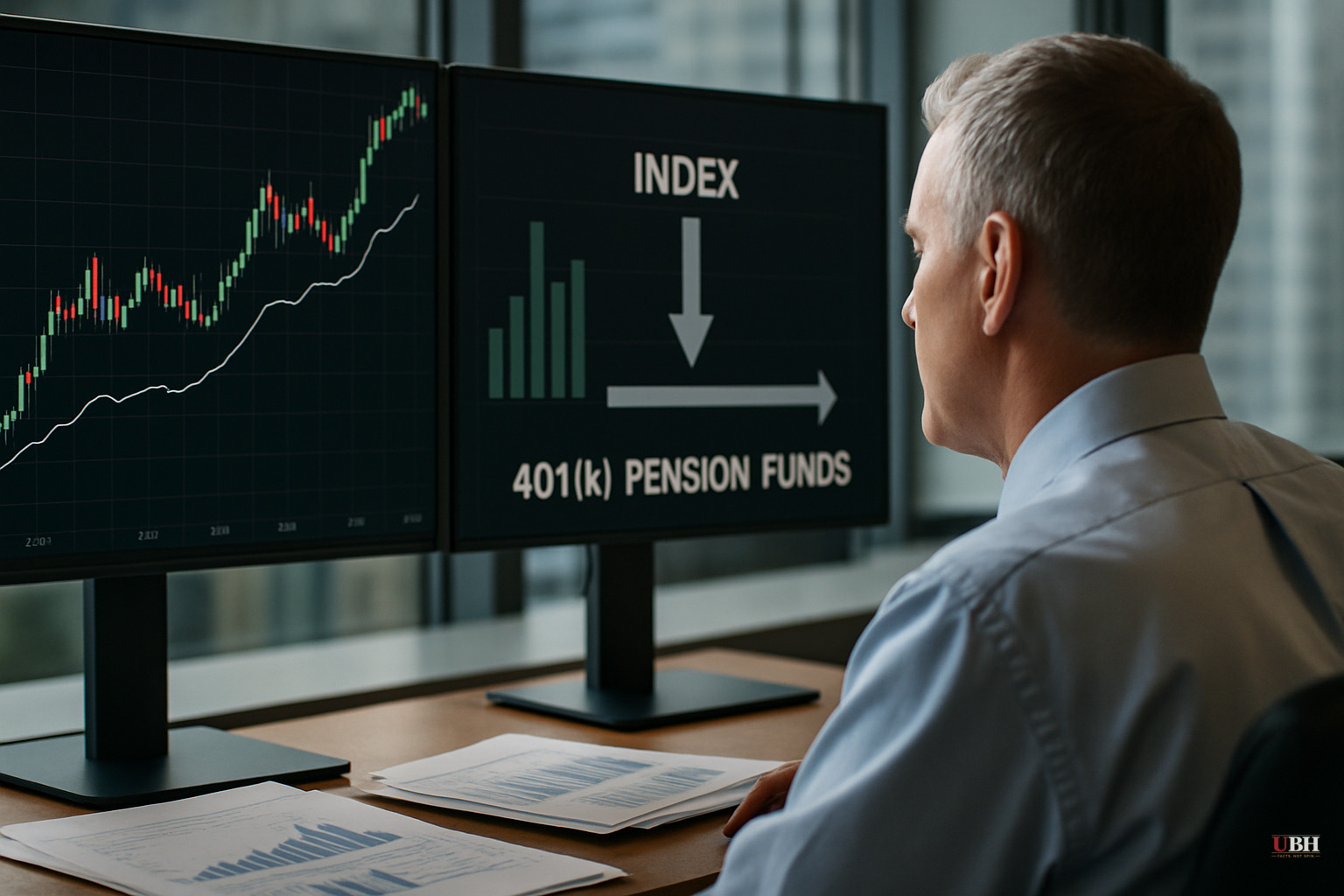
The Conveyor Belt Nobody Talks About
Here is the basic mechanics, stripped of jargon.
A company generates buzz — narrative, scarcity, a compelling founder story. Option activity and momentum traders bid the stock up. Once the market cap is large enough, index committees add it to a major benchmark. The moment that happens, every passive ETF and mutual fund tracking that index is forced to buy it. No discretion. No fundamental review. The price already reflects the hype, and now every American with a target-date fund owns a slice.
Index inclusion, in this framework, is not a quality filter. It is a size filter. Big enough, and you're in. Cash flow optional.
Apollo's Chief Economist Flags the Price Discovery Problem
Torsten Slok, Chief Economist at Apollo Global Management, recently flagged a chart showing companies with negative earnings outperforming companies with positive earnings and called it out plainly: "Something is broken in price discovery."
Slok's observation comes from inside institutional finance, not from a gold-bug newsletter. When a senior economist at one of the largest alternative asset managers in the world says price discovery is broken, it warrants attention from regulators.
SpaceX as the Sharpest Current Example
QTR's Fringe Finance, writing on ZeroHedge, uses SpaceX as the most recent and arguably most extreme illustration of this dynamic. SpaceX is not public. It does not file audited financials with the SEC. Its valuation is built almost entirely on narrative: Starlink subscriber projections, government launch contracts, and what critics describe as a founder premium.
The comparison to earlier cycles matters here. QTR's Fringe Finance notes having seen the same dynamic with Chinese reverse takeover schemes. Hype drove the price, retail and eventually institutional money followed, and then the floor dropped when cash flows didn't materialize.
SpaceX is not a Chinese reverse merger. It has real revenue, real government contracts, and a genuine technological lead in commercial launch. That is the strongest good-faith case for its valuation. The critique, though, is not that SpaceX is a fraud. It is that the valuation methodology used in private rounds relies on projections that the public never gets to scrutinize, and that once those valuations get absorbed into pre-IPO or index-adjacent vehicles, they become reference points for future public pricing without the scrutiny a public filing would demand.
As QTR's Fringe Finance writes, "narrative and scarcity can overwhelm cash economics for a very long time, especially when investors are convinced they are looking at a once-in-a-generation story."
The Retirement Fund Exposure
This is where it stops being an abstract finance debate.
When an overvalued company crosses the threshold for index inclusion, passive ETFs and mutual funds tracking that index are forced to purchase it at whatever price the market has already assigned. No discretion is permitted.
That means the average worker with a 401(k) in a target-date fund has no say. Their fiduciary is contractually required to hold that position. The fund's mandate does not allow it to say "this looks expensive."
The result, as QTR's Fringe Finance frames it, is "a structural conveyor belt for institutionalizing air pockets and gutting the once conservative retirement and pension accounts millions of Americans depend on."
The Mechanism in Three Steps
QTR's Fringe Finance lays out the sequence explicitly:
First, the inflation phase. A company captures the market's imagination with a story large enough to suspend ordinary valuation discipline — AI, autonomous driving, space, or simply the promise of scale and disruption. The story arrives first. Cash generation can show up later, if at all.
Second, the options market amplifies the move. Call buying forces dealer hedging. Dealer hedging forces more buying. The stock rises because the stock is rising. Price momentum becomes its own justification.
Third, index inclusion and passive ownership lock in those elevated valuations and distribute them across the retirement system as "diversification."
The Gap in Current Coverage
The ZeroHedge/QTR piece is the primary public venue running this argument at length right now. Mainstream financial media has covered passive-investing distortions in academic terms but has not run sharp accountability journalism connecting those distortions specifically to retirement fund exposure. The audience most affected, working-class savers, reads neither ZeroHedge nor the financial press.
What Would Change This
Three things could break the conveyor belt: the SEC could impose earnings or cash-flow criteria on index eligibility; index providers like S&P Global could voluntarily raise the bar; or a major market correction tied to an overvalued index constituent could force a political reckoning.
The unresolved question is whether regulators view mandatory passive ownership of overvalued assets as a systemic risk worth addressing before a correction, or only after one. As QTR's Fringe Finance puts it, the market is "no longer merely tolerating excess. It is operationalizing it."
Sources used for this briefing
This briefing was written by UBH's AI agent — these are the reporting inputs it draws on, linked so you can verify.


