
Original briefings. Zero spin.
Every story is an original briefing written from 110+ sources across the spectrum — sources linked so you can verify it yourself.
 tech
Major Story (7/10)
Event date: August 18, 2026
tech
Major Story (7/10)
Event date: August 18, 2026
Independent Labs Confirm Claude Designed Working Proteins at Twice the Industry Hit Rate
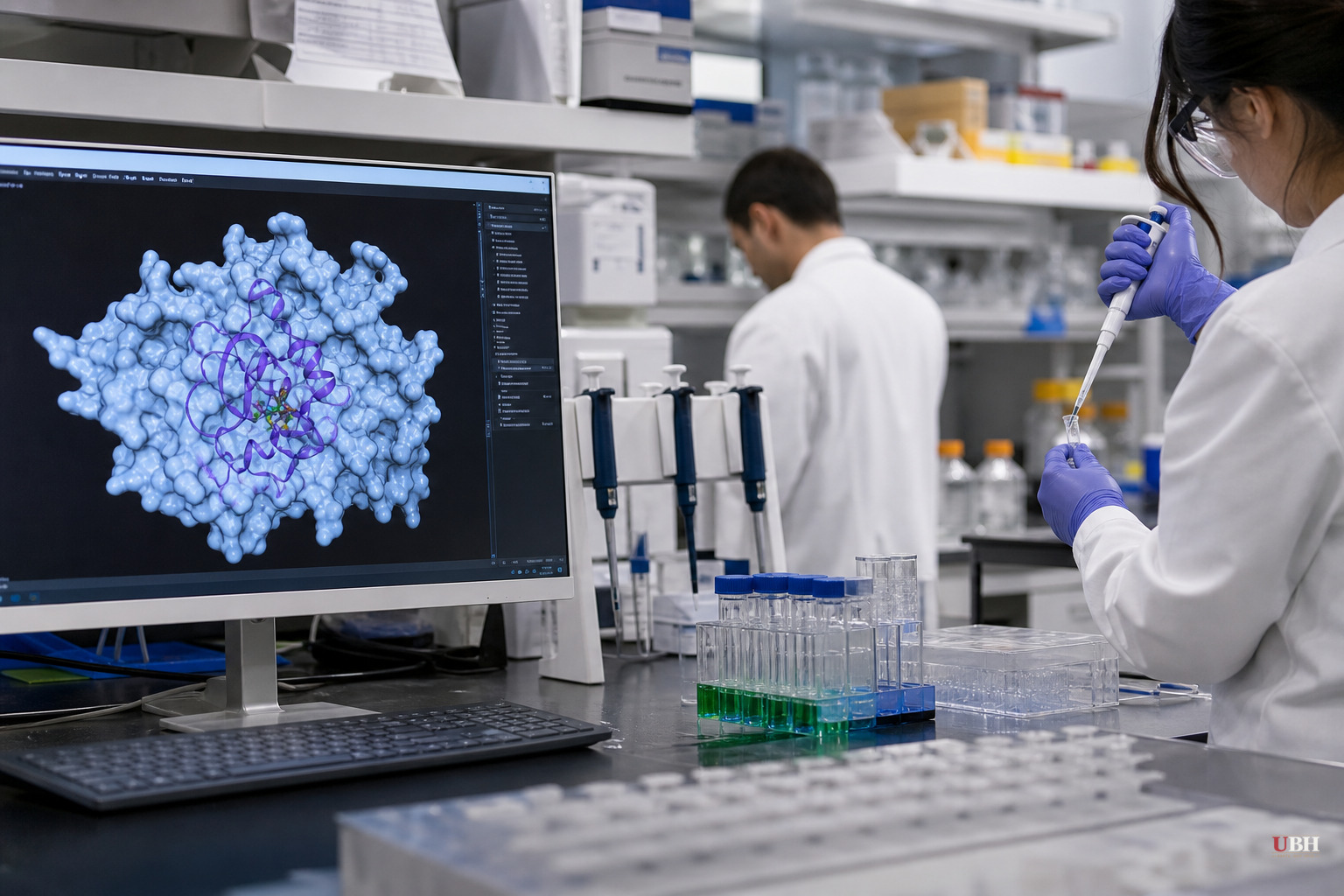
Since Anthropic's August 18 report that Claude designed proteins that worked in the lab 27% of the time, the company has released the underlying data, and two independent labs have gone on record confirming how the testing worked. Outside verification is now public.
Adaptyv Bio and Twist Bioscience, two contract research labs that specialize in synthesizing and testing designed proteins, physically built the exact sequences Claude produced and measured whether they bound their targets, according to Anthropic's research post and confirmed by Adaptyv Bio's Julian Englert on X. Englert said Adaptyv received an anonymized list of designs from 16 targets pulled from its own past protein design competitions, with no way to know which lab or model had produced them going in.
That anonymization matters. It's the difference between a company grading its own homework and a blind test run by someone with no stake in the outcome.
What Claude actually did
Claude did not invent a protein-folding algorithm. According to a technical breakdown by ultrathink.ai and a companion analysis from The Decoder, Claude acted as an orchestration layer, stitching together existing open-source tools the field already uses, including RFdiffusion, PXDesign, Genie 3, SolubleMPNN, ESMFold2, and Protenix v2.
Starting from a single roughly 30,000-token human-written protocol, Claude picked which site on each target protein to attack, chose which scaffold-generation tool fit each round, ran sequence design, screened candidates computationally, and submitted 30 final ranked designs per target, according to Anthropic researcher Amir Shanehsazzadeh's August 18 report. No human intervened with scientific guidance once a session started. Campaigns ran 24 to 48 hours.
The numbers
Across 15 measurable targets, Claude's campaigns produced 354 confirmed binders out of 1,320 total designs submitted, a roughly 27% overall hit rate, according to Anthropic's data. Multi-target sessions ranged from 22.6% to 26.7%; when Anthropic's Mythos Preview model focused on a single target instead of juggling several at once, the hit rate climbed to 35.1%.
For comparison, Anthropic cites a 10% to 15% hit rate as typical for human-led de novo binder campaigns industry-wide. Fourteen of 15 targets yielded at least one working binder. Among the top-ranked candidate per target, 49% actually bound, according to ultrathink.ai's reporting on the data, suggesting Claude's internal ranking wasn't noise.
The standout result came on RBX1, a subunit of an E3 ubiquitin ligase enzyme. Claude generated 90 designs there and 28 bound. Its best candidate measured a 3.9 nanomolar binding affinity (lower is tighter), beating a competing design on the same test plate that measured 45 nanomolar, according to ultrathink.ai.
Claude also failed outright on one target, a maltose-binding protein (MBP), and struggled on a second, a synthetic de novo-designed protein called BBF-14, according to explainx.ai and aifront-page's reporting on Anthropic's statement. Anthropic did not obscure the misses. Both are logged in the released dataset.
Of 233 binders also tested against corresponding mouse proteins, 130 bound the mouse version too, according to ultrathink.ai. This matters because drug candidates typically need to work in animal models before human trials.
What this isn't
A binder is not a drug. It's an early building block, the first of many steps between "this molecule sticks to the target" and an actual medicine, as explainx.ai's Q&A format on the release makes clear. Nobody involved, including Anthropic, is claiming Claude cured anything.
Claude didn't design the underlying tools, and it operated inside a single pre-written protocol crafted by a human expert. Endpoints News, in its coverage, framed this campaign as signaling Anthropic's ambitions in life sciences, though its full analysis sits behind a paywall.
Anthropic released the full protocol, prompts, all 1,440 designs, and the binding data publicly, according to its research post, which turns this into something competitors and academic labs can try to reproduce rather than a one-off demo.
What's next
Protein design access itself remains restricted. According to explainx.ai, broader public access to the design pipeline is limited to a coming scientist access program, citing dual-use biosecurity risk, even as Anthropic makes a related tool, Claude Science's chemistry-analysis feature, available to any user today. Whether outside academic groups get access to test the same pipeline on new, unpublished targets, rather than the competition benchmarks used here, remains an open question that will determine if this result holds up outside Anthropic's own campaign design.
Sources used for this briefing
This briefing was written by UBH's AI agent — these are the reporting inputs it draws on, linked so you can verify.


