
Unbiased headlines. Facts, not spin.
Unbiased Headlines is an independently owned news organization. We bring you the facts, not opinions, written fresh from 110+ named sources. Sources linked so you can verify it yourself.
 economy
Major Story (7/10)
economy
Major Story (7/10)
IMF Chief Georgieva Says Bessent's Growth Plan Can't Fix U.S. Debt Fast Enough
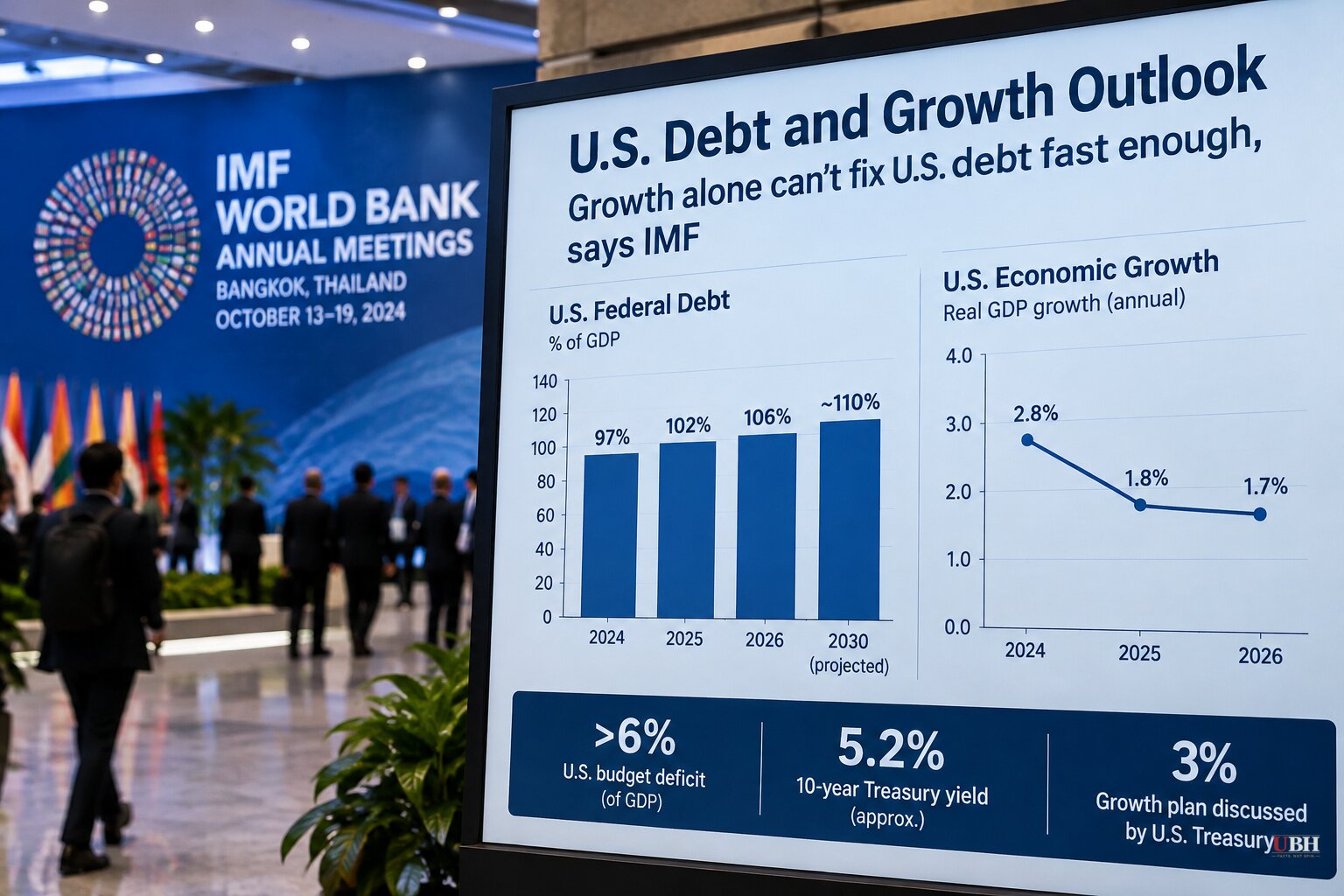
At the IMF and World Bank annual meetings in Bangkok, with rich-world debt as the main theme, the fund's chief has put the United States by name at the center of it.
IMF Managing Director Kristalina Georgieva said at a panel Wednesday, Oct. 14, that Treasury Secretary Scott Bessent's reliance on economic growth to tame the national debt is not enough. "Growth of course helps, but it cannot deliver fast enough the necessary adjustments," she said. "Some [fiscal] measures would be necessary."
She added: "There is no magic. You have to go in a direction of tightening that, bringing it down, bringing deficit down."
Bessent's bet on 3%
Georgieva said Bessent recognizes that federal deficits and debt have grown "too high." But she said "the authorities very much rely on strong growth in the United States" to bring them down.
That is Bessent's stated position. "With 3% growth, we grow our way out of this," he said last month. He has argued that sustained growth above 3%, combined with spending restraint, can bend the debt-to-GDP curve. Administration officials point to the AI build-out, reshoring of manufacturing and tax cuts for consumers as the drivers.
Bessent also said last week, according to BigGo Finance, that "what matters is the debt-to-GDP ratio, and we're going to start bending that curve and bringing it down. That could happen very soon." In August he said the deficit had likely peaked. Before taking the job, he said he wanted the deficit under 4% of GDP by the end of Trump's term.
The numbers behind the warning
U.S. public debt has passed $40 trillion and exceeds 100% of GDP. It is on track to break the record set after World War II.
The Treasury has not yet released figures for the fiscal year that ended Sept. 30. The deficit is expected to top 6% of GDP, up from 5.8% in fiscal 2025.
Benn Steil, senior fellow at the Council on Foreign Relations, put that in daily terms in a Sept. 25 note: at a 6% deficit, "the debt will rise another $7 billion by the end of today—and each subsequent day."
The IMF projects U.S. gross government debt could reach 142% of GDP by 2031, and forecasts U.S. growth of 2.3% in both 2026 and 2027. The Congressional Budget Office projects debt-to-GDP will pass the 106% record by 2030, according to BigGo Finance. CBO Director Phillip Swagel has said stabilizing debt would take 5% to 6% growth, BigGo reported. Economists expect real U.S. growth this year of only slightly above 2%.
Markets are already charging for it
The Treasury market has taken a beating this year. The benchmark 10-year yield hovered near 5.2% on Wednesday, close to its highest level since 2002. Investors are betting that surging energy costs and heavy AI spending will keep borrowing costs elevated.
Higher energy costs tied to the Iran war have also contributed to inflation and multidecade-high interest rates globally, according to the Associated Press.
Spillover to the rest of the world
Rodrigo Valdes, director of the IMF's Fiscal Affairs Department, said "fiscal risks are rising, and a proper reaction is largely absent in many countries." He added: "In major advanced economies, the effect of fiscal indiscipline does not stop at the border. It travels to the rest of the world."
The IMF's latest Fiscal Monitor says interest payments in the world's poorest countries have reached historic highs relative to revenue, while falling aid leaves financing gaps some cannot cover. On average, nearly 10% of government spending in those countries goes to debt repayment.
Alexander De Croo, the former Belgian prime minister who now administers the UN Development Programme, told the Associated Press the median developing country pays three times more in interest costs than developed countries do. "We don't see really a light at the end of the tunnel," he said.
Georgieva also warned of widening global imbalances, saying the U.S. must save more and Europe must invest more, according to BigGo Finance.
Washington's seat at the table
Bessent did not attend the Bangkok meetings; CNBC reported he reportedly missed them to attend to "domestic engagements." BigGo Finance also reports he skipped a G20 finance ministers' meeting he was expected to chair, and says the U.S. delegation was led by Deputy Treasury Secretary Francis Brooke and Under Secretary for International Affairs Erin Browne. The U.S. holds the largest voting share at the IMF.
What comes next
The Treasury's final deficit figures for the fiscal year that ended Sept. 30 are still to come. They will show whether the deficit landed above the 6% of GDP that is widely expected, against the 5.8% recorded in fiscal 2025. The gap between Bessent's 3% growth target and the slightly-above-2% economists expect remains the open question.
Sources used for this briefing
7 links from 6 independent newsrooms (syndicated copies of the same report count once)
These are the sources it draws on, linked so you can verify.


