
Unbiased headlines. Facts, not spin.
Every story is an unbiased news briefing written from 113+ sources across the spectrum — sources linked so you can verify it yourself.
 economy
Major Story (7/10)
September 26, 2026 at 12:41 AM
economy
Major Story (7/10)
September 26, 2026 at 12:41 AM
ICE Raids in Southwest Kansas Cattle Country Delay Beef Shipments, Industry Groups Warn of Price Hikes
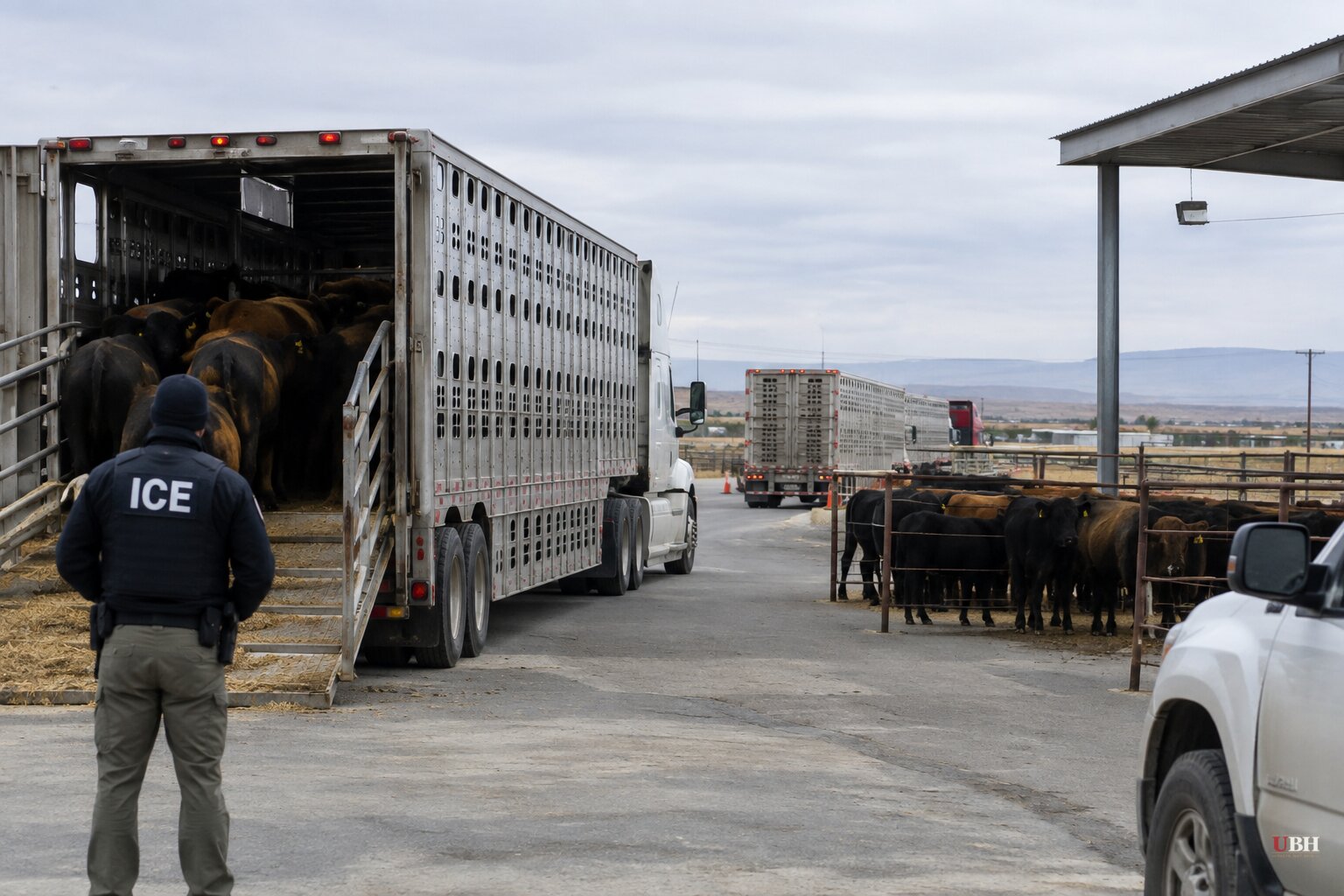
Ground beef hit a record $6.92 a pound this year, according to Fox News, up nearly 60% from five years ago. Beef prices are rising more than twice as fast as overall inflation, according to the Washington Sun. Now the supply chain that gets cattle from pasture to package just took another hit, and this one came from the federal government's own immigration enforcement.
What happened in Kansas
U.S. Immigration and Customs Enforcement ran operations this week in southwest Kansas, centered on Dodge City, Garden City and Liberal, with additional activity reported in Texas and Oklahoma, according to Agri-Pulse. The Kansas Livestock Association, Oklahoma Cattlemen's Association and Texas Cattle Feeders Association released a joint statement Thursday saying the operations delayed shipments of thousands of fed cattle to processors, causing what they called "millions of dollars in lost revenue and additional costs."
Scarlett Mabinger, vice president of communications for the Kansas Livestock Association, told the Associated Press (via 2News) that some plants had to shut down temporarily and send cattle back to feedlots. "So then they're having to be returned back to the feed yard to wait, which, of course, causes an animal health issue, causes financial issues," she said.
National Beef's plant in Liberal adjusted its shift start times because of the ICE activity, according to the Kansas News Service, cited by Agri-Pulse. Cargill and National Beef both run plants in Dodge City, and National Beef also has a plant in Liberal, according to Agri-Pulse. A Kansas State University study cited by Agri-Pulse found the Dodge City Cargill plant can slaughter around 6,000 head of cattle per day, the Dodge City National Beef plant can slaughter 5,800 head per day, and the Liberal National Beef plant can slaughter 6,000 head per day. Empirical Foods runs a ground beef plant in Garden City, and Tyson Foods operates nearby in Holcomb.
Amy Soberanes, a community organizer in Dodge City, told the AP she has been delivering food to residents afraid to leave their homes. "I have seen kids cry to me because their mom and dad are gone," she said. The Kansas Reflector reported that the Dodge City school district urged parents to update emergency contacts and that residents planned demonstrations.
DHS pushes back on the framing
The Department of Homeland Security confirmed its presence in Kansas but said it is not conducting worksite raids, according to 2News. DHS Secretary Markwayne Mullin said in a statement that ICE has been "targeting heinous criminals," though he did not provide a breakdown of how many people were arrested or their criminal histories. Sen. Jerry Moran, R-Kan., said he spoke directly with Mullin and was told the department's warrants are only for arresting individuals charged with criminal activities, according to the Washington Sun and Agri-Pulse.
Cattle groups and local residents describe widespread disruption and, according to one Dodge City city commissioner cited in reporting, people being stopped at random, while DHS says the operation is targeted at criminals with warrants. Neither side has produced arrest numbers or records to settle it publicly.
Sen. Roger Marshall, R-Kan., who faces a competitive re-election race against Democratic challenger Rev. Adam Hamilton, criticized the lack of local coordination. "Law enforcement officers were not given advance notice or the level of cooperation we would expect from ICE's enforcement and removal operations," Marshall said, according to the Washington Sun. Hamilton argued ICE should focus on "serious criminals" and noted that Dodge City, Garden City and Liberal officials said they had no advance notice, with one city commissioner saying people were being stopped at random in the street.
A herd already too small, made harder to rebuild
The raids land on an industry that was already stretched. The national cattle herd has shrunk for years, and the number of beef cows is at its lowest point in decades, according to the Washington Sun, with analysts expecting supplies to stay tight into 2027.
The Trump administration's answer so far has been to import more beef. A temporary order took effect September 1, expanding lower-tariff access for 300,000 metric tons of imported lean beef trimmings, according to Fox News. Fox News reported that Secretary of Agriculture Brooke Rollins has expressed sympathy for cattle ranchers even as the administration pushes the policy, which is meant to ease grocery prices while the domestic herd rebuilds.
Ranchers see it differently. Flooding the market with cheaper imported beef, they argue, pushes cattle prices down at the exact moment producers need higher prices to justify expanding their herds, Fox News reported. Fox also points to structural problems well beyond imports: four companies, two of them Brazilian-owned, now control roughly 85% of American beef processing capacity, up from 36% in 1980. State-inspected beef that meets USDA-equivalent standards still can't legally cross into a neighboring state, according to Fox News, a regulatory quirk that makes it easier in practice to import beef from another continent than to sell it one state over.
So the same ranchers dealing with a shrunken herd, a concentrated processing market and new foreign competition are now also losing shipping days and workers to immigration enforcement, according to the joint statement from the three cattle associations. "These disruptions come at a time of enhanced focus and pressure on the cattle and beef supply chain," the groups said. "They are a costly and unnecessary impact to cattle producers already suffering from unwelcome political interference to both the markets as well as the physical supply chain."
No one has published a number yet on how much this week's disruptions will add to the price of a pound of ground beef. The cattle associations say the effects "last for days and weeks after such operations conclude." Whether Congress or the administration adjusts either the ICE approach, the import tariffs, or the processing bottleneck first is still an open question, and ranchers in Kansas, Oklahoma and Texas are the ones absorbing the cost while it gets sorted out.
Sources: Fox News, Agri-Pulse, americanfarmlandowner, 2News (KMVT)/Associated Press, Washington Sun, newstalkkzrg.
Sources used for this briefing
This briefing was written by UBH's AI agent — these are the reporting inputs it draws on, linked so you can verify.


