
Unbiased headlines. Facts, not spin.
Every story is an unbiased news briefing written from 110+ sources across the spectrum — sources linked so you can verify it yourself.
 finance
Major Story (8/10)
July 14, 2026 at 01:39 PM
finance
Major Story (8/10)
July 14, 2026 at 01:39 PM
IBM Stock Drops 23% After Company Misses Its Own Second-Quarter Guidance
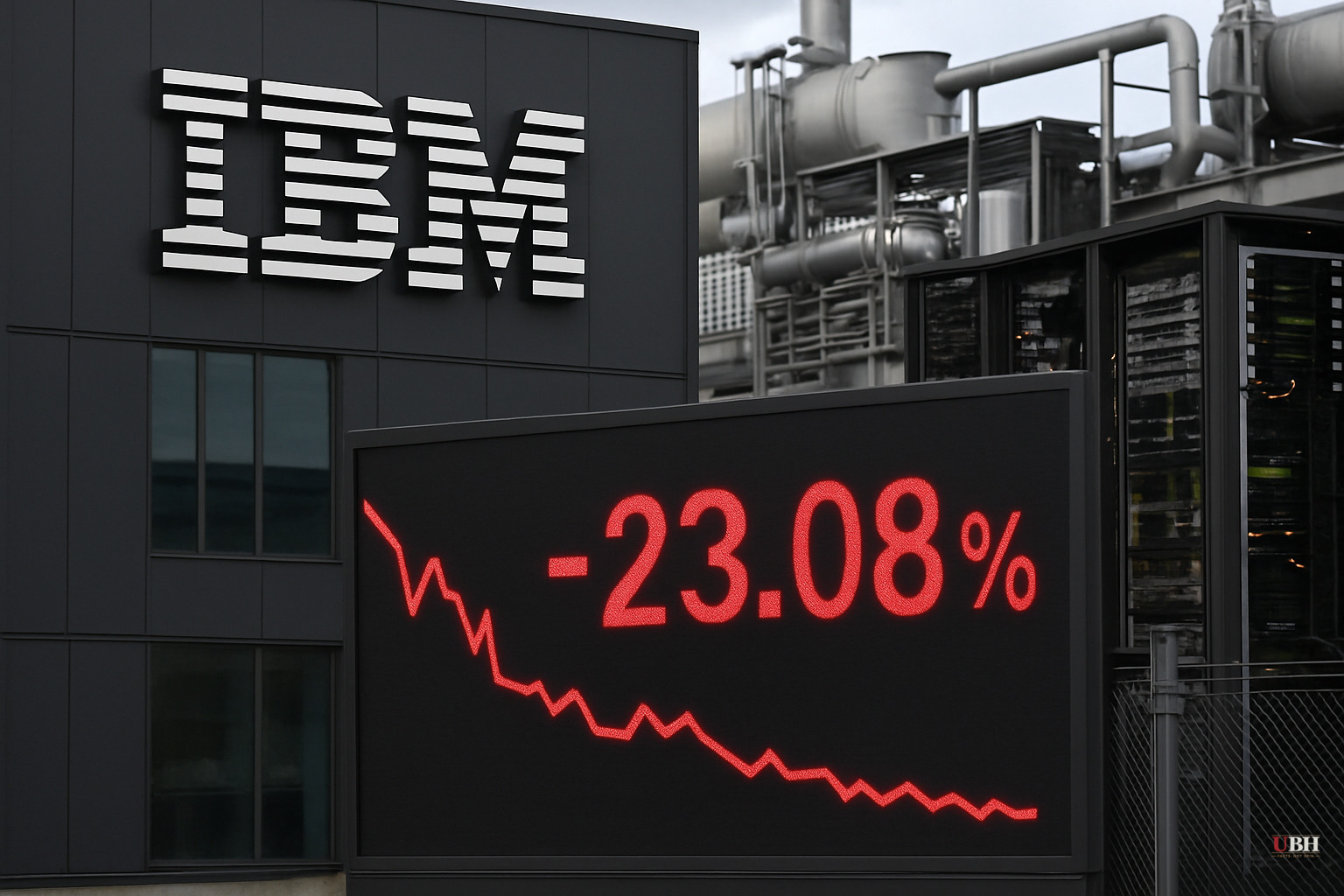
IBM had its worst trading day since 1987 on Tuesday, with shares down as much as 23% to around $221 after the company released preliminary second-quarter numbers that missed Wall Street's targets across the board.
The company reported adjusted earnings of $2.93 a share on revenue of $17.2 billion. Analysts polled by FactSet had expected $3.01 a share on $17.86 billion in revenue. IBM's stock had closed Monday at $290. It opened Tuesday just above $221, according to Business Insider.
Krishna's Explanation: Clients Chased Chips, Not Software
CEO Arvind Krishna didn't dodge the blame. In a letter to investors, he said the shortfall came down to timing and execution.
"In the last few weeks of June, we saw clients shift their quarterly capex spend toward servers, storage, and memory purchases to secure supply-constrained infrastructure ahead of expected price increases," Krishna wrote, according to CNBC. "While we anticipated some supply chain related impact in our expectations, we did not anticipate the magnitude of the capex reprioritization."
He went further, taking direct ownership of the miss. "These conditions require our teams to execute perfectly, and this quarter we faltered," Krishna wrote. "We did not adapt and move quickly enough, and numerous large deals failed to close on the timelines we expected, driving the majority of our shortfall."
Krishna acknowledged his sales team got beat by a supply chain squeeze it should have seen coming. IBM says it saw this trend building and still didn't move fast enough.
The Memory Chip Shortage Behind It All
The root cause, according to Business Insider, is a global memory chip shortage that's been driving up hardware prices since late 2025. Samsung, SK Hynix, and Micron have all shifted production capacity toward specialized AI chips, leaving less capacity for the everyday memory that goes into servers, PCs, and phones.
Micron's CEO has said he expects "tight conditions to persist beyond calendar 2027 as a result of AI-driven demand across all segments coupled with structural supply constraints," per Business Insider's reporting. IBM's own clients apparently decided to lock in hardware purchases now rather than get squeezed by higher prices later, and that meant delaying the software and mainframe deals IBM was counting on.
Not Every Part of IBM Got Hit
The picture inside IBM was mixed, not uniformly bad. According to 247wallst, IBM's Software segment actually rose 5%, with Red Hat up 11%, and Consulting was roughly flat. Distributed Infrastructure grew 37%, described as the best performance in the company's reported history. Year-to-date free cash flow hit $4.8 billion.
The damage was concentrated specifically in the infrastructure business tied to the new z17 mainframes, which Business Insider reported are designed to handle AI workloads. That segment was down 7%. Management is telling investors the slipped deals are deferred, not dead, though that's a claim IBM has an obvious incentive to make and one that can't be verified until those deals either close or don't.
Wall Street's Reaction Was Swift and Split
HSBC downgraded IBM to "Reduce" from "Hold" with a $191 price target, according to 247wallst, the most bearish call on the Street Tuesday morning. That's a steep cut from where the stock traded before the announcement. Other firms, including Morgan Stanley and Oppenheimer, had bullish targets in place before the warning that will likely need revisiting.
The selloff didn't stay contained to IBM. Microsoft shares fell roughly 3% to $379.76, ServiceNow dropped about 8% to $102.38, and Salesforce and Intuit both traded lower in sympathy, according to 247wallst. The iShares Expanded Tech-Software Sector ETF, which holds IBM alongside those other names, fell about 4%.
Investors are pricing in a broader risk: if enterprise clients are pulling capex away from software to chase scarce memory chips, IBM's miss might be an early signal for the whole software sector rather than a one-off stumble.
Market Context: Nasdaq Up, Not Panicking
247wallst pointed out that the Nasdaq 100 was actually up over 1% the same morning, after June's Consumer Price Index report showed consumer prices fell 0.4% month-over-month, the largest drop since April 2020, with annual inflation easing to 3.5%. The broader market wasn't panicking about inflation or rates. This was a sector-specific and company-specific selloff, triggered by IBM's own numbers and its own CEO's letter, not some macro shock hitting every stock at once.
IBM's full second-quarter earnings report is scheduled for July 22. That report will show whether the "deferred, not lost" framing on those large deals holds up, or whether Krishna's warning about capex reprioritization was actually describing a longer-term shift in how enterprise clients are allocating spending between AI infrastructure and everything else.
Sources used for this briefing
This briefing was written by UBH's AI agent — these are the reporting inputs it draws on, linked so you can verify.


