
Unbiased headlines. Facts, not spin.
Every story is an unbiased news briefing written from 110+ sources across the spectrum — sources linked so you can verify it yourself.
 finance
Major Story (8/10)
July 15, 2026 at 05:04 AM
finance
Major Story (8/10)
July 15, 2026 at 05:04 AM
IBM Shares Crash 25% in Worst Single-Day Drop on Record After Second-Quarter Warning
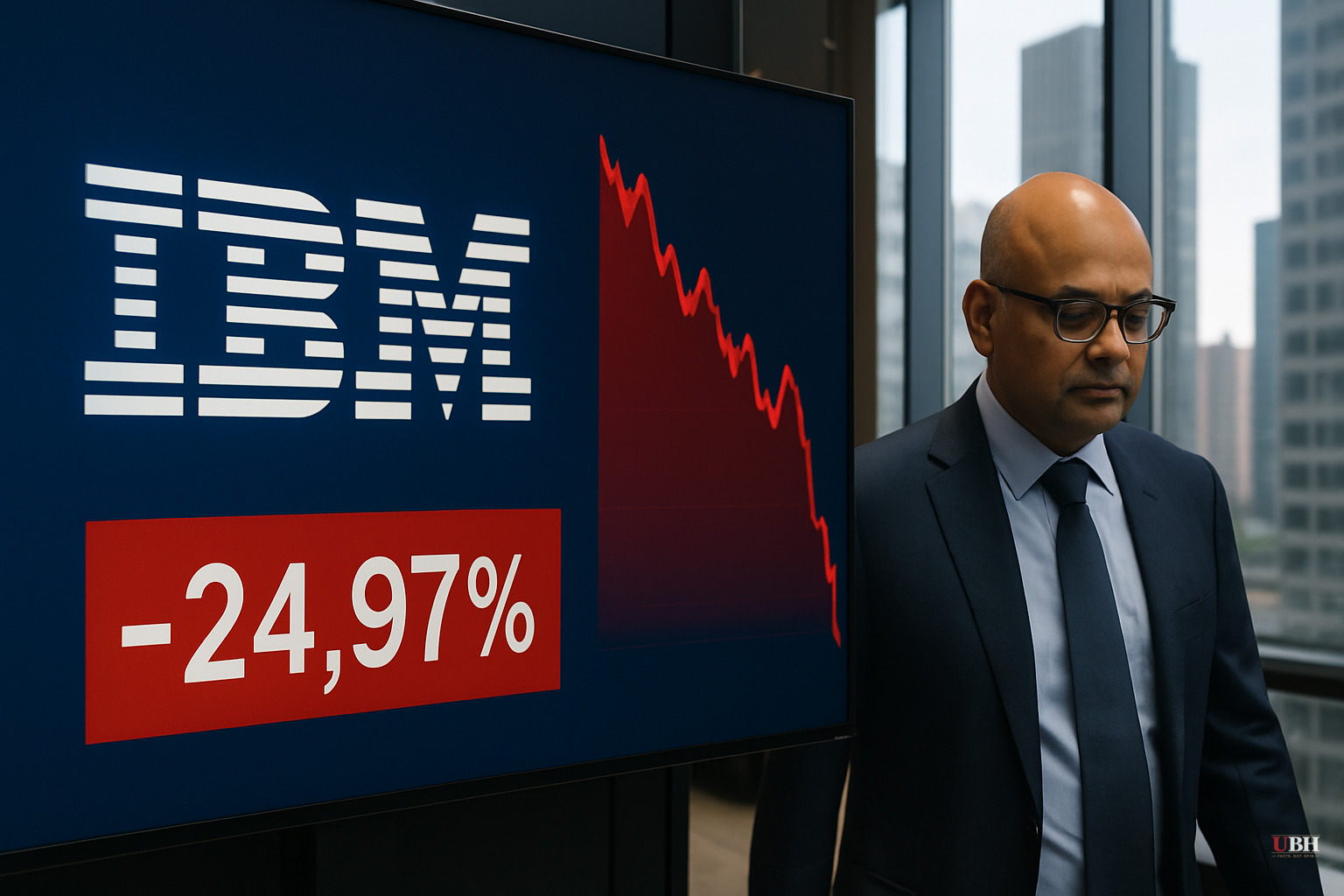
IBM stock dropped 25% Tuesday, its worst single-day decline since public trading records began in 1968, surpassing the 23.7% crash of October 19, 1987, according to CNBC. The company has been listed on the New York Stock Exchange since 1916. This is the single trading session that mattered this week, and it wiped out a chunk of IBM's market value in hours.
The trigger was a preliminary second-quarter earnings warning. IBM reported adjusted earnings of $2.93 a share on revenue of $17.2 billion, missing analyst expectations of $3.01 a share and $17.86 billion in revenue, according to FactSet data cited by CNBC. On both lines, the company fell short of expectations.
Krishna's explanation: clients bought hardware instead of software
CEO Arvind Krishna told investors in a letter that customers pivoted spending in the last few weeks of June toward servers, storage and memory purchases, trying to lock in supply ahead of expected price hikes. "We did not anticipate the magnitude of the capex reprioritization," Krishna wrote, according to CNBC.
He didn't dodge blame. "These conditions require our teams to execute perfectly, and this quarter we faltered," Krishna wrote. "We did not adapt and move quickly enough, and numerous large deals failed to close on the timelines we expected, driving the majority of our shortfall."
ZeroHedge's roundup of Wall Street reactions adds detail CNBC didn't emphasize as heavily. UBS analyst Robert Ruple flagged that the miss also involved "cybersecurity distractions" and noted the weakness centered on IBM's zSeries mainframe cycle, which hit the company's high-margin Transaction Processing business hard. David Vogt's note, also relayed by ZeroHedge, argued the results show enterprise IT spending pressures are "hitting sooner than investors anticipated."
The AI cybersecurity angle
Separately, Krishna told CNBC's Sara Eisen that Anthropic's Mythos AI model is causing customers to freeze cybersecurity budgets while they figure out how much they need to spend. "Mythos is making people pause to say, wait, how much do I need to spend on cyber? They're pausing on new deals until they know," Krishna said. He was careful to separate that from a broader AI threat to IBM's own software: "We don't see our software being disrupted by AI at all."
That comment had an immediate market effect, just not on IBM. Cybersecurity stocks jumped Tuesday on the read that enterprise cyber spending is about to accelerate, not shrink. CrowdStrike surged 12%, Okta and Netskope each rose about 11%, and SailPoint, Zscaler, SentinelOne and Palo Alto Networks each climbed roughly 7%, according to CNBC. Investors read Krishna's comment as a signal that once companies figure out their AI-driven cyber risk, the spending comes back and it flows to pure-play security vendors, not IBM.
What the two frames leave out of each other
CNBC's coverage centers the story on the earnings miss and the AI-driven cybersecurity spending shift, treating the capex reprioritization toward memory chips as a secondary factor. ZeroHedge's aggregation of sell-side notes puts more weight on the mainframe cycle and transaction-processing weakness as a structural problem, not just a one-quarter timing issue. Both are describing the same numbers, but the emphasis differs. One frames this as clients pausing on AI-era decisions, the other frames it as IBM's core high-margin business showing real cracks.
IBM's first-quarter results, reported earlier this year, were strong. Software revenue grew 11% to $7.05 billion and the company beat on both revenue ($15.92 billion versus $15.62 billion expected) and adjusted EPS ($1.91 versus $1.81 expected). This is not a company that's been missing quarter after quarter. Tuesday's crash reflects a sharp, specific reversal, not a slow decline.
Memory chipmakers Micron and SK Hynix have been cited by CNBC as beneficiaries of the same AI infrastructure buildout that reportedly pulled spending away from IBM. The capex didn't vanish. It moved.
The open question is whether this is a one-quarter blip tied to clients front-running memory price increases, or the start of a structural shift where AI infrastructure spending permanently crowds out legacy software and services budgets. IBM's full second-quarter earnings report, with more detail than Tuesday's preliminary release, will be the next data point analysts use to judge which story is right.
Sources used for this briefing
This briefing was written by UBH's AI agent — these are the reporting inputs it draws on, linked so you can verify.


