
Unbiased headlines. Facts, not spin.
Unbiased Headlines is an independently owned news organization. We bring you the facts, not opinions, written fresh from 110+ named sources. Sources linked so you can verify it yourself.
 finance
Major Story (7/10)
Event date: October 29, 2026 ·
HSBC Joins Barclays in Sounding Out Insurers on AI Data Center Loans, Bloomberg Reports
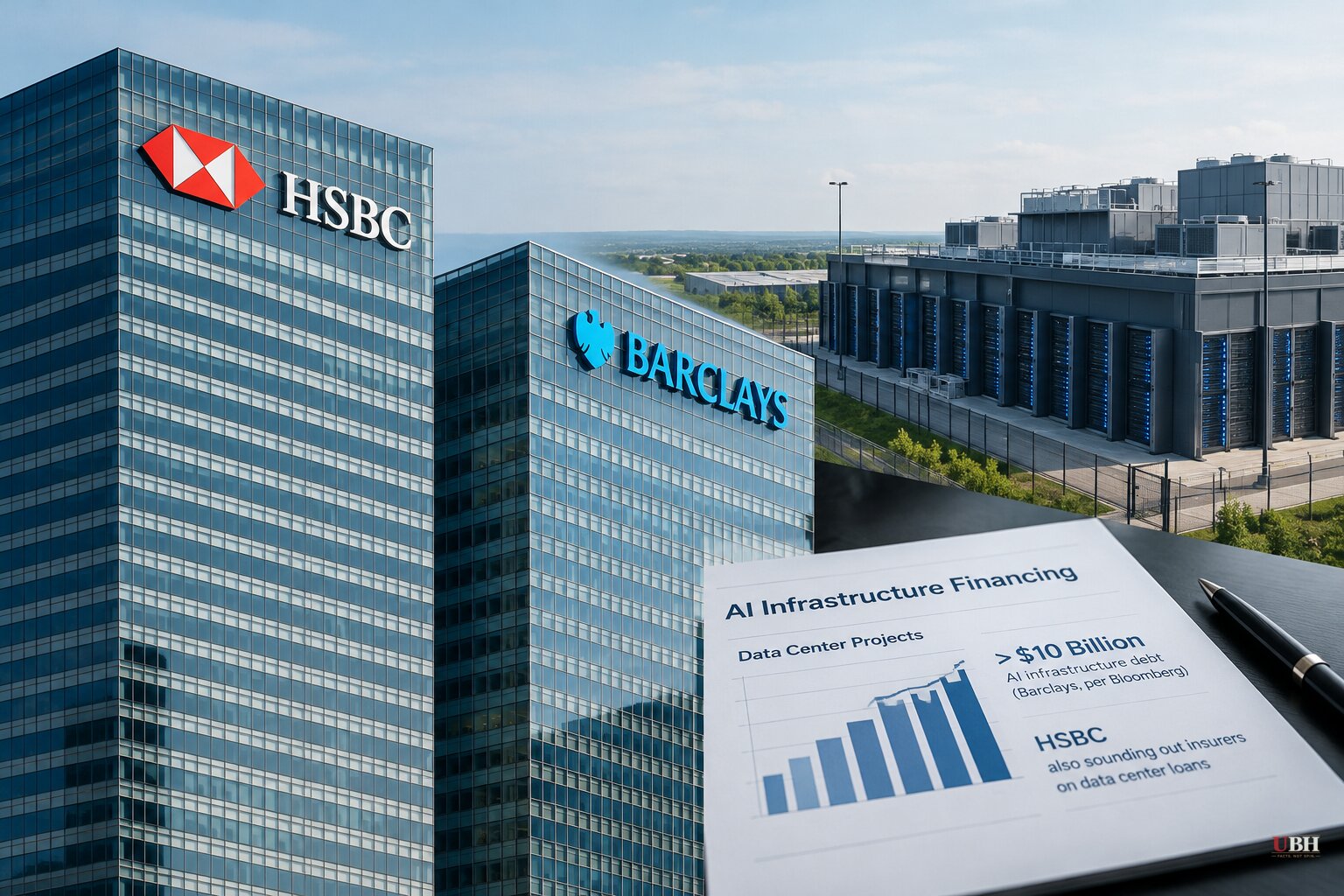
Since Bloomberg reported on Oct. 28 that Barclays was testing insurer appetite for default protection on more than $10 billion of AI infrastructure loans, the list of lenders doing the same has grown. A follow-up Bloomberg report, citing people familiar with the talks, says HSBC is now in preliminary discussions with insurers about credit risk insurance on a series of project finance deals, including loans tied to AI infrastructure.
Size, pricing and participating insurers have not been disclosed. HSBC's talks follow an earlier check on whether insurers would cover a portfolio made up entirely of data center loans.
Barclays, HSBC and Deutsche are all shopping the risk
Bloomberg reported, citing people familiar, that Barclays is targeting coverage that would absorb more than 50% of the credit risk on certain AI-linked facilities. The talks are exploratory, with no decision on size or timing. A Barclays spokesperson declined to comment.
This is not HSBC's first move. Bloomberg reported on Sept. 18 that the bank was discussing a significant risk transfer (SRT) referencing more than $1 billion of loans financing data centers and other AI infrastructure. Terms were still being negotiated at that point.
Deutsche Bank has also been working on an SRT covering roughly €2 billion ($2.3 billion) of project finance debt, including data center loans, according to Bloomberg reporting in September.
The mechanics are simple. Credit risk insurance lets a bank hand a set share of borrower-default losses to insurers in exchange for premiums. That can cut regulatory capital requirements, which frees the bank to write more loans without selling the ones it already holds.
It is a standard tool. Banks also use derivatives, outright loan sales and SRTs to manage exposure. What is unusual is the pile of AI-linked debt being hedged at the same time.
Capacity is the constraint
A Willis Towers Watson survey found credit risk insurers had already increased their participation in data center financing. But capacity looks tight: several non-trade credit insurers indicated they were approaching their sector exposure limits or had already reached their available capacity for data center risks.
A separate Bloomberg investigation published Oct. 28 found that bankers are having a harder time offloading risk to insurers and other investors. Bloomberg spoke with more than 30 bankers, money managers and private equity executives involved in data center financing, and all of them said raising cash is significantly harder than it was months ago.
Bloomberg also reported that yields on some bonds and loans funding the buildout have climbed into double digits. The cost of insuring the debt of companies from Broadcom to SpaceX and Oracle in the credit default swap market spiked to levels more typical of junk-rated borrowers.
Elon Musk warned that hundreds of so-called neoclouds could go under if they are cut off from fresh financing, according to Bloomberg.
The swap market is getting crowded
Figures attributed to Morgan Stanley and Goldman Sachs data show single-name CDS volume on the top ten AI hyperscalers and chipmakers hit a record $140 billion year to date, up 691% from $17.7 billion a year earlier. The same figures put weekly volume at $8 billion to $10 billion, versus roughly $1 billion to $2 billion earlier this year.
Those numbers come from a secondary write-up of bank data, not from the banks themselves, and should be read that way.
CDS is not only a bank hedge. Hedge funds can buy protection on a basket of tech names without owning any of the debt, a bet that spreads widen if AI spending slows.
The case against alarm
Citadel Securities has warned clients that even the biggest tech names could get caught up as they put their balance sheets behind scores of AI projects. But Bloomberg reported that Citadel is not predicting an imminent credit crunch, and that tech giants lined up tens of billions in new financing in the same week.
The firm's concern is about the buyer base. "When you have such a large quantum of debt coming, at some point the challenge could be less about finding an investment-grade backstop, and more about finding the actual buyers willing to absorb more of the risk coming from the same handful of investment-grade backstop providers," said Citadel analyst Tucker Roberts.
Hedging by banks is also what prudent lenders are supposed to do. Transferring risk to insurers is a regulated way to keep lending while limiting concentration, and it does not by itself signal that any borrower is in trouble.
What to watch
Barclays has not set the size or timing of any insurance deal, and HSBC's terms are undisclosed. Whether insurers will take on tens of billions in AI-linked credit risk at prices banks will accept is still unanswered. If that capacity runs out, lenders face a choice: write fewer AI loans, or hold more of the risk themselves.
Sources used for this briefing
6 links from 5 independent newsrooms (syndicated copies of the same report count once)
These are the sources it draws on, linked so you can verify.


