
Unbiased headlines. Facts, not spin.
Unbiased Headlines is an independently owned news organization. We bring you the facts, not opinions, written fresh from 110+ named sources. Sources linked so you can verify it yourself.
 defense
Major Story (8/10)
Event date: November 4, 2026 ·
Houthi Missile Attacks Cancel 94% of Riyadh Airport Departures From Oct. 10 to Oct. 27
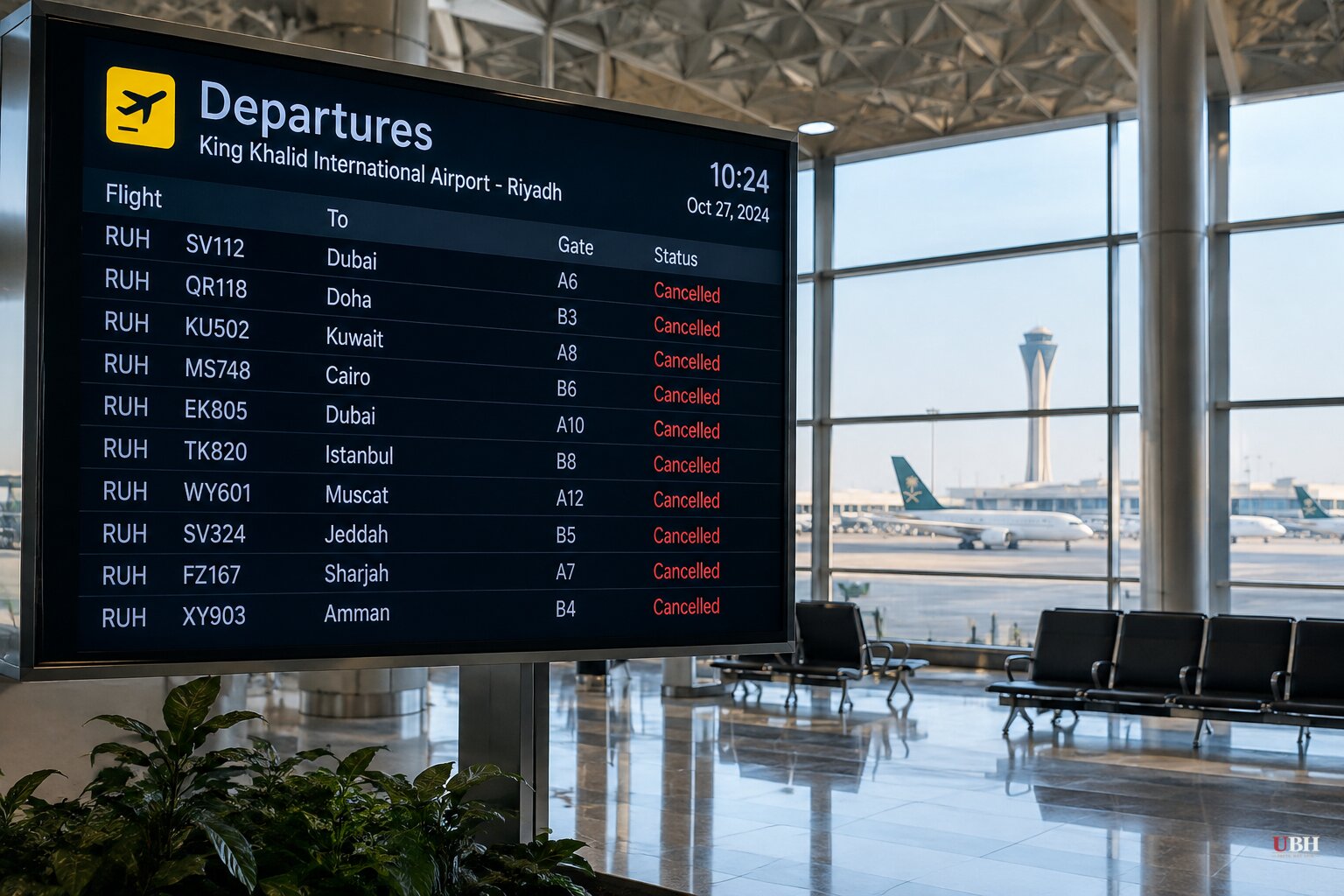
Houthi missiles hit Riyadh's King Khalid International Airport in October, killing more than a dozen people and shutting down the hub. Of the 4,345 flights scheduled to depart between the deadliest strike on Oct. 10 and Oct. 27, about 94% were canceled, according to aviation data firm Cirium.
The Saudi-led coalition said in October that the Houthis had launched 20 attacks on the airport since Oct. 1, and that other Saudi airports were also targeted. Saudi Arabia accuses Iran of waging war against it through the Houthis. One account puts the toll at 14 civilians dead and hundreds injured, with flights suspended until Oct. 18.
A year of cancellations before Riyadh
Riyadh is the sharpest point of a much wider problem. From Feb. 1 through Oct. 27, airlines canceled 26,561 flights at Dubai, Doha and Riyadh, Cirium's figures show. That is five times the number from a year earlier.
Scheduled flights at those three hubs also fell almost 21%. So there were more cancellations of fewer flights.
Abdulaziz Al-Duailej, president of Saudi Arabia's civil aviation authority, told counterparts at a recent meeting in Doha that regional developments had "cast a shadow on the civil aviation sector, air transport traffic, demand levels and operational capacity of airlines."
Who has pulled back
Riyadh Air, Saudi Arabia's youngest airline, moved its operations to an airport about 400 kilometers (249 miles) away. According to its website, it is running a limited schedule until further notice.
Foreign carriers have set restart dates far out:
- Air France extended its Riyadh suspension to Dec. 12. KLM canceled Riyadh and Dammam through Nov. 27.
- Lufthansa Group airlines canceled Riyadh flights until Nov. 18.
- Philippine Airlines extended its Riyadh suspension to Nov. 29.
- Cathay Pacific postponed resuming Hong Kong–Riyadh and Hong Kong–Dubai service to Jan. 31, 2027.
- Singapore Airlines canceled its Singapore–Dubai flights SQ494 and SQ495 until Feb. 28, 2027.
- Delta Air Lines pushed the launch of its Atlanta–Riyadh route to March 2027.
British Airways has also scaled back schedules to Abu Dhabi, Amman, Bahrain, Doha, Dubai, Tel Aviv and Riyadh.
Longer routes, higher costs
Eurocontrol says about 1,150 flights a day have had to take alternative routes since the conflict began. That adds roughly 206,000 kilometers and 28,000 minutes of flying time daily, and burns an extra 602 tonnes of fuel.
IATA projects global airline fuel spending of about $350 billion in 2026, roughly 40% above 2025. IATA Director General Willie Walsh said average jet fuel prices could rise about 70% year on year.
With Western aircraft barred from Russian airspace and flights restricted over Iran, Europe–Asia traffic is squeezed into a few congested corridors. Greece's finance minister, Kyriakos Pierrakakis, had to weigh flying through Frankfurt or Istanbul on his way to the IMF meetings in Bangkok.
The damage reaches well beyond the Gulf. Bangladesh's civil aviation authority said on Nov. 3 that 171 direct and transit flights on Bangladesh–Saudi Arabia routes had been affected, hitting 23,077 passengers. Biman Bangladesh Airlines was the worst hit among direct services, with 45 disrupted.
Iran's warning
Iran has warned that airports, pipelines and other economic targets in Gulf states could be hit if the United States and Israel launch renewed military action against it, according to earlier reports from Iran International. No such action has been announced.
Ameneh Mehvar, a Middle East regional expert at conflict monitor ACLED, said attacks on airports "bring a lot of visibility—the destruction they create—and that's the strategy." She added: "It is not only about the specific costs that they inflict, it's about the impact that will follow."
The case that traffic will come back
Not everyone sees lasting damage. MENA risk consultant Amandeep Kaur Ahuja told EnterpriseAM that airports may expand faster than airline fleets, but she still expects the traffic to arrive, just later than planned. She called higher investor return demands a likely short-term effect of the war rather than a permanent one.
Aviation consultant Garth Lund said travelers will still connect through the Gulf at a good fare. That has let regional carriers keep much of their networks. GCC seat capacity for November is down 11% year on year, he said, mainly because foreign airlines cut back. Emirates plans a 6% capacity cut and Qatar Airways 5%, while Etihad is adding 7%.
The recovery has been uneven. Dubai International handled 31.5 million passengers in the first half of 2026, down 31.3% from a year earlier, though monthly traffic rose from 3.5 million in April to 5 million in June. By May, 51 of the 90 airlines that previously served the airport had returned.
The money already committed
The building plans assume a stable region. Dubai's $35 billion Al Maktoum International Airport expansion is due in 2032 with room for 150 million passengers a year, more than double the roughly 63 million Dubai International is on pace to handle this year. Saudi Arabia is targeting 330 million annual passengers by 2030.
Boeing is adding to the squeeze. The company expects to miss its target of 500 737 deliveries in 2026 and to hand over around 90 787s, the low end of its guidance.
The next test is the restart calendar. Lufthansa's Riyadh return is currently set for Nov. 18, and Air France's for Dec. 12. Whether they hold depends on whether the Houthi strikes on King Khalid stop.
Sources used for this briefing
6 links from 5 independent newsrooms (syndicated copies of the same report count once)
These are the sources it draws on, linked so you can verify.


