
Unbiased headlines. Facts, not spin.
Unbiased Headlines is an independently owned news organization. We bring you the facts, not opinions, written fresh from 110+ named sources. Sources linked so you can verify it yourself.
 defense
Major Story (7/10)
At Least 20 European Flights Hit by Hoax Bomb Threats Thursday; EU Says Too Early to Link Them
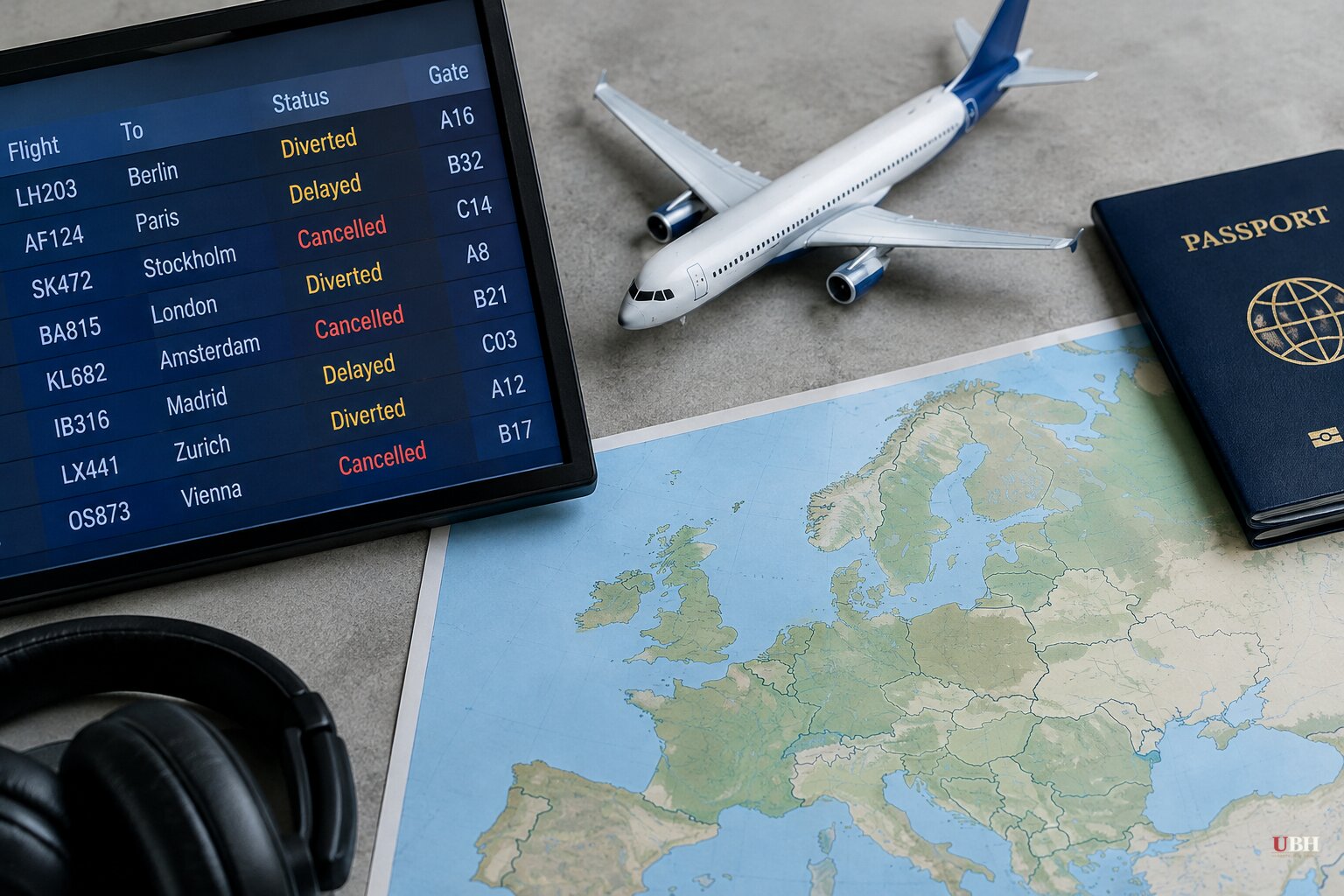
Since Tuesday, Nov. 3, when British authorities dismissed threats against about seven flights as hoaxes, the campaign against European air travel has grown sharply. Counts for Thursday, Nov. 5, vary. CBS News tallied at least 20 flights hit on Thursday and at least 27 across the week. A Reuters-based count put Thursday's total alone at at least 27, with airlines affected from Ireland to Bulgaria. Every threat so far has turned out to be a hoax.
What happened in the air
The most dramatic case involved an Aer Lingus flight from Dublin to Rome. French Prime Minister Sébastien Lecornu's office said it was diverted to the military base at Évreux in Normandy, where all 151 passengers and six crew got off safely. A French Air Force aircraft escorted it, and bomb disposal teams met it on the ground.
In Bulgaria, three Ryanair flights made emergency landings. Flights from Copenhagen and Madrid landed in Sofia, and a flight from London was diverted to Plovdiv, the Bulgarian Ministry of Transport said. The Bulgarian Air Force said MiG-29 fighters escorted all three.
Czech police said four planes bound for Prague had received threats. They assessed the relevance of the threats as "low" but activated security measures anyway. Police later said inspections found no explosives and that measures at the airport had ended.
Finnair said Flight 1761 from Helsinki to Rome was targeted, and nothing was found after it landed. A second Finnair flight, operated by Jettime and bound for Vienna, also received a threat and landed normally. A person familiar with the matter said Italy's air force escorted the Rome-bound flight.
In Poland, a LOT flight from Warsaw to Paris was stopped as it taxied for takeoff, and passengers were moved to another aircraft. A LOT flight from Warsaw to Brussels landed, and inspections found nothing suspicious, the airline said. A Wizz Air flight from Milan landed safely in Bucharest, according to airport spokesperson Teo Postelnicu.
Spanish authorities received three emailed threats covering two Air Europa flights from Madrid to Paris and four Iberia flights heading to Spain from Rome and Milan. Air Serbia was also among the carriers targeted. Heathrow also received a threat, but unlike most of the others it was not treated as credible enough to divert an aircraft.
Part of a longer run
This is not a one-day event. Airlines have now gone three days running with threats, at a smaller scale earlier. On Nov. 2, a Wizz Air plane landed in Budapest under fighter escort. On Nov. 3, a Ryanair flight from Manchester to Murcia was checked by Spanish Guardia Civil officers and a sniffer dog. Polish authorities landed two passenger planes, from London and Copenhagen, and temporarily halted operations at Warsaw-Modlin airport.
At least some of Thursday's threats arrived by email. Beyond that, the content of the messages has not been confirmed.
Who is behind it
No government has attributed the threats to anyone, and no authority has confirmed a link between them. Tzitzikostas said it is too early to say whether the incidents are related and that the Commission is monitoring the situation with affected states and the EU Aviation Safety Agency.
Suspicion has drifted toward Russia anyway. Denmark, Poland and Romania, all affected Thursday, have previously accused Moscow of hybrid attacks. Germany blamed Russia for an August drone attack on Leipzig airport. Britain has blamed Russia in the past and linked Iran to a suspected plot against a U.S. airbase. Both Moscow and Tehran deny involvement.
The BBC reported that an email sent Thursday morning to airport authorities in Rome was signed "Fighters of the Male State." The BBC said the name likely refers to Muzhskoi Legion, an ultra-right Russian group banned by a Moscow court in 2021. The BBC also noted that another group could be using the name, and that as of Thursday evening no hard evidence tied the hoaxes to Russia, Iran or their proxies.
Experts interviewed by CBS and the BBC do not agree on how organized this is. Air transport security expert Paul Mason told the BBC's Radio 5 Live that the threats appear to have been made "in a credible manner across a broad range of airlines," which he said suggests "a very deliberate" effort. David Kaminski-Morrow, air transport editor at FlightGlobal, said the cluster "seems unusual" but that it is "hard to determine the extent to which they might be organized." He added that "the publicity alone could spur further threats unrelated to earlier ones."
Why airlines keep reacting
Kaminski-Morrow noted that under an international aviation convention more than 80 years old, the pilot in command has final authority over a flight's safety. In his words, the business consequences of ignoring a threat that proved to be a hoax "would be prohibitive." That is why a low-credibility email can still put a Rafale or a MiG-29 alongside a passenger jet.
The British government has said the U.K. has "one of the most robust aviation security systems in the world" with processes for "malicious hoax threats."
It is not yet clear whether national police and the EU can trace the emails to a sender. Tzitzikostas has urged national threat-assessment and investigation authorities to work closely with airports, airlines and law enforcement, and an EU-level view on whether the waves are connected has not yet been given.
Sources used for this briefing
8 links from 8 independent newsrooms (syndicated copies of the same report count once)
These are the sources it draws on, linked so you can verify.


