
Unbiased headlines. Facts, not spin.
Unbiased Headlines is an independently owned news organization. We bring you the facts, not opinions, written fresh from 110+ named sources. Sources linked so you can verify it yourself.
 defense
Major Story (8/10)
Bomb Threat Hoaxes Have Hit More Than 30 European Flights This Week; Two Emails Were Signed 'Male State'
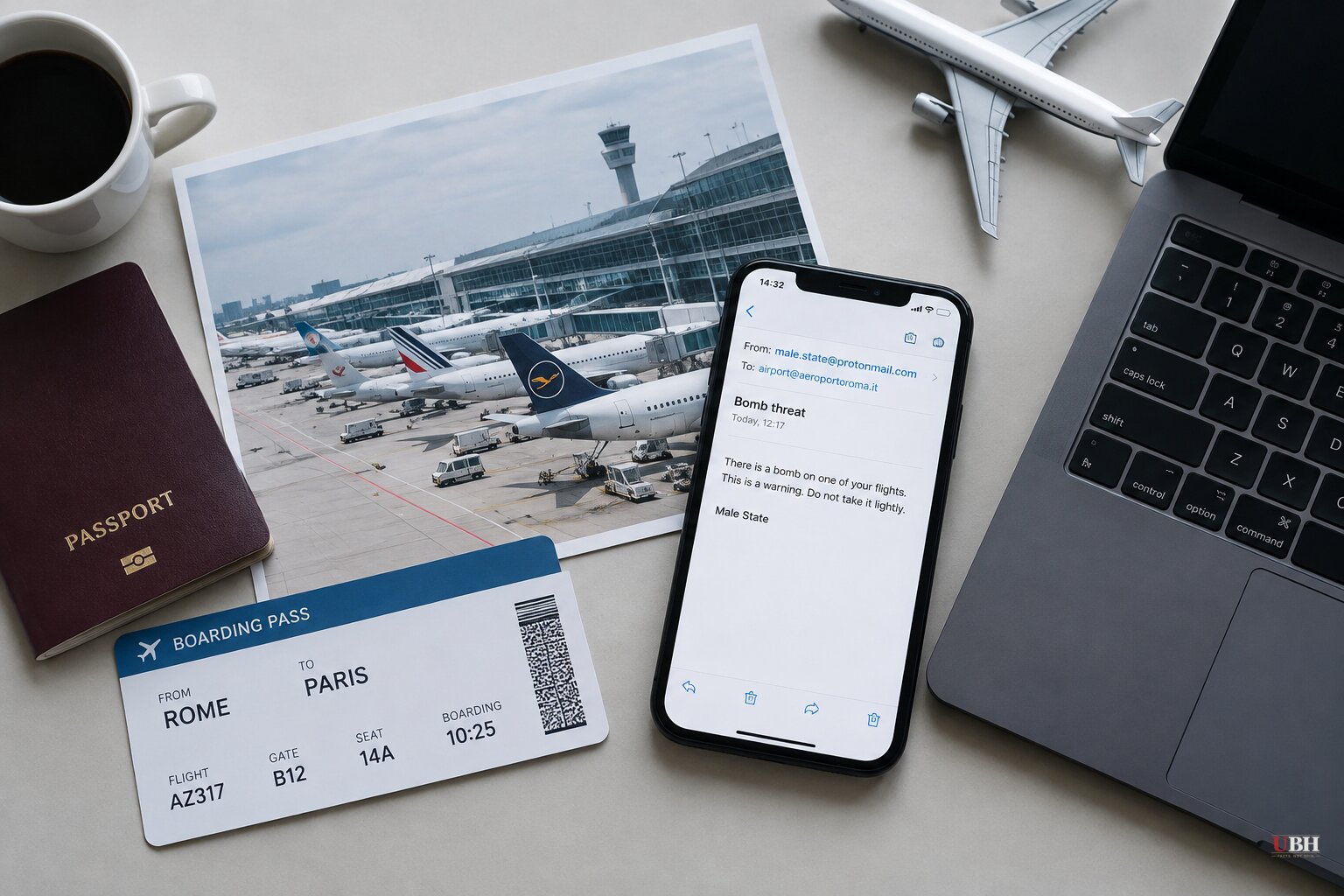
Since a Wizz Air flight from London Luton to Sofia was escorted to Budapest by a Hungarian fighter jet on Monday, Nov. 2, hoax bomb threats against European passenger planes have grown from a single diversion into a continent-wide disruption. The newest detail is a signature: emails sent to airports in Rome and Sofia were signed "fighters of the Male State."
The tally keeps climbing
Counts differ depending on who is doing the counting. The Guardian put the week's total at no fewer than 34 flights, including at least 25 on Thursday, Nov. 5. CBS News counted at least 27 on Thursday. NBC News counted at least 14 airliners at the time of its update.
The Thursday threats touched flights linked to Italy, Ireland, the UK, Spain, Bulgaria, Romania, Poland, Finland, Austria, Denmark, Belgium, Portugal, France, Greece, Serbia and Czechia. Airlines included Ryanair, Aer Lingus, Wizz Air, Finnair, easyJet, Aegean, Iberia, Sky Express, Air Serbia and LOT.
Every flight landed safely. Searches found no explosives.
In Britain, the Metropolitan Police said threats were made against four aircraft departing from or arriving at Heathrow, and Birmingham airport also received a threat. After assessment, police said "no security issues [were] identified."
The 'Male State' emails
The emails to Rome and Sofia were signed "fighters of the Male State," according to sources at Aeroporti di Roma and a text seen by Agence France-Presse. The text reportedly read: "We, the fighters of the Male State, will make history with our actions today. Your feminist regime will remember this for ever. The explosion will occur in 60 minutes. Today, your skies will turn red."
Male State is a Russian far-right, ultranationalist movement founded in 2016 by Vladislav Pozdnyakov, a prominent supporter of the war in Ukraine. Pozdnyakov did not comment on or claim the threats on his Telegram channel.
Two airport officials who spoke to the Associated Press on condition of anonymity said a Rome-bound threat and one received at another European airport both came from a group calling itself anti-feminist and used some of the same language. It was not clear whether the same group sent both.
The Czech angle is different. A representative of Prague's Václav Havel Airport said the threats against four flights bound there came in an anonymous email that other airports also received. Czech police assessed the threats as low risk, and inspections came back negative.
Who is behind it
Nobody has said. Investigators told reporters on Thursday that no evidence shows the hoaxes are orchestrated by a terror group or a state actor such as Russia or Iran, though inquiries across Europe continue.
European officials have blamed Russia and Iran for hybrid attacks and sabotage in recent months, and Russia has denied engaging in hybrid warfare. Europe has also seen attacks on supermarket refrigeration systems, drone incursions and mysterious triggers to alert apps.
EU Transport Commissioner Apostolos Tzitzikostas said it is "too early to draw conclusions on whether the reported incidents are linked." He said "national investigations remain ongoing" and that an EU-level information-sharing mechanism on aviation security had been activated.
Analysts split on how organized this is. Paul Mason, an air transport security expert, told the BBC the threats appear to have been made "in a credible manner across a broad range of airlines," which suggested to him "a very deliberate act." Jacob Funk Kirkegaard of the Bruegel think tank said the threats look like "stress-testing" of how governments and airports respond, aimed at sowing "chaos, uncertainty, about the reliability of air traffic across Europe."
David Kaminski-Morrow of FlightGlobal was more cautious. "The cluster of threats seems unusual, but it's hard to determine the extent to which they might be organized," he said, adding that "the publicity alone could spur further threats unrelated to earlier ones."
The cost and the one rough landing
Philip Baum, a visiting professor of aviation security at Coventry University, estimated each disrupted flight can cost an airline as much as $250,000 once replacement crews, missed connections and knock-on delays are counted. Military escorts are paid for by governments, not airlines.
The most dramatic case was Aer Lingus flight EI402 from Dublin to Rome. A French fighter escorted it to the Évreux-Fauville air base in Normandy, where all 151 passengers and six crew were evacuated while a bomb squad searched the plane.
The office of French Prime Minister Sébastien Lecornu said the pilot had not cooperated with authorities as expected. It did not say why. Aer Lingus said it was working to re-accommodate customers. French aviation security authorities have opened an investigation.
Pilots have the final say on safety under an international aviation convention, which Kaminski-Morrow noted has been in place for more than 80 years. Airlines have little room to ignore a threat even when they suspect a hoax. Finnair spokesperson Stiina Tuunanen said threats are "almost always unfounded."
The International Air Transport Association condemned the disruption. Nick Careen, its senior vice president for operations, safety and security, urged authorities to identify where the threats came from.
It is not yet known whether the Rome and Sofia emails and the Prague email share an author. National investigations are still running, and no authority has confirmed a link between the threats.
Sources used for this briefing
8 links from 8 independent newsrooms (syndicated copies of the same report count once)
These are the sources it draws on, linked so you can verify.


