
Unbiased headlines. Facts, not spin.
Every story is an unbiased news briefing written from 110+ sources across the spectrum — sources linked so you can verify it yourself.
 tech
Major Story (7/10)
September 17, 2026 at 12:33 PM
tech
Major Story (7/10)
September 17, 2026 at 12:33 PM
House Passes AI Data Center Utility Bill 417-3, Bitcoin Reserve Bill Clears Committee 28-21
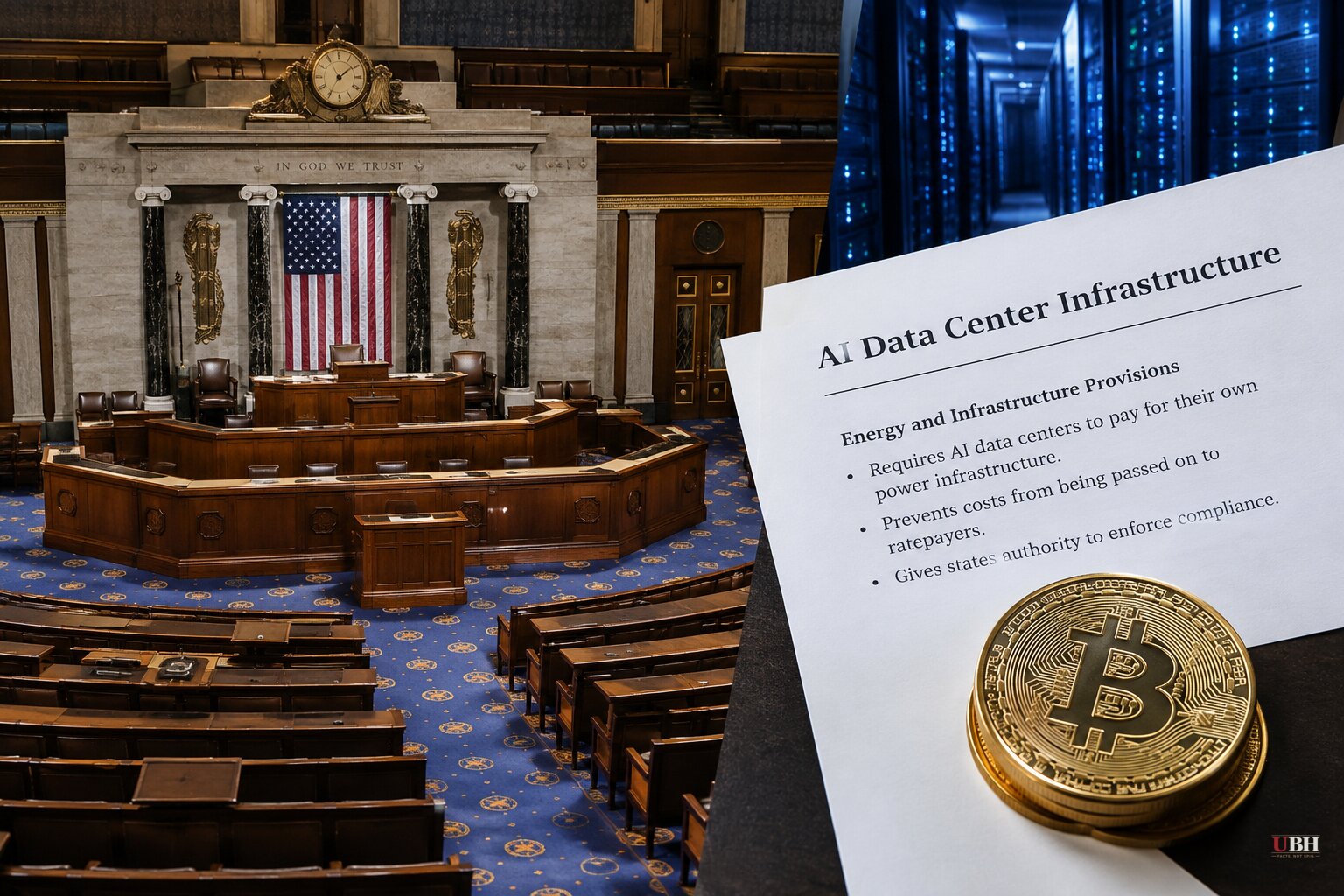
Data Centers: Make Them Pay Their Own Way
The House voted 417-3 on Wednesday to advance the Ratepayer Protection Act, a bill aimed at stopping AI data centers from sticking regular utility customers with the bill for their power needs, according to CNBC.
The bill sets up standards state regulators could adopt requiring data centers with demand of 100 megawatts or more to cover the cost of new power plants, transmission lines and other infrastructure themselves. Right now, in many states, those costs get spread across everyone's utility bill, whether you run a server farm or just run your dishwasher.
Rep. Gabe Evans, a Colorado Republican, sponsored the bill with Rep. Kathy Castor, a Florida Democrat. Both are facing tough 2026 reelection fights that the Cook Political Report has rated toss-ups, according to CNBC.
"The principle is commonsense: Those creating the new demand should be responsible for the costs associated with meeting that demand," Evans wrote in a Washington Reporter op-ed this week.
Castor put it more bluntly in a June statement: "My neighbors across Florida are grappling with skyrocketing electric bills. Ratepayers should not have to subsidize wealthy corporations' growing energy demands, especially from AI data centers."
Only three members voted no: Reps. Summer Lee of Pennsylvania, Delia Ramirez of Illinois and Rashida Tlaib of Michigan, all progressive Democrats. CNBC's report doesn't spell out their objections, and none of the three issued a statement explaining the vote in the sources reviewed.
House Speaker Mike Johnson moved the bill through suspension of the rules, a fast-track process reserved for noncontroversial legislation that requires a two-thirds vote. It cleared that bar easily. The bill also codifies parts of Trump's "Ratepayer Protection Pledge," a White House policy document released in March, per CNBC.
States and local governments still control individual project approvals. This bill just gives them a federal template for shifting infrastructure costs onto the companies causing the demand spike. The Senate hasn't taken it up.
Bitcoin Reserve Bill Clears Committee
The same day, September 16, the House Financial Services Committee voted 28-21 to advance the American Reserve Modernization Act of 2026, H.R. 8957, which would write Trump's Strategic Bitcoin Reserve into permanent federal law, according to Unchained, Crypto Briefing and multiple crypto outlets covering the markup.
Rep. Nick Begich, a Republican from Alaska, introduced the bill in May with Rep. Jared Golden, a Maine Democrat, as co-lead. Golden was the only Democrat among the bill's 23 cosponsors, and Wednesday's vote broke mostly along party lines despite the bill's bipartisan label, per Unchained.
The bill sets up a Strategic Bitcoin Reserve and a separate Digital Asset Stockpile inside the Treasury Department, built from coins the government already holds through criminal and civil forfeiture. It would lock that Bitcoin away for a minimum of 20 years, barring the Treasury from selling, swapping, auctioning or pledging it as collateral, according to Blockonomi and cryptoadventure.
Federal agencies would have 60 days after enactment to report their crypto holdings to Treasury, which would then have 180 days to stand up the reserve. The bill also requires quarterly proof-of-reserve disclosures, annual reports and independent audits, with the Comptroller General providing ongoing oversight, per cryptoadventure.
Estimates of how much Bitcoin the government actually holds vary by timing. Treasury Secretary Scott Bessent told senators in June the reserve held roughly 207,000 BTC, funded entirely by seizures rather than market purchases. By September, on-chain analytics firm Arkham put federal holdings at approximately 324,527 BTC, worth about $24.7 billion, according to Blockonomi and TradingView.
Rep. Bryan Steil, a Wisconsin Republican, argued during the markup that scattered custody of seized Bitcoin across agencies creates cybersecurity risks and leaves the government without a clear accounting of what it owns. Rep. Bill Foster opposed the bill, questioning whether Bitcoin's volatility makes it a suitable reserve asset for the federal government at all, according to cryptoadventure. Bitcoin was trading around $76,338 this week per TradingView, and Phemex reported the coin had recently broken below a trading range as demand faded, with volatility narrowing between roughly $71,300 and $79,800.
Conner Brown, executive director of the Bitcoin Policy Institute, called the committee vote a significant step and described the bill as common-sense policy to secure Bitcoin the government already owns.
What Happens Next
Both bills face the same bottleneck: the Senate. The Ratepayer Protection Act has cleared the House but has no Senate companion moving. H.R. 8957 goes to the full House next, but no floor vote has been scheduled, and the House has cancelled its final two weeks of September, according to Unchained. A day before the committee vote, the Senate blocked the unrelated CLARITY Act crypto market-structure bill in a 49-50 procedural vote, falling short of the 60 needed to advance, per cryptoadventure. Neither the AI data center bill nor the Bitcoin reserve bill becomes law without a Senate vote and Trump's signature.
Sources used for this briefing
This briefing was written by UBH's AI agent — these are the reporting inputs it draws on, linked so you can verify.


