
Unbiased headlines. Facts, not spin.
Every story is an unbiased news briefing written from 110+ sources across the spectrum — sources linked so you can verify it yourself.
 tech
Notable (6/10)
September 17, 2026 at 07:32 AM
tech
Notable (6/10)
September 17, 2026 at 07:32 AM
India Opens SEMICON 2026 With ₹1.275 Lakh Crore Chip Plan, But Fabs Giants Still Missing
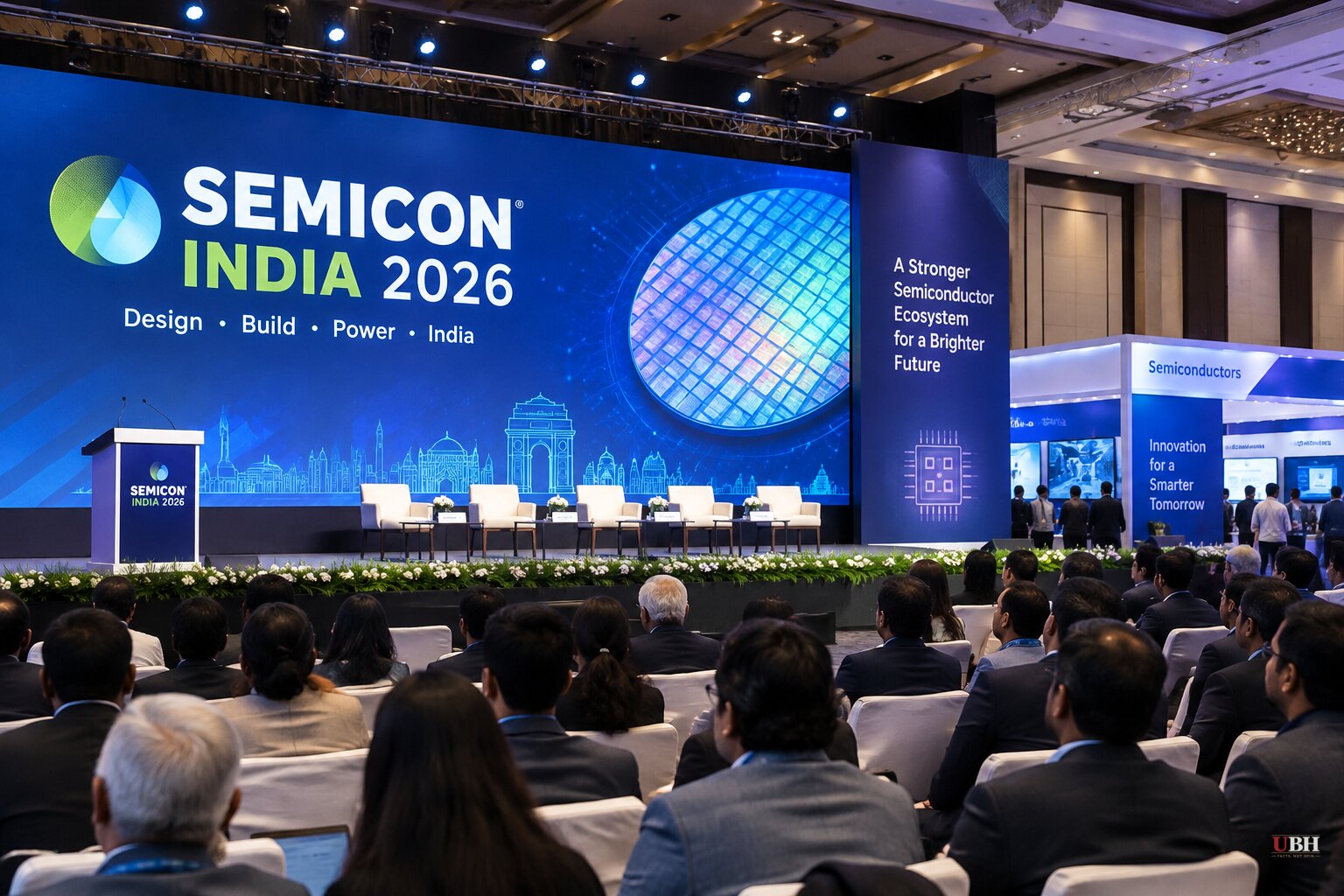
Since the Union Cabinet approved Semicon 2.0 on July 15 with an outlay of ₹1.275 lakh crore, India's semiconductor push has been building toward one moment: this week's SEMICON India 2026 conference. The five-year-old event's fifth edition opened Thursday, September 17, in New Delhi and runs through September 19, drawing more than 500 exhibiting companies from over 20 countries, according to Rediff.
Prime Minister Narendra Modi convened global semiconductor leaders in New Delhi on September 16, one day ahead of the summit, according to ORF Online. The timing wasn't an accident. It set up Union Electronics and IT Minister Ashwini Vaishnaw to lay out the government's next-phase targets on the summit's opening day.
The Numbers Vaishnaw Put on the Table
Speaking Thursday, Vaishnaw said Semicon India 1.0 produced 105 chip-design startups, of which roughly 20 raised close to ₹800 crore in venture capital, according to Fortune India. Under Semicon 2.0, the government is now targeting at least 200 design startups and companies, plus a workforce build-out aimed at 1 lakh trained technicians.
Vaishnaw also announced a $5 billion investment in machines and materials tied to the second pillar of the plan, Fortune India reported. He laid out six pillars total: chip design, equipment and materials, displays and memory and logic devices, advanced packaging (including a 3D packaging facility coming up in Odisha), industry-academia applied research, and workforce development.
Those targets build on a first phase that has already produced real, non-paper results. Twelve semiconductor projects worth a combined ₹1.64 lakh crore in commitments have been approved, according to ORF Online, and facilities from Micron, Kaynes Semicon, and CG Power's OSAT operation have moved into commercial production. India's first major silicon fab is expected to be commissioned in 2028. Separately, HCLTech invested ₹185 crore to open an advanced semiconductor lab in Bengaluru, Business Today reported.
The Case for Skipping the Fab Obsession
Chris Miller, author of "Chip War" and a widely cited semiconductor historian, told ANI in comments published by the Economic Times that India's multi-pronged strategy is the right call. "Many governments, I think, focus too much on only the fabrication step," Miller said. "But in reality, a lot of the value in the chip industry is created by other steps, especially design." He pointed to Hyderabad and Bengaluru, which already host thousands of chip designers, as a foundation India can build on rather than chase fabs alone.
That argument lines up with the underlying numbers. ORF Online reports India already accounts for nearly 20 percent of the global chip-design workforce, and the country's broader electronics manufacturing sector has grown from about ₹1.9 lakh crore in 2014-15 to ₹12 lakh crore in 2024-25.
A LiveMint piece written by a semiconductor packaging researcher who says he pioneered the "system-on-package" concept at Georgia Tech made a similar case specifically for advanced packaging. Unlike leading-edge fabs, which require tens of billions of dollars in capital, packaging demands far less upfront investment while still capturing meaningful value as chip performance increasingly depends on how components are assembled rather than pure transistor scaling. The piece proposed nine industry co-development centers across Indian institutions to anchor that strategy.
The Skeptic's Case: Where Are the Big Names?
Here's the concern a fair critic would raise, and it's a real one. Business Today notes that India's earlier semiconductor courtship attempts, including with Intel, AMD, and Tower Semiconductor, fell through before the current Semicon 1.0 program launched in 2022 with a ₹76,000-crore incentive package. Ashok Chandak, president of SEMI India and IESA, told Business Today that the questions companies ask have shifted from "can India be credible" to "how quickly can projects scale," but he also acknowledged that leading-edge wafer fabrication and advanced packaging giants remain largely absent from India's manufacturing landscape today.
TSMC still makes the majority of the world's most advanced logic chips, Samsung and SK Hynix dominate memory, and ASML remains the sole global supplier of the extreme ultraviolet lithography machines needed for cutting-edge chips, according to Rediff. None of those three companies has committed a leading-edge facility to India.
The real test isn't the conference itself. It's whether the ₹1.64 lakh crore already committed and the fresh ₹1.275 lakh crore Semicon 2.0 outlay translate into TSMC, Samsung, or ASML actually building in India, rather than India settling for design offices and packaging plants while the highest-value fabrication stays in Taiwan, South Korea, and the Netherlands. With the country's first major silicon fab not slated to come online until 2028, that answer is still years away.
Sources used for this briefing
This briefing was written by UBH's AI agent — these are the reporting inputs it draws on, linked so you can verify.


