
Unbiased headlines. Facts, not spin.
Every story is an unbiased news briefing written from 110+ sources across the spectrum — sources linked so you can verify it yourself.
 tech
Notable (6/10)
September 17, 2026 at 05:07 AM
tech
Notable (6/10)
September 17, 2026 at 05:07 AM
Nonprofit Report Says AI Data Center Boom Could Triple Global E-Waste by 2050
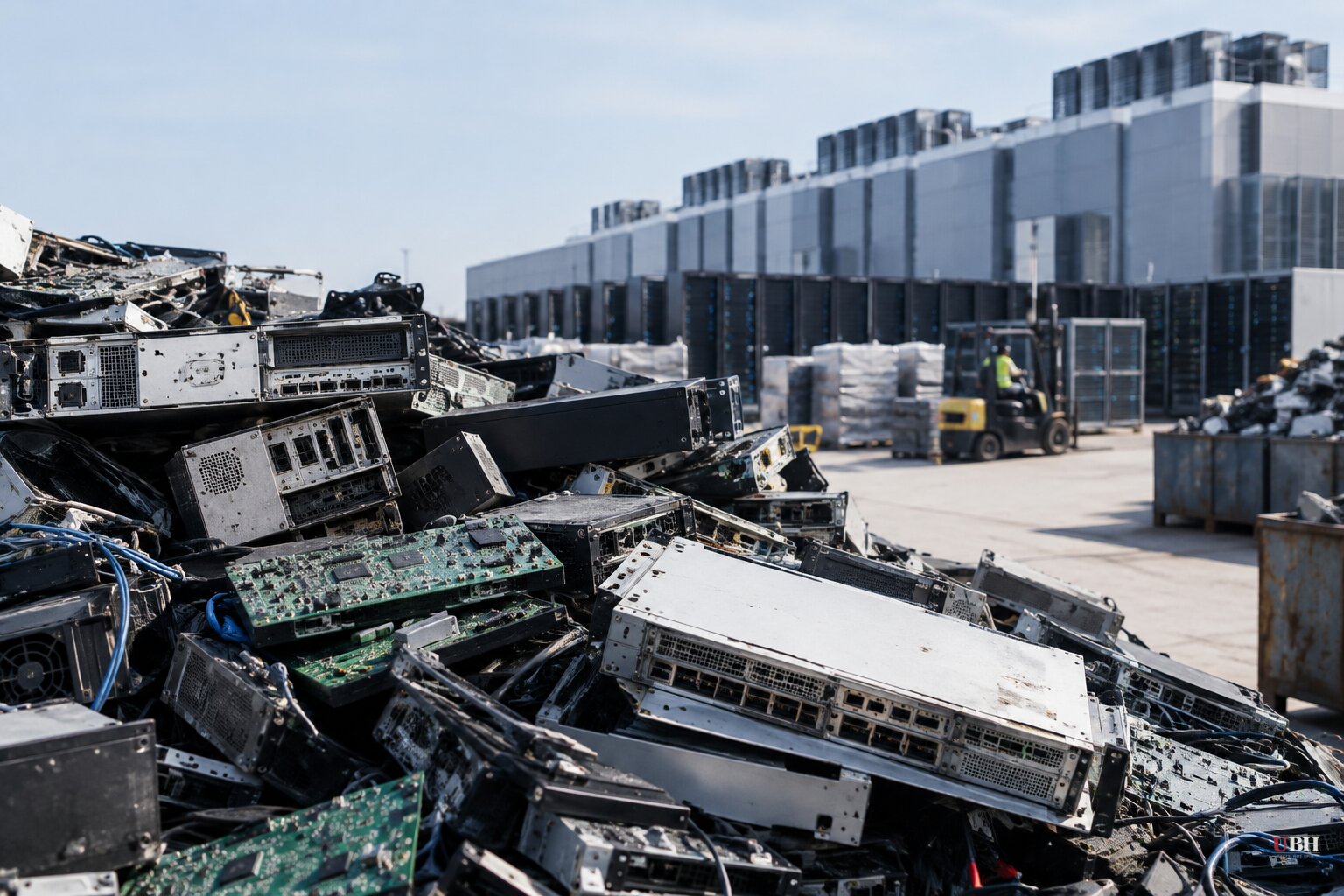
A nonprofit group says the AI boom is about to create a garbage problem nobody is planning for. The Basel Action Network (BAN) published the first part of a four-part white paper series called "The Coming AI Waste Wave" on Wednesday, September 16, and the numbers are big.
BAN projects that AI-driven electronic equipment retirement could hit 8.6 to 13.1 million metric tons a year by 2030. By 2050, the group says total AI-related e-waste could reach 395 to 617 million metric tons, enough to fill 23 million shipping containers. Lined up end to end, according to BAN, those containers would circle the globe roughly six times.
"AI may feel weightless, but every model depends on an enormous amount of highly specialized, cutting edge hardware," said Jim Puckett, BAN's founder and chief of strategic direction, in a press release cited by The Verge. "If companies and governments do not begin planning for this new waste tsunami, today's AI buildout could become an even more cataclysmic toxic waste crisis than we are already experiencing."
Why BAN's number is so much bigger than everyone else's
Previous studies looked mainly at servers and GPUs. A 2024 study estimated AI e-waste at 1.2 to 5 million tons by 2030. Another study from February 2026 put AI server waste at 131,000 to 225,000 tons annually by the end of the decade, comparable to the total e-waste of a country the size of Denmark, according to Career Ahead Online.
BAN says those studies miss about 87 percent of a data center's electro-mechanical infrastructure. Its own count adds power distribution, cooling systems, backup power, networking gear, and cabling. It also adds a category it calls "AI Waste Contagion," which covers phones, PCs, and telecom equipment that BAN assumes will get replaced early because of AI's rising computing demands.
Eurasia Review reports the gap is stark: BAN's estimate runs 40 to 60 times the most widely cited academic projection for AI e-waste. That's a scope difference, not a factual dispute between studies. BAN counted more categories of hardware, so it got a bigger number.
The math behind the projection
BAN's model starts with industry construction plans. It cites McKinsey's estimate of nearly $7 trillion in AI infrastructure capital spending between 2025 and 2030, and roughly 100 gigawatts of new global computing capacity by 2030, growing toward 219 gigawatts, according to Eurasia Review. From there, BAN calculates roughly 70,000 metric tons of e-waste per gigawatt of data center capacity, based on server racks weighing about 1,360 kilograms each, plus switches, cabling, and other equipment, according to The Guardian.
The Guardian also reports 4,871 new data centers are currently in the US construction pipeline, though not all are explicitly AI-designated.
A key assumption drives the whole forecast: BAN assumes most of this hardware gets replaced every two to five years rather than repaired or reused. That assumption is doing a lot of work. NotebookCheck noted that BAN's "figures are projections, not measured outcomes, and depend on assumptions about the pace of data-center construction and how often operators replace their equipment." Nobody has measured actual AI-driven e-waste at 2050 scale, because 2050 hasn't happened.
The part that's already a fact, not a projection
While the AI-specific numbers are forward-looking estimates, the underlying e-waste system BAN is worried about is already broken today. Less than a quarter of the 68.3 million tons of e-waste the US generates each year gets formally collected and recycled, according to The Verge. Globally, only about one-fifth of e-waste is properly managed, BAN says, with the rest often burned or buried in informal recycling operations abroad that expose workers, including children according to the World Health Organization, to lead and chromium.
The US has not ratified the Basel Convention, the international treaty limiting hazardous waste trade, and US recyclers still ship e-waste overseas where it ends up in unregulated "backyard recycling," according to investigations cited by The Verge.
"We're doing a terrible job of handling e-waste in the US," Vince Beiser, author of the book Power Metal, told The Guardian. "Some of it gets dumped overseas. Most of it just gets dumped in landfills, which is a problem because it can leach all kinds of nasty things into the water, into the soil."
A reasonable skeptic could argue BAN's 2050 numbers are speculative and built on assumptions the industry could easily falsify by designing hardware for longer service lives or building domestic recycling capacity, something tech companies have financial incentive to do given the cost of the metals inside this gear.
BAN says PFAS contamination in AI hardware will be the subject of Part 3 of its white paper series. No date for that release has been announced. The unresolved question is whether data center operators, chipmakers, and US regulators start building recycling and reuse infrastructure now, or wait until BAN's projections either prove out or prove wrong.
Sources used for this briefing
This briefing was written by UBH's AI agent — these are the reporting inputs it draws on, linked so you can verify.


