
Unbiased headlines. Facts, not spin.
Every story is an unbiased news briefing written from 110+ sources across the spectrum — sources linked so you can verify it yourself.
 tech
Major Story (7/10)
Event date: June 16, 2026
tech
Major Story (7/10)
Event date: June 16, 2026
California Signs 15 AI and Youth Safety Bills While a Bill Banning Robo-Firings Still Awaits Newsom's Signature
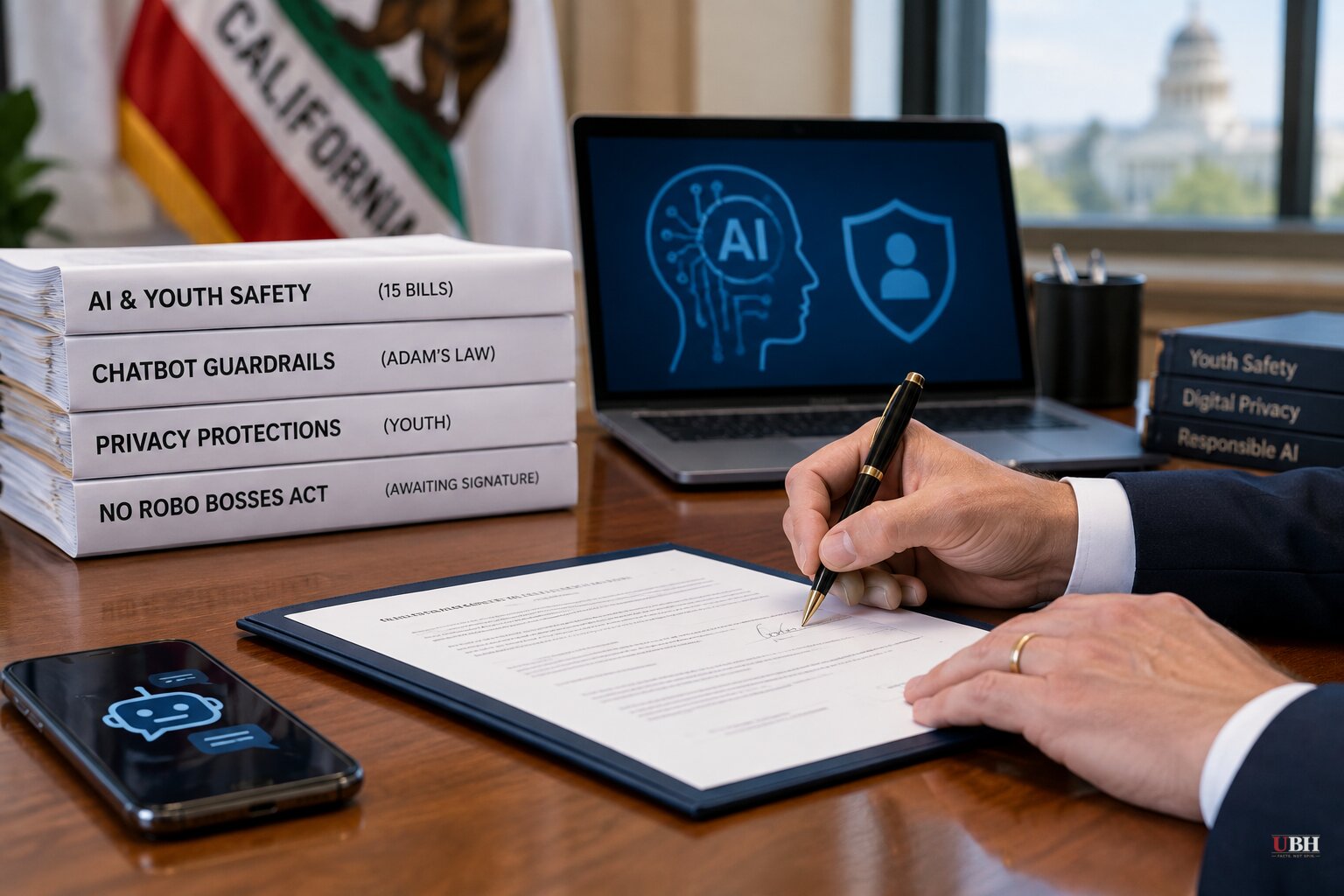
California Governor Gavin Newsom signed 15 bills addressing artificial intelligence, online youth safety, and privacy on September 16, according to the law firm Freshfields. The package expands a legal framework the state has been building for years and lands as Congress's own effort to override state AI rules remains stalled.
The headline measure is SB 1119, known as Adam's Law, which expands California's existing AI companion chatbot statute, SB 243. Starting July 1, 2027, chatbot operators must determine a user's age under the state's Digital Age Assurance Act or apply child-protective safeguards to everyone. Before launching or significantly changing a chatbot, companies must document a child-user risk assessment covering physical harm, financial harm, severe psychological or emotional harm, privacy intrusions, and discrimination, then mitigate what they find.
Operators that let kids use their chatbots also have to publish a child safety policy, build crisis-response protocols with parental notification, disable persistent conversational memory for users under 15, cut off push notifications, and stop chatbots from depicting sexual content or claiming to be sentient, according to Freshfields. Other bills in the package, including AB 1946, AB 2246, and AB 1856, amend existing California privacy and AI statutes.
What Newsom has not yet done is act on the No Robo Bosses Act, according to the law firm Epstein Becker Green. That bill would bar employers from relying solely on automated systems to fire or discipline workers and would require human oversight of those decisions. The legislature already passed it. Newsom has until September 30, 2026, to sign or veto, and as of this week no decision has been announced.
The employment-AI fight is not confined to California. Connecticut requires covered employers to start disclosing on October 1, 2026, whether AI contributed to certain mass layoffs, per Epstein Becker Green. Colorado took the opposite path. After a federal judge in the U.S. District Court for the District of Colorado enjoined enforcement of the state's original Colorado AI Act in April, pending a joint request for a preliminary injunction from xAI, the Justice Department, and the Colorado Attorney General, Governor Jared Polis signed SB 26-189 in May, repealing that law and replacing it with narrower notice and disclosure duties for "automated decision-making technology." Colorado opened formal rulemaking on the replacement law in August.
Courts are also opening new liability lanes. In Mobley v. Workday, a federal court allowed discrimination claims to proceed against both an AI hiring-tool vendor and the employers using it, according to Epstein Becker Green. A separate case, Kistler v. Eightfold AI, is testing whether AI-generated applicant scores make a vendor subject to federal consumer-reporting law.
At the federal level, industry-aligned groups are making what the Washington Post's Benjamin Guggenheim describes as a last-ditch push to preempt state AI laws before the new Congress convenes. One such group, Little Tech, is backing a new congressional caucus aimed at that goal. Companies pushing preemption argue a patchwork of state rules, some requiring risk assessments, others requiring layoff disclosures or age verification, forces them to build compliance systems fifty different ways, raising costs and slowing product rollouts.
But Epstein Becker Green notes that the most comprehensive federal AI bill currently in discussion-draft form would actually carve out state authority over employment-related AI use from its preemption provisions. If that holds, existing state employment AI laws in Colorado, Connecticut, Illinois, and California would stay intact even if a federal bill passes, undercutting the industry's preemption push on the employment front specifically.
On the political side, New York Assemblymember Alex Bores told the Washington Post he has launched a $30 million campaign aimed at countering industry influence over AI policy and building AI safety coalitions in battleground states ahead of the midterms. Bores is a state legislator, not a member of Congress, and the Post's report does not specify his campaign's donor base or exact spending breakdown.
The open question is whether Newsom signs the No Robo Bosses Act by his September 30 deadline. If he does, California will have moved on both consumer-facing AI chatbot rules and workplace automated-decision rules in the same month, deepening the exact regulatory patchwork the preemption lobby says it wants Congress to erase. If he vetoes it, California employers get one less compliance requirement while Connecticut's October 1 layoff-disclosure rule takes effect regardless.
Sources: Washington Post, Freshfields, Epstein Becker Green.
Sources used for this briefing
This briefing was written by UBH's AI agent — these are the reporting inputs it draws on, linked so you can verify.


