
Unbiased headlines. Facts, not spin.
Every story is an unbiased news briefing written from 110+ sources across the spectrum — sources linked so you can verify it yourself.
 finance
Major Story (7/10)
June 27, 2026 at 08:08 PM
finance
Major Story (7/10)
June 27, 2026 at 08:08 PM
High-Yield Checking and Savings Accounts Still Beat Traditional Banks, But the Fine Print Matters
What Alliant Actually Launched
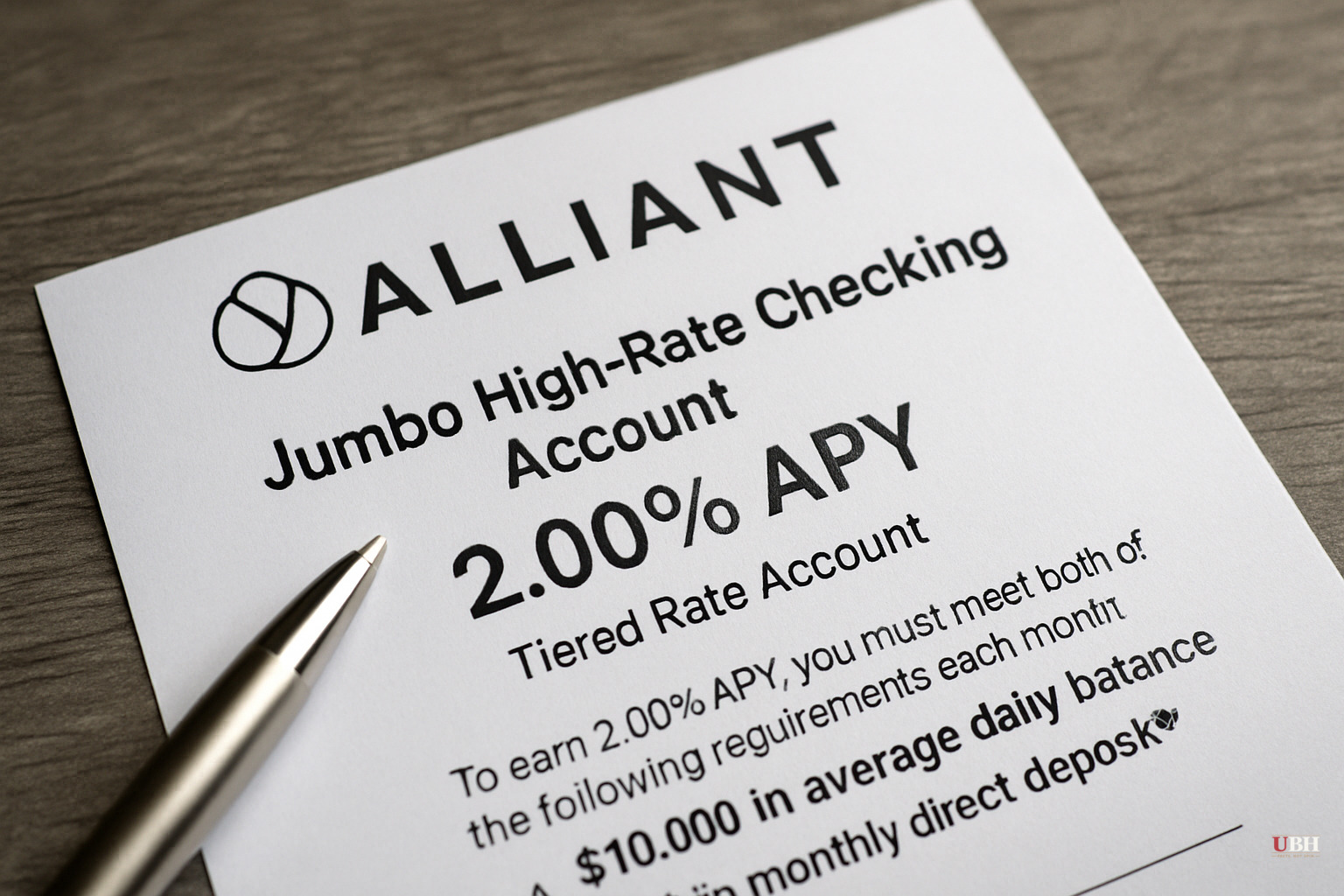
Alliant Credit Union rolled out a Jumbo High-Rate Checking Account with a tiered rate structure topping out at 2.00% APY. According to CNBC, the account carries no monthly fees, no cap on earnings, and automatically pairs with an Alliant High-Rate Savings Account.
The catch: earning that 2.00% requires $5,000 or more in monthly direct deposits and a $10,000 average daily balance. Drop below those thresholds and the rate falls to 1.00% APY (with $2,500 to $4,999 in monthly direct deposits) or 0.25% APY (with $1,000 to $2,499). No qualifying activity means ZERO dividend. There is also a $25 minimum to open the account online.
Alliant's existing High-Rate Checking Account pays a flat 0.25% APY with no tiers, so the Jumbo version is a meaningful step up for members who already run large cash flows through the credit union.
How It Compares to the Competition
The 2.00% headline rate looks solid on paper, but it's not the best available. CNBC also highlights the Consumers Credit Union Rewards Checking, which pays up to 5.00% APY on balances up to $10,000. To get there, members must meet a list of monthly activity requirements including debit card purchases and enrollment in eStatements. The account offers unlimited ATM fee reimbursement and carries only a $5 minimum to open.
For those who prefer a traditional bank over a credit union, CNBC points to All America Bank's Ultimate Rewards Checking, which pays up to 3.95% APY on balances up to $15,000. Requirements: 10 debit card purchases per month and enrollment in eStatements. No minimum balance, no monthly fees.
So Alliant's new account does NOT lead the market on rate. Its competitive edge, if there is one, is the combination of no balance cap on earnings and the bundled savings account. That may be useful if you are consolidating accounts at a single institution.
The Savings Account Landscape
If you are not interested in juggling debit card swipe counts or direct deposit routing, high-yield savings accounts are a cleaner option right now. According to CNBC, both SoFi and American Express are offering 3.10% APY on their high-yield savings accounts as of May 19, 2026, with zero monthly fees and no minimum balance required.
SoFi adds a sign-up bonus of $50 or $400 depending on direct deposit amount, early paycheck access, and up to $2 million in additional FDIC insurance coverage. American Express High Yield Savings keeps it simpler: 3.10% APY, no minimums, no fees, 24/7 customer service.
Bankrate's high-yield savings comparison, while its scraped content did not render usable rate data in these source materials, consistently tracks the online savings market and is worth checking for current rate movements before opening any account.
The Strongest Case for Sticking With Traditional Banks
Critics of high-yield accounts at online banks and credit unions raise a fair point: these rates are variable and can be cut at any time. The Federal Reserve's rate decisions drive deposit rates, and when the Fed eases, these accounts typically follow quickly. A saver who restructures their finances around a 3.10% APY today may find that rate significantly lower within months if the Fed moves. Traditional brick-and-mortar banks, while paying less on standard savings, offer local branches, face-to-face service, and established lending relationships that some customers genuinely value.
The counterweight is that CNBC notes high-yield savings accounts can earn more than ten times the APY of a traditional savings account — a gap that is substantial on any meaningful balance. The inconvenience of an online account is a personal calculation, but the differential on yield is not close.
What to Watch Before Opening Anything
Every rate listed in these sources is variable and subject to change without notice, as CNBC explicitly flagged for the American Express product. None of these are locked-in yields like a CD.
For the Alliant Jumbo Checking specifically, the $10,000 average daily balance requirement means you are tying up significant liquidity to earn 2.00% on a checking account, when a no-strings-attached high-yield savings account from SoFi or American Express is currently paying 3.10% on any balance.
Whether the Federal Reserve will cut rates before year-end remains an open question heading into the second half of 2026. If it does, variable-rate accounts across all these institutions will likely reprice downward, and the calculus on which account structure makes sense shifts again. The Fed's next scheduled policy meeting will determine whether these rates hold.
Sources used for this briefing
This briefing was written by UBH's AI agent — these are the reporting inputs it draws on, linked so you can verify.


