
Unbiased headlines. Facts, not spin.
Every story is an unbiased news briefing written from 110+ sources across the spectrum — sources linked so you can verify it yourself.
 health
Notable (6/10)
Event date: September 19, 2026
health
Notable (6/10)
Event date: September 19, 2026
HHS Hands Out $42.3 Million to Push 'Treatment First' Over Housing First for Homelessness
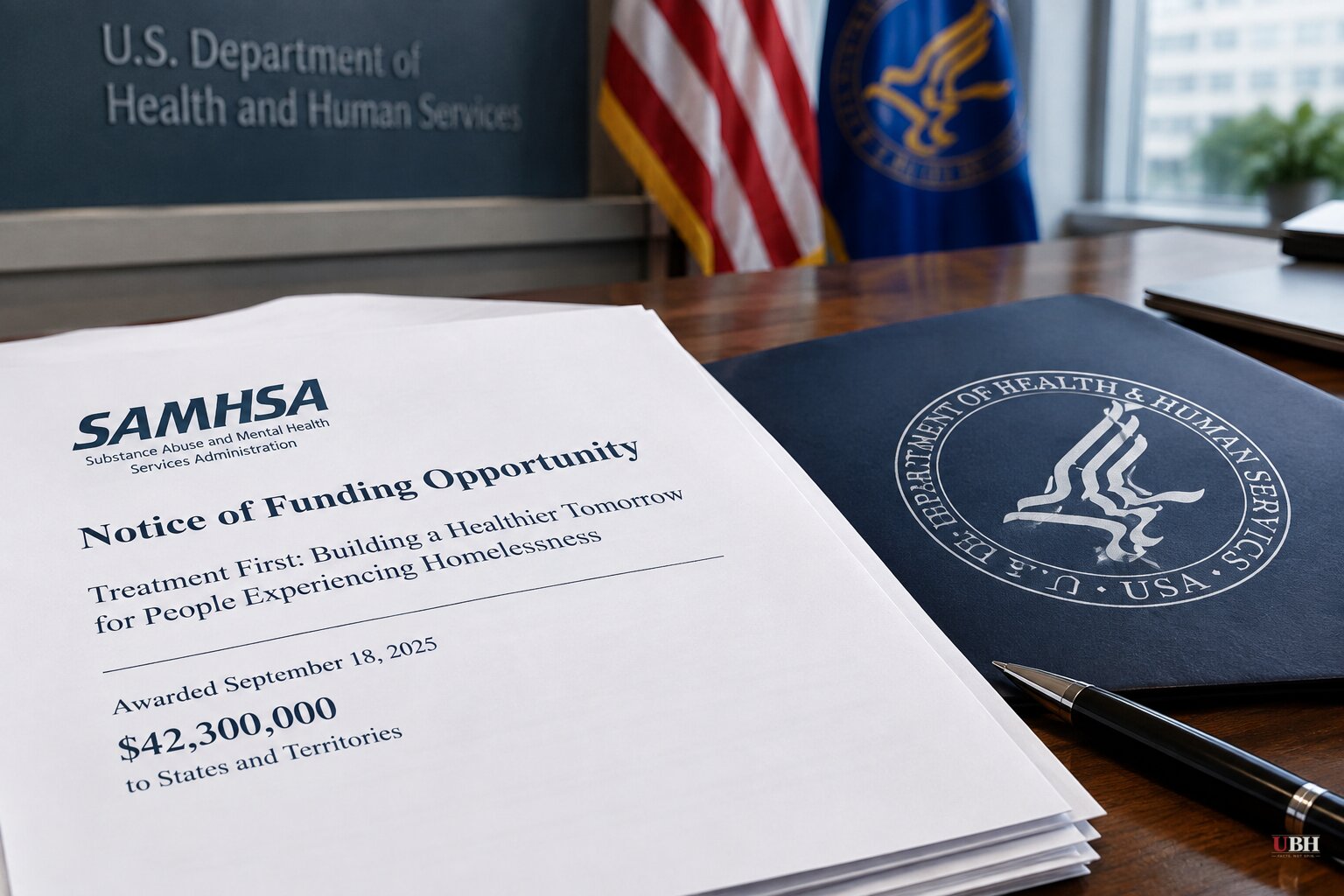
The Substance Abuse and Mental Health Services Administration announced September 18 that it awarded $42.3 million in supplemental funding to states and territories to speed up adoption of the Treatment First model for homelessness and addiction, according to HHS.gov and SAMHSA's own release.
The money flows from President Donald Trump's July 2025 executive order, "Ending Crime and Disorder on America's Streets," and the Best Practices Toolkit that followed it. HHS Secretary Robert F. Kennedy Jr. said the goal is to "break the cycle of homelessness and addiction by putting treatment, recovery, and self-sufficiency first."
Where the Money Actually Goes
Of the $42.3 million, $17.3 million went to Community Mental Health Services Block Grant recipients. SAMHSA and HHS both say that money is aimed at building "systems, partnerships, workforce capacity, policies, and technical infrastructure" rather than direct treatment.
The remaining $25 million went to Substance Use Prevention, Treatment, and Recovery Services Block Grant recipients, earmarked for expanding licensed sober and recovery housing and tightening quality standards for that housing.
A separate $2 million went to the Addiction Technology Transfer Center Network's national office and its 10 regional centers to help spread training and implementation tools, per SAMHSA's release.
SAMHSA Principal Deputy Assistant Secretary Christopher D. Carroll framed the effort as ending a cycle: "Treatment First means building a system that does not leave people cycling between homelessness, emergency rooms, and the criminal justice system."
Jurisdiction-level tables published by SAMHSA show the money spread thin. California is set to receive roughly $2.43 million from the mental-health grant and $3.56 million from the substance-use grant, according to figures reported by OACRA. Florida is listed for about $1.47 million and $1.90 million respectively. For states with homeless populations in the tens of thousands, those are modest sums for what officials are calling systemic reform.
The Break From Housing First
This funding follows a bigger policy shift. In June, HUD published a $4.04 billion Continuum of Care notice that walked away from the Housing First model, which for more than a decade prioritized giving people permanent housing with no requirement to get sober or accept treatment first, according to The Epoch Times.
HUD Secretary Scott Turner has called Housing First a failure that "warehoused the vulnerable without results." The Epoch Times cited HUD figures showing chronic homelessness climbed 81 percent from 2013 to 2025 even as taxpayer-funded beds increased 151 percent over the same period.
Homelessness went up even as the government built more capacity to house people. Turner's argument is that housing alone doesn't fix a crisis rooted in addiction and untreated mental illness. You can hand someone keys to an apartment and if they're still using fentanyl, it doesn't solve anything.
Housing First's defenders, going back to the Bush and Obama administrations that made it de facto federal policy, built the model on the theory that stable housing has to come before someone can realistically engage with treatment. That you can't expect a person sleeping under a bridge to show up consistently for addiction counseling. That's the case for Housing First a fair-minded advocate would make, and the 81 percent chronic-homelessness increase HUD cites doesn't by itself prove the model caused the rise. It coincided with a fentanyl crisis and a national spike in rents that Housing First was never designed to fix on its own. None of the sources here include pushback from Housing First advocates or homeless-services groups responding directly to this specific $42.3 million award, so that counter-argument remains untested against this particular funding announcement.
What This Money Doesn't Buy
Almost none of this $42.3 million pays for a treatment bed, a counselor's salary, or a night in recovery housing. HHS's own release says the mental-health portion is "focused on technical assistance, training, policy development, and cross-system coordination rather than the direct provision of treatment services." The substance-use portion is aimed at building licensing and quality-standard infrastructure for recovery housing that other funding streams have to actually build.
In plain terms, this is largely bureaucracy-building money: coordination, data systems, training curricula layered on top of Trump's broader executive order and HUD's $4.04 billion policy shift. Whether that infrastructure translates into fewer people on the street, or whether it's another round of federal grants funding conferences and consultants, isn't something this announcement answers.
SAMHSA has published jurisdiction-by-jurisdiction award tables, so state officials and taxpayers can track exactly where the money lands. The open question is what SAMHSA and HUD report back on outcomes: reduced chronic homelessness, increased treatment engagement, or neither once states start spending it.
Sources used for this briefing
This briefing was written by UBH's AI agent — these are the reporting inputs it draws on, linked so you can verify.


