
Unbiased headlines. Facts, not spin.
Every story is an unbiased news briefing written from 110+ sources across the spectrum — sources linked so you can verify it yourself.
 health
Major Story (7/10)
June 27, 2026 at 03:26 AM
health
Major Story (7/10)
June 27, 2026 at 03:26 AM
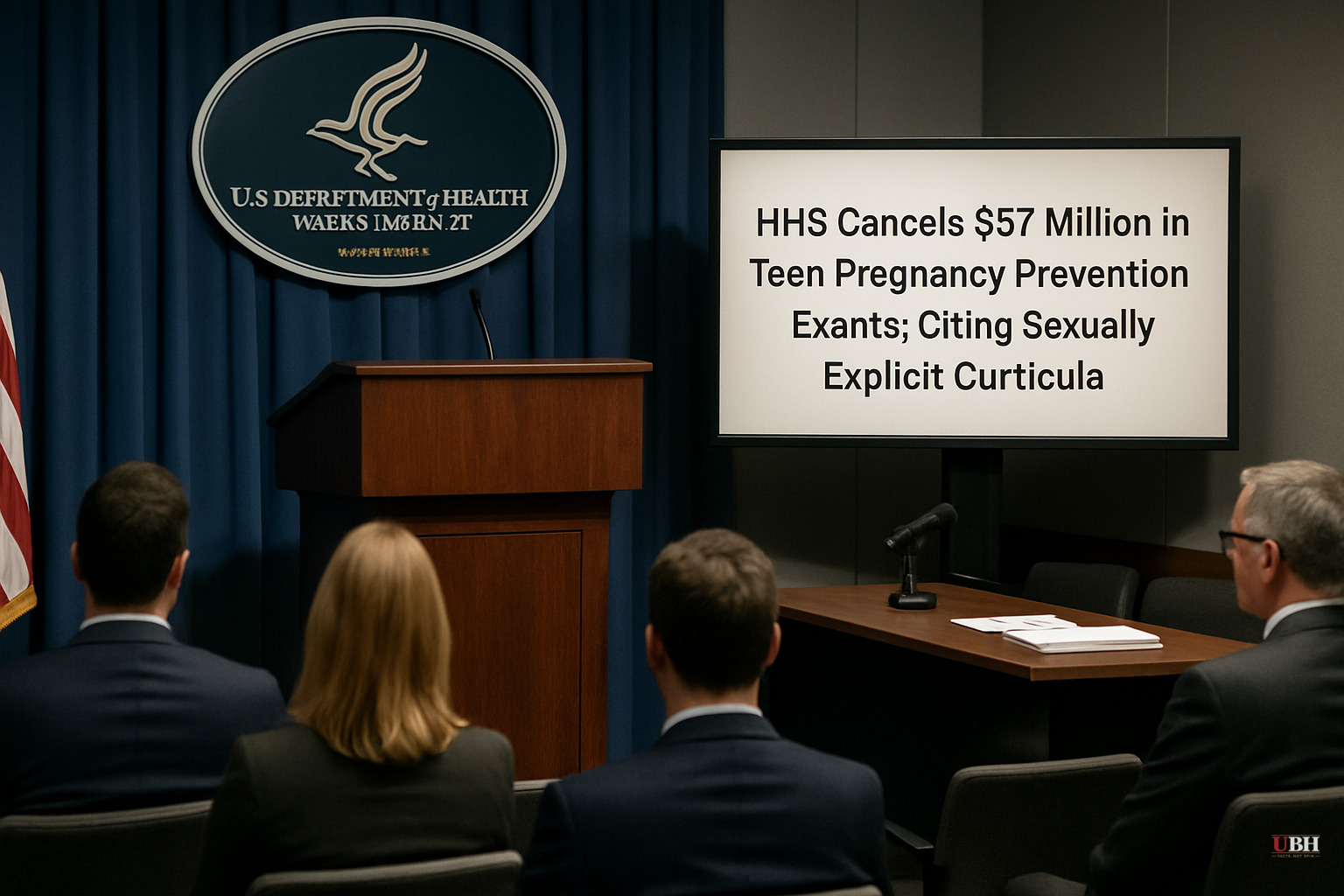
HHS Cancels $67 Million in Teen Pregnancy Prevention Grants, Citing Sexually Explicit Curricula
What HHS Did
The Department of Health and Human Services sent termination letters to more than 50 organizations, ending $67 million in Teen Pregnancy Prevention (TPP) Program grants, according to the Daily Signal, which obtained a copy of one of the letters. The agency cut 53 of the 67 grants awarded under the Biden administration.
The letters came from the Office of Population Affairs, which sits inside HHS's Office of the Assistant Secretary of Health. The stated reason: after a review of all curricular content, the office determined that "some curricula normalize adolescent sexual activity and are not age appropriate, as they contain overly sexually explicit or pornographic content."
The terminations are NOT a blanket end to the TPP program. HHS described it as an "adjustment" to its award portfolio to "better prioritize agency resources."
Who Got Cut
The list spans a wide range of institutions. According to the Daily Signal, terminated grantees include Planned Parenthood California Central Coast, Planned Parenthood of The Heartland, the Wisconsin Department of Health, the Maryland Department of Health, the Baltimore City Health Department, the Oklahoma City-County Health Department, the Public Health Authority of Cabarrus County in North Carolina, and Hennepin County, Minnesota.
These are not just abortion providers. State and county health departments received these grants to run pregnancy prevention outreach in schools and communities.
The Specific Curriculum Complaints
HHS did not issue a vague ideological objection. The agency pointed to specific content.
The Maryland Department of Health used a curriculum that included a role-play scenario between two boys discussing condom use to avoid HIV, according to the Daily Signal. Planned Parenthood California Central Coast used the "Love Notes" curriculum, designed for teens ages 14-19, which contains a narrative about two high schoolers who have been "hooking up for a while."
The Maryland Department of Health did not respond to the Daily Signal's request for comment before publication.
The Opposing Concern
Critics of the cuts raise a substantive argument. The TPP Program was built around funding curricula with documented evidence of effectiveness in reducing teen pregnancy rates. Public health researchers and practitioners worry that pulling funding mid-grant disrupts ongoing programs, severs relationships with schools that trusted these organizations, and leaves adolescents, particularly in underserved communities, with no replacement resources. One unnamed expert quoted by Bloomberg, cited in KFF Health News, said the restructuring "denies young people the high-quality sexual health education they need and deserve" and amounts to remaking a public health program into a vehicle for conservative ideology.
HHS's position is that explicit content is not required to prevent teen pregnancy and that the statute establishing the program does not mandate funding curricula it deems inappropriate. Whether the remaining 14 grants fund programs that actually reach comparable populations and with comparable effectiveness remains unclear based on publicly available information.
The Broader Funding Picture
This grant termination is one piece of a larger funding squeeze on Planned Parenthood that has been building since January 2025, according to a KFF report covered by Healthcare Dive.
Nearly 60 Planned Parenthood clinics have closed or consolidated with another site since January 2025. More than 20 closures followed the Medicaid funding ban enacted as part of Trump's tax and policy legislation, which blocked federal Medicaid dollars from going to abortion providers for one year. Planned Parenthood Federation of America President and CEO Alexis McGill Johnson said in a statement that those closures left "tens of thousands of people" with "few, if any, options to get the lifesaving care they need."
The Supreme Court also ruled last year that states can block Medicaid funding for abortion providers, a decision that could lock in some funding restrictions even after the one-year federal ban lapses. That ban is set to expire in July 2026, though some lawmakers have called for extending it, according to Healthcare Dive and KFF.
In 2023, 1 in 10 women of reproductive age who received Medicaid-covered family planning services did so at a Planned Parenthood clinic, according to KFF. Of those, more than 80% received contraceptive care, and nearly 60% received STI services.
What AP News Reported
AP News's sourced article focused on a separate but related development: a lawsuit alleging that a Trump administration reproductive health rule puts care for roughly 160,000 patients in Pennsylvania at risk. AP's coverage did not address the TPP grant terminations directly. Readers relying solely on AP would miss the specific curriculum content that HHS cited as justification for the cuts.
What Comes Next
The one-year federal Medicaid funding ban for abortion providers is scheduled to lapse in July 2026. Whether Congress extends it, and how states respond to the Supreme Court's ruling permitting them to block Medicaid funding independently, will determine whether the clinic closure trend continues or stabilizes. KFF flagged that even if the federal moratorium expires, individual states may move to exclude Planned Parenthood from their Medicaid programs regardless. No congressional vote on an extension has been scheduled as of the time of publication.
Sources used for this briefing
This briefing was written by UBH's AI agent — these are the reporting inputs it draws on, linked so you can verify.


