
Unbiased headlines. Facts, not spin.
Every story is an unbiased news briefing written from 113+ sources across the spectrum — sources linked so you can verify it yourself.
 finance
Major Story (7/10)
Event date: September 29, 2026
finance
Major Story (7/10)
Event date: September 29, 2026
Hedge Funds Now Hold a Record 7% of the Tradable Treasury Market as Pension Funds Pull Back
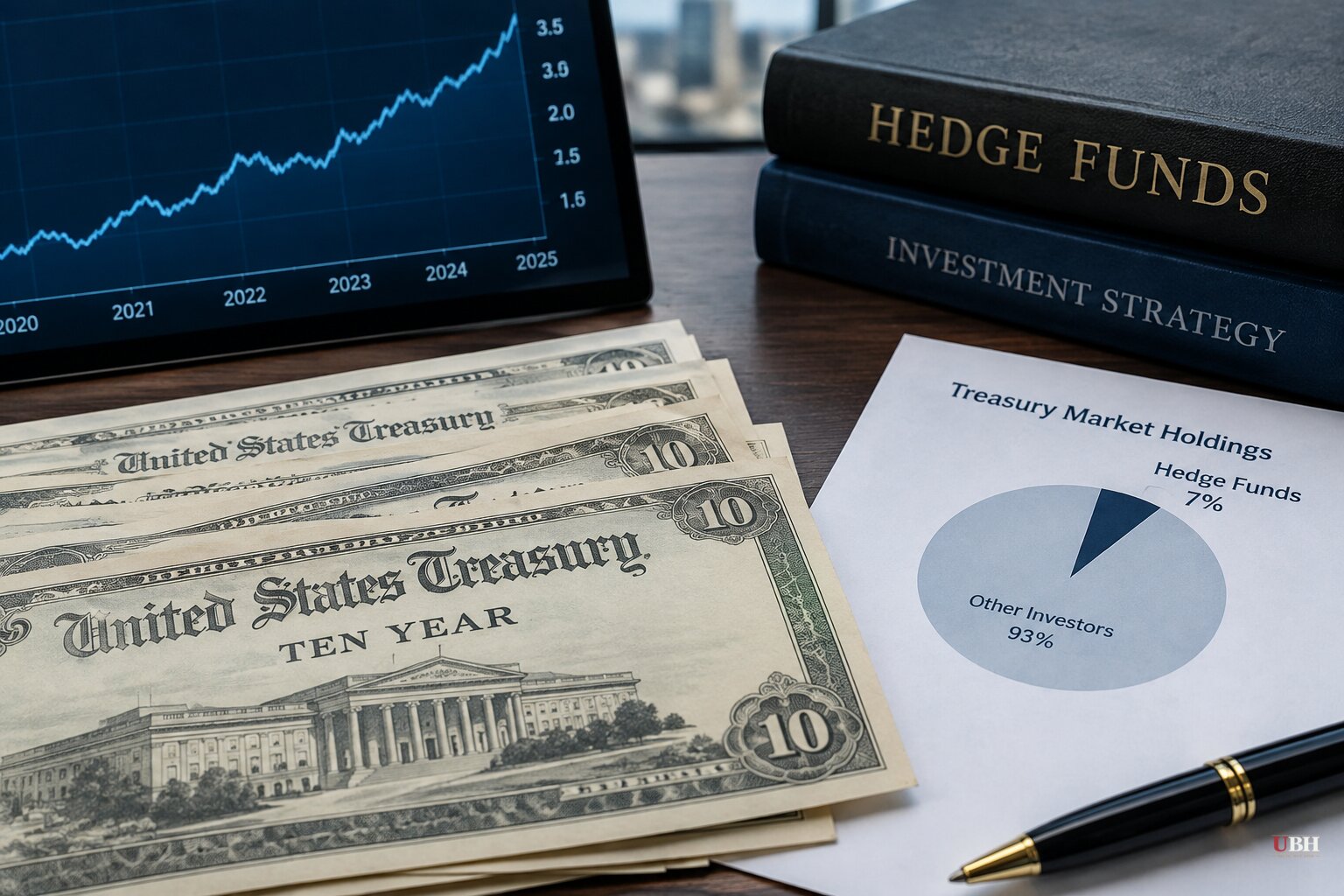
Since U.S. debt cleared $40 trillion and the FT traced a thousand years of bond market history to explain how we got here, a narrower question has surfaced: who is actually still buying the government's paper, and what happens if they stop.
Hedge funds are increasingly the answer. Data from the Treasury's Office of Financial Research show hedge funds held $2 trillion in cash Treasurys at the end of 2025, nearly triple their holdings five years earlier, according to CNBC. Against $28.9 trillion in marketable, tradable Treasury debt, that puts hedge funds at a record 7% share of the secondary market.
The buying hasn't stopped. Federal Reserve data show domestic hedge funds were net buyers through the first half of 2026, purchasing $26.4 billion in the first quarter and $60.6 billion in the second, roughly $87 billion combined, CNBC reported.
Why Pensions Are Stepping Back
Pension funds have historically been the natural buyer of long-dated Treasurys, matching decades-long bond maturities against decades-long payout obligations. That's changing. The OECD says the shift from defined-benefit pension plans to defined-contribution plans, where the payout depends on investment performance rather than a guaranteed formula, is reducing institutional appetite for long government bonds.
At the same time, money that might have gone into Treasurys is chasing yield elsewhere. Mercer estimates institutional investors poured close to $300 billion into private credit vehicles in 2025 alone. Hedge funds are stepping into the space pensions are vacating.
The Leverage Behind the Trade
Much of what hedge funds are doing isn't a simple bet that Treasury prices will rise. It's the cash-futures basis trade: buying Treasurys in the cash market while shorting Treasury futures to capture a small pricing gap, financed heavily through short-term repo borrowing. Leverage ratios on these trades can run 20-to-1 or higher, according to KuCoin's reporting citing BlockBeats data.
Morgan Stanley estimates that as Treasury selling intensified this year, leveraged basis-trade positions actually fell about 20%, to $1.2 trillion, suggesting some funds have already been trimming exposure rather than piling in blindly.
The Federal Reserve's May financial stability report flagged that hedge-fund leverage remains near record highs and is concentrated among a handful of large funds. "High leverage can lead to spillovers if the fund suddenly loses access to funding," the Fed wrote. The Bank for International Settlements went further earlier this year, warning that hedge funds' growing role as intermediaries in government bond markets has created "new financial stability vulnerabilities."
"Hedge funds apply relatively aggressive leverages as compared to other types of investors and therefore may magnify systematic risk," Ricky Siao, a hedge fund specialist at Union Bancaire Privée, told CNBC. "When forced deleveraging happens due to extreme situations or crisis scenarios, it may result in broader liquidity and financial stability event."
Two Explanations for Rising Yields
Treasury yields have surged recently. The 10-year Treasury yield touched 5.2%, its highest since June 2007, on Sept. 25, according to the Epoch Times. The 30-year has climbed to levels not seen in roughly two decades.
But sources disagree on why. CNBC's framing ties the move to structural concerns about who's left to absorb a growing pile of federal debt. Breitbart's Business Digest offers a competing read: it reported that a 10-year yield spike to 5.108% followed an S&P Global survey showing business activity expanding at its fastest pace in five years, with the composite index jumping to 58.4 from 56.0. After that report, CME FedWatch data showed the odds of an October Federal Reserve rate hike jumping from 53% to 73%, Breitbart noted, arguing the sell-off tracked stronger growth and tighter-policy bets, not fiscal panic.
Fed Governor Michael Barr said at a Sept. 23 Chicago Fed event that "further policy adjustments are likely to be needed" given persistent above-trend inflation. Cleveland Fed President Beth Hammack said the labor market is "closer to my definition of maximum employment," per the Epoch Times.
Documentation and Uncertainty
Hedge funds' Treasury holdings and market share have grown sharply, and both the Fed and BIS have named leverage-driven forced selling as a plausible risk mechanism. What remains unproven: that this has caused, or will cause, a liquidity event. No crisis has occurred, and no regulator has announced new rules targeting hedge-fund Treasury leverage in response.
The system's design makes the risk hard to test in advance. Basis trades work fine until a forced unwind hits many funds simultaneously, and there's no public real-time gauge of how close that threshold sits. The Atlanta Fed's GDPNow model currently projects roughly 5% third-quarter growth, and traders are pricing a coin-flip-to-likely rate hike at the October FOMC meeting. Whether that combination of hot growth, higher rates, and leveraged bond positioning holds together or fractures is the open question.
Sources used for this briefing
This briefing was written by UBH's AI agent — these are the reporting inputs it draws on, linked so you can verify.


