
Unbiased headlines. Facts, not spin.
Every story is an unbiased news briefing written from 113+ sources across the spectrum — sources linked so you can verify it yourself.
 finance
Major Story (7/10)
Event date: September 25, 2026
finance
Major Story (7/10)
Event date: September 25, 2026
10-Year Treasury Yield Hits 5.08%, Highest Since 2007, As Municipal Bonds Post Worst Losses in Years
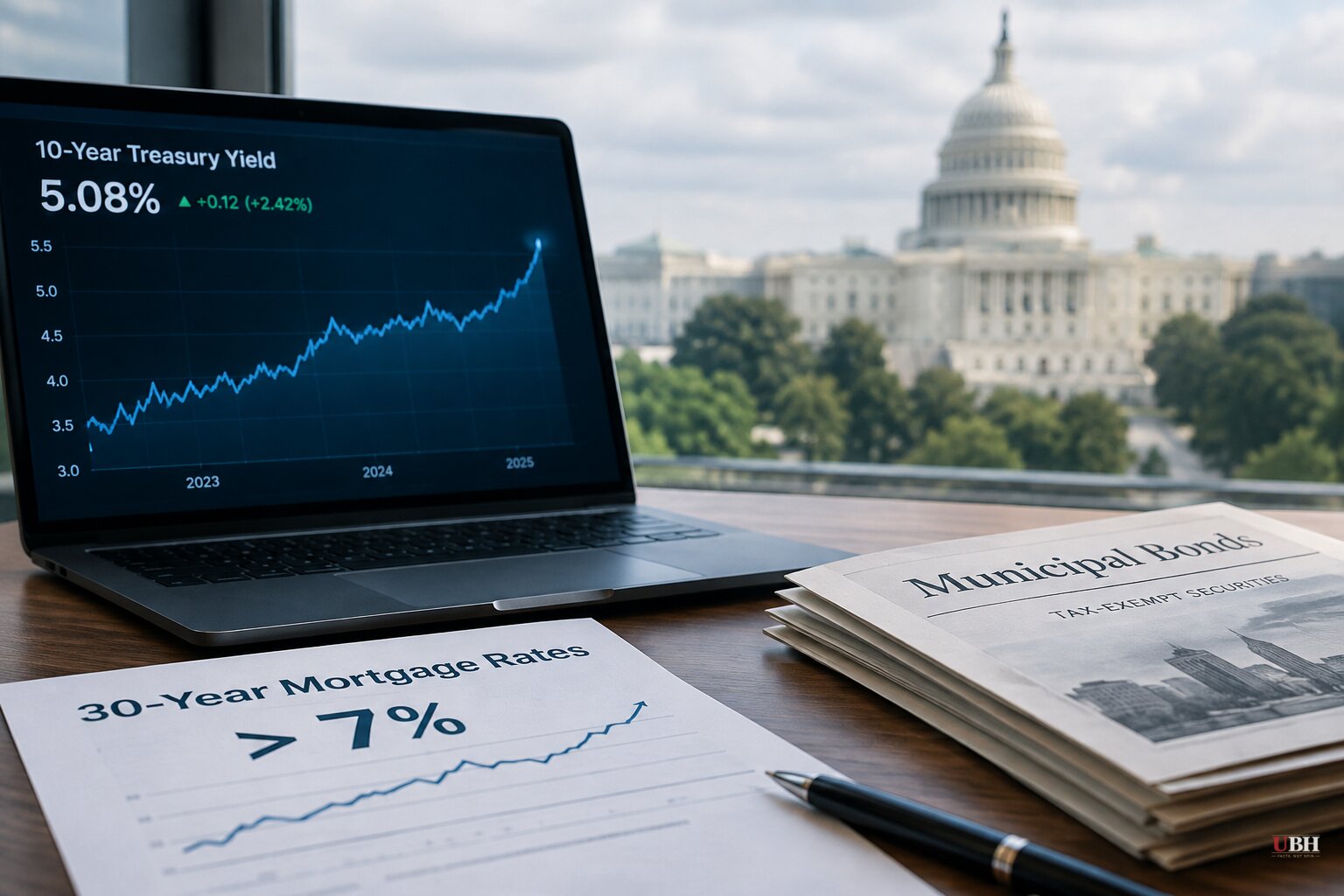
Yields Blow Past 2007 Levels
The 10-year Treasury yield climbed to 5.079%, according to Breitbart, the highest level since July 2007. The 2-year yield rose to 4.876% the same day. Stocks sank and oil prices jumped as the selloff hit.
The pain is already showing up in mortgages. According to the Epoch Times, 30-year mortgage rates have surpassed 7%, making home purchases more expensive for anyone who needs to borrow. Cash buyers now have a real edge in bidding wars.
Why It's Happening
Federal Reserve Governor Michael Barr said further tightening of monetary policy is likely needed to bring inflation down to the Fed's 2% target, according to Breitbart. That comes as S&P Global's flash composite purchasing managers index rose to 58.4 in September, the highest reading since July 2021, signaling the economy is accelerating, not slowing down, despite already-elevated rates.
Goldman Sachs Asset Management points to additional pressure from Fed Chair Kevin Warsh's hawkishly received Jackson Hole speech, an announcement from Treasury Secretary Scott Bessent about intervening at the long end of the yield curve, and escalating Middle East tensions reigniting inflation fears. Elevated government debt is also cited by AllianceBernstein as a structural pressure keeping inflation risk elevated.
Who Actually Eats the Losses
Higher yields don't just mean pricier new borrowing. They also crush the market value of bonds already sitting on someone's balance sheet. As the Epoch Times' Jeffrey Tucker explains, bond prices and yields move in opposite directions. When new Treasuries pay more, older bonds issued at 3% or 4% coupons become less attractive and drop in price.
Banks and insurers holding large inventories of older fixed-rate paper are now carrying unrealized losses. Those losses stay on paper only as long as the institutions aren't forced to sell. Bond funds that mark to market see their net asset values fall even without a single trade. Tucker frames it plainly: the steepening curve transfers wealth from existing bondholders to new borrowers, because the market has to clear at the new, higher yield.
Munis Get Hammered
The municipal bond market has taken it especially hard. The Bloomberg Municipal Bond Index fell 1.81% last week and is down 3.63% year-to-date, according to AllianceBernstein's September 28 commentary. The muni yield curve flattened, with 2-, 10- and 30-year AAA yields up 45, 30 and 18 basis points respectively.
The Bond Buyer reported munis started this week with yields surging another 10 to 15 basis points as Treasuries cheapened further, with 10-year muni-to-Treasury ratios around 80%. James Pruskowski, managing director at Hennion & Walsh, told the Bond Buyer that quarter-end is historically volatile as institutions shore up balance sheets, and warned retail investors should brace for "statement shock" when their September account statements arrive.
Goldman Sachs Asset Management noted August was the strongest supply month on record for munis, overwhelming reinvestment demand and pushing muni/Treasury ratios to 64%, 71% and 87% for 5-, 10- and 30-year maturities by month's end.
The Case This Is Actually a Buying Opportunity
There's a legitimate concern here: rising yields mean more expensive mortgages, pricier corporate and municipal borrowing, and a heavier interest burden on federal debt taxpayers ultimately cover. That's a real cost, not a hypothetical one, and it's already visible in 7% mortgage rates.
But for income investors, the same selloff has created what several advisers call a rare opening. AllianceBernstein says the 10-year AAA muni is now yielding 4.05%, the highest level in a decade, translating to a taxable-equivalent yield of 6.84% for top earners. The broader Bloomberg Muni Index is trading below par at $96.29 with a yield of 4.69% — a taxable-equivalent yield of 7.92%, the highest since August 2001.
Michael McMeans, a financial planner with Silverling Financial in Columbus, Ohio, told MarketWatch munis are "on sale" and called them "huge value" for anyone earning over $400,000. Donald LaGrange of Murphy & Sylvest in Dallas said a New York City client could save $37,000 in total taxes by switching into municipals, since combined federal, state and city taxes were taking about 47% of her interest income. Joon Um of Secure Tax & Accounting in Beverly Hills cautioned that credit quality, duration and liquidity still matter and the tax break alone shouldn't drive the decision.
AllianceBernstein points to a precedent: the last comparable selloff, from August to October 2023, saw the muni index drop 5.2% before rallying 8.7% in November and December.
The Credit Quality Wrinkle
Not every muni story is a bargain. Moody's reported municipal downgrades outpaced upgrades by 20% in the second quarter, driven largely by pressure in K-12 education from enrollment declines and rising costs, according to Goldman Sachs Asset Management. Goldman said it doesn't view that as the start of a broader trend. Illinois, meanwhile, was upgraded by both Moody's and S&P to A1/A, which the firm attributed to sustained fiscal discipline — proof that not every issuer is deteriorating.
Whether the muni market repeats its late-2023 pattern — a sharp fall followed by a strong rebound — is the open question fund managers are now watching heading into the fourth quarter. Barr's comments suggest the Fed isn't done tightening, which means the pressure on both Treasuries and munis may not be finished either.
Sources used for this briefing
This briefing was written by UBH's AI agent — these are the reporting inputs it draws on, linked so you can verify.


