
Unbiased headlines. Facts, not spin.
Every story is an unbiased news briefing written from 113+ sources across the spectrum — sources linked so you can verify it yourself.
 finance
Major Story (8/10)
September 29, 2026 at 09:50 AM
finance
Major Story (8/10)
September 29, 2026 at 09:50 AM
10-Year Treasury Yield Hits 5.24%, Highest Since 2007, as Fed Signals More Hikes
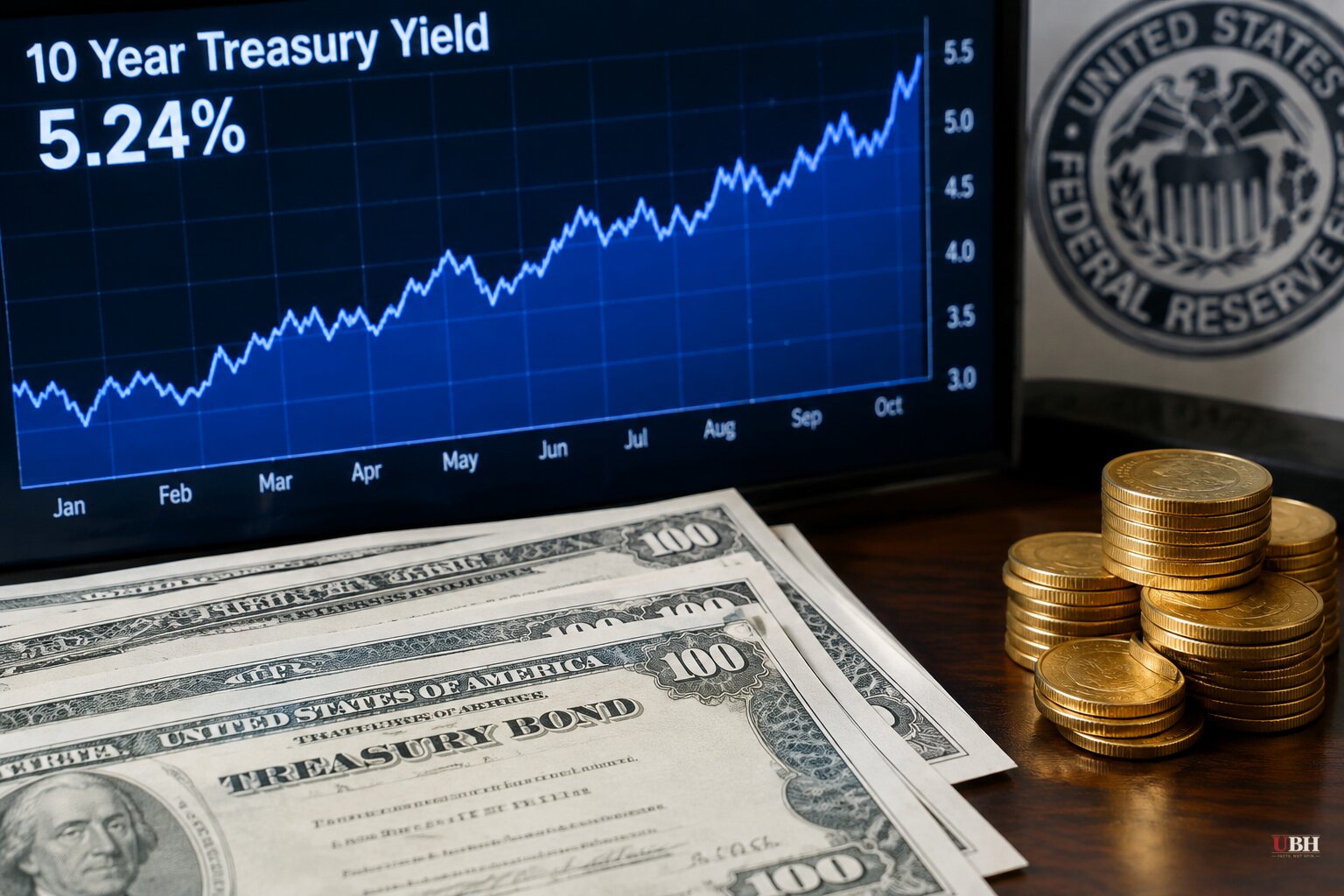
The bond market has had a brutal month, and it's not over yet.
The 10-year Treasury yield was hovering near 5.240% in early trade Tuesday, September 29, according to Morningstar, its highest level since 2007. The 30-year yield edged up to 5.555%, a level not seen since 2004. The 2-year note sat at 4.899%, according to Invezz.
StockCharts tracked the move back to a 4.639% close on Tuesday, August 25. From there, yields climbed steadily, then accelerated hard. The ICE BofA MOVE Index, Wall Street's bond-market fear gauge, sat near 70 in late August and jumped roughly 29% last week alone, per StockCharts, putting it on pace to close the third quarter above 100.
Why Yields Are Spiking
Three forces are colliding, according to the sources. First, demand for new government debt is drying up. Jon Butcher, senior US economist at Aberdeen Investments, told Family Wealth Report that this week's seven-year Treasury auction posted its weakest bid-to-cover ratio in a year, with indirect demand falling too. "There is a growing investor reluctance to absorb Treasury supply," Butcher said, tying it directly to expectations of a tighter Fed path rather than inflation fears.
Second, the Fed is leaning hawkish. Fed Governor Michael Barr told a Chicago Fed housing conference that "further policy adjustments are likely to be needed" because inflation "is above our 2% target and not clearly trending toward target in a timely way," according to Invezz. That follows a quarter-point hike that brought the Fed's benchmark rate to 3.75%-4%, the first increase in three years. New York Fed President John Williams separately said another hike "may be appropriate by the end of the year," according to Reuters as cited by Family Wealth Report. Traders were pricing a roughly 70% chance of an October hike and a 57% chance of back-to-back hikes in October and December, per Family Wealth Report.
Third, oil is climbing on the stalemate in US-Iran talks, pushing up inflation expectations. Brent crude for November delivery rose 0.7% to $106.04 a barrel Tuesday, with the market in steep backwardation, according to Morningstar. Tickmill Group strategist Patrick Munnelly summed it up: "Higher oil is raising inflation expectations, resilient U.S. data are keeping the Fed hawkish, and investors are demanding more compensation for duration risk."
Stocks Are Holding, For Now, But Not Evenly
Despite the bond carnage, US equities have barely blinked. The S&P 500 is close to flat month-to-date, according to StockCharts, and futures for the S&P 500 and Nasdaq were flat Tuesday morning while the Dow dipped 0.1%, per Morningstar. Chipmakers and AI stocks showed renewed strength, with ASML gaining more than 3% in European trade.
That headline calm masks real damage underneath. StockCharts found that since August 25, the Information Technology sector is the only one beating the S&P 500's 1.3% gain, while seven of eleven sector ETFs are down 4.5% or more. Utilities have been hit hardest, down 17% from a late-February record and 11% below their 200-day moving average, the widest gap since October 2023. BigGo Finance notes foreign investors are still buying US stocks at a record pace, with $426 billion in net purchases in the second quarter of 2026.
The Dollar-Decline Debate
The New York Times recently argued the world is growing "wary of the U.S.," citing foreign governments pulling gold from American vaults and talk of the dollar's fading dominance, framing it as a consequence of the Trump administration's debt levels and sanctions policy. Breitbart pushed back hard on that framing, pointing to Treasury Department data showing foreigners purchased a net $1.75 trillion in long-term American securities over the 12 months through July, more than double the roughly $799 billion purchased in the equivalent period ending July 2024. Breitbart's read of that data shows the composition shifting from Treasury bonds toward stocks and corporate debt, that foreign buyers went from net sellers of $151.5 billion in US stocks in the year through July 2024 to net buyers of $941.9 billion by July 2026.
Both things can be true at once. Foreign appetite for the dollar's safe-haven government debt has genuinely cooled, which is exactly what's showing up in the weak auction demand Aberdeen's Butcher flagged. At the same time, foreign money isn't fleeing America. It's rotating into US stocks and corporate bonds instead. The concern that foreign capital could pull back from Treasuries in a way that raises US borrowing costs is not unfounded. The auction data backs that part up. The broader claim that global investors are abandoning America has less support in the numbers Breitbart cites.
What Comes Next
BigGo Finance's review of five prior yield-surge episodes—2022, 2016, 2006, 1999, and 1994—found equity outcomes ranging from a technical bear market to a rally, meaning history offers no clean playbook for how stocks handle this. StockCharts flags this week's US jobs data as the next real test. Economists expect close to 100,000 jobs added in September, well above the roughly 50,000 needed to hold the unemployment rate steady. A hot number, paired with firm wage growth, would likely cement the Fed's hawkish path and keep the bond selloff running into October, a month that Bloomberg notes has posted a median Treasury loss of 0.7% over the past decade, right behind September's typical 0.9% drop.
Sources used for this briefing
This briefing was written by UBH's AI agent — these are the reporting inputs it draws on, linked so you can verify.


