
Unbiased headlines. Facts, not spin.
Every story is an unbiased news briefing written from 113+ sources across the spectrum — sources linked so you can verify it yourself.
 finance
Low Interest (2/10)
September 29, 2026 at 08:45 AM
finance
Low Interest (2/10)
September 29, 2026 at 08:45 AM
FT's Robin Wigglesworth Traces a Thousand Years of Bond Market History as U.S. Debt Hits $40 Trillion
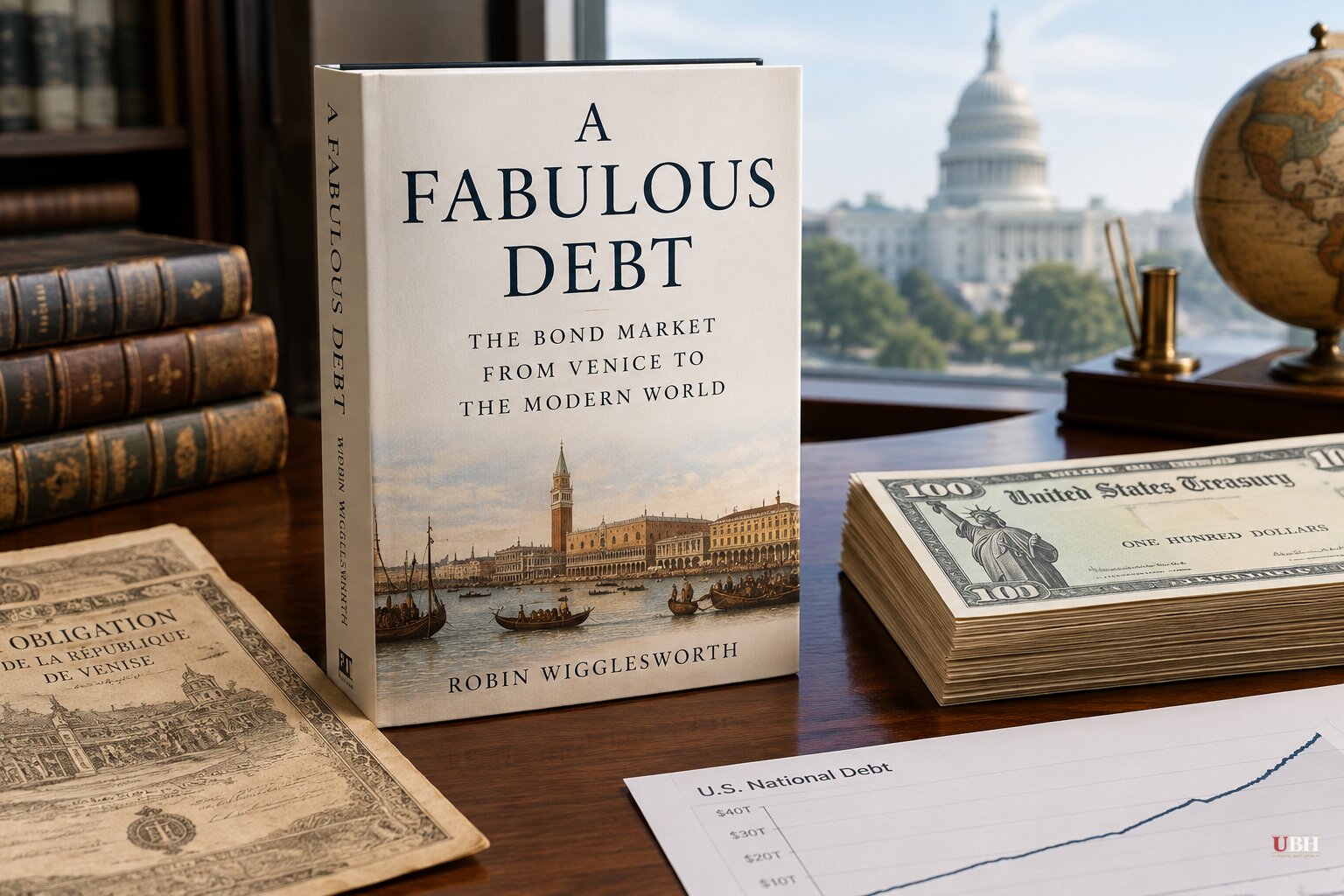
Robin Wigglesworth spent years as the Financial Times' global finance correspondent before taking over the outlet's Alphaville blog. In October 2021 he published Trillions, a history of the index fund that the Wall Street Journal called a "magisterial, delightfully written history." Now he's back with a bigger target: the bond market and the $40 trillion pile of U.S. government debt sitting on top of it.
Wigglesworth's new book is titled A Fabulous Debt. Where Trillions covered roughly 100 years of financial history, this one goes back a full millennium, starting with medieval Venice, according to Wigglesworth's own account of the project. Venice, he notes, originally used bonds to fund its wars while surrounded by hostile territory in its lagoon.
From there the book moves through 19th century French mathematician Louis Bachelier, whose work laid groundwork for modern financial theory, up through the postwar decades when the mechanics of modern bond and index investing took shape. Publishers Weekly called the finished product "a must-read for anyone interested in global finance," praising what it described as Wigglesworth's "Dickensian eye for memorable events and characters."
The Index Fund Backstory
Trillions told the story of John McQuown, a Wells Fargo banker in the early 1970s credited with inventing the index fund, and Vanguard founder John Bogle, who made that fund available to ordinary retail investors rather than just institutions. That invention has since scaled to the point that index and passive funds collectively own roughly 20% of publicly traded U.S. companies, a figure Bloomberg's Matt Levine has repeatedly used to needle the industry in posts with titles like "Index Funds Are a Bit More Illegal" and an earlier one asking whether index funds are "Marxist."
A financial structure built to be passive and low-cost for retail savers now controls a fifth of corporate America's ownership. Whether that concentration is a triumph of cheap capital for regular investors or a quiet distortion of how public companies are governed is a legitimate argument, and Levine's tongue-in-cheek framing captures both sides of it without settling it.
Why Bonds Now
Wigglesworth told an interviewer he sees the bond market as the financial system's central nervous system, something largely invisible until it misfires. "The first time I talked to people about the bond market and understood the bond market," he said, "was like how it must feel for a surgeon looking at an actual beating heart on the operating table."
The U.S. national debt stands at roughly $40 trillion and is still climbing, a figure both parties in Washington have spent decades expanding through deficit spending, tax cuts unmatched by cuts in outlays, and emergency spending bills passed under presidents of both parties. Neither side gets a pass here. Republicans who campaign on fiscal discipline and then vote for unfunded tax cuts, and Democrats who campaign on fairness and then vote for unfunded entitlement expansion, have both fed the same number.
A reasonable skeptic might push back that debt-driven hand-wringing has been a constant in American politics for generations, and the bond market has absorbed it without collapsing so far. That's a fair point, and it's exactly the kind of claim a book grounded in a thousand years of bond history is positioned to test rather than assert.
What's Still Unclear
The portion of Wigglesworth's remarks describing exactly what he found "profoundly dangerous" in today's bond market has not been fully laid out in available interviews. What is documented is his framing of the book as history rather than warning: a thousand years of sovereigns borrowing against the future, with the index fund era serving, in his words, as "the humble hero" and "the glue that holds it together."
Whether that glue holds as the U.S. debt load keeps expanding is the open question A Fabulous Debt is built to explore. Readers looking for Wigglesworth's specific diagnosis of what's dangerous about the current bond market will need the full book, not just the promotional interviews, to get it.
Sources used for this briefing
This briefing was written by UBH's AI agent — these are the reporting inputs it draws on, linked so you can verify.


