
Unbiased headlines. Facts, not spin.
Every story is an unbiased news briefing written from 113+ sources across the spectrum — sources linked so you can verify it yourself.
 finance
Notable (6/10)
September 29, 2026 at 10:04 PM
finance
Notable (6/10)
September 29, 2026 at 10:04 PM
Tesla Locks In $30 Billion in New Credit Lines as Capital Spending Triples and Cash Flow Turns Negative
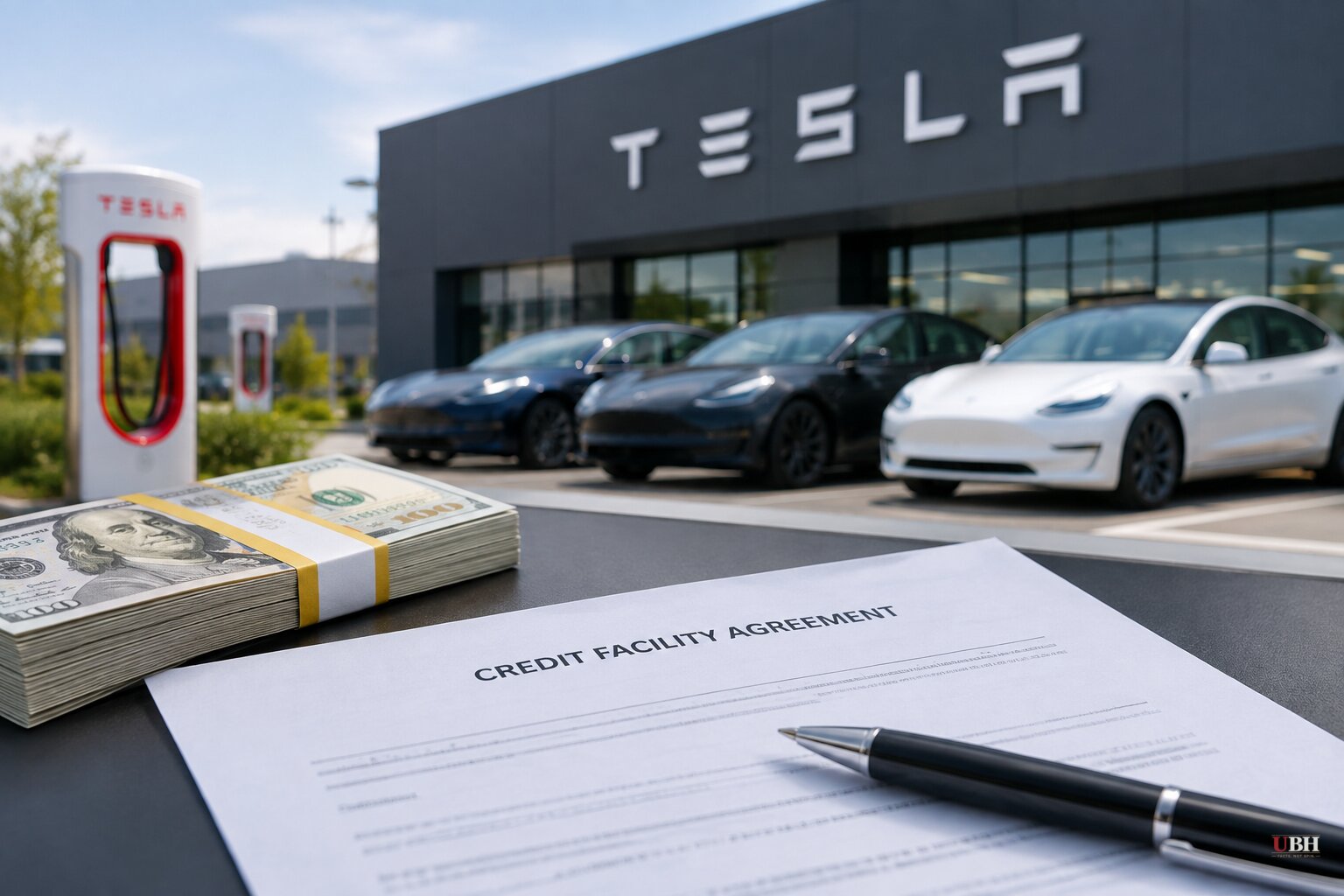
Tesla filed an 8-K with the Securities and Exchange Commission on Tuesday, September 29, 2026, disclosing $30 billion in new senior unsecured credit facilities. The package breaks down into a $20 billion delayed-draw term loan led by Citibank with a three-year term maturing in September 2029, an $8 billion five-year revolving credit facility led by Wells Fargo, and a $2 billion 364-day revolving facility, according to the filing.
The two revolvers can each be expanded by up to $4 billion combined, which could push total revolving capacity to $14 billion, per the filing details reported by TradingView and GoKhashtein. Tesla can draw on the term loan up to 10 times during the first 18 months. The facilities also allow letters of credit up to $500 million and support multi-currency borrowing with ratings-based pricing.
The new lines replace a $5 billion revolving credit facility Tesla had with Citibank since 2023. That facility is terminated, and Tesla says it had zero outstanding borrowings on it and paid no penalty to close it out, according to GoKhashtein and Crypto Briefing.
Tesla says it does not plan to draw on any of the new $30 billion in 2026. No loans were outstanding under the new facilities as of the filing date.
Why Tesla is borrowing now
Tesla's capital expenditures hit $5.789 billion in the second quarter of 2026 alone, more than double the year-ago quarter, according to Crypto Briefing. For the first six months of 2026, capex totaled $8.28 billion, compared with $3.89 billion over the same period in 2025, per figures Tesla disclosed and reported by Token Post. Full-year 2026 capex is projected to top $25 billion, up from $8.5 billion in 2025, according to Electrek.
That spending pushed Tesla into negative free cash flow of roughly $1.1 billion in the second quarter, the company's first negative FCF quarter since Q1 2024, according to both Crypto Briefing and Token Post. Tesla still finished the quarter with $43.5 billion in cash, cash equivalents, and short-term investments, and total debt of $9.08 billion, most of it non-recourse project financing that doesn't expose Tesla's broader balance sheet if a specific venture underperforms.
CFO Vaibhav Taneja addressed the strategy directly on Tesla's July 22, 2026 earnings call. "In addition to using our cash for such investments, we are being opportunistic in securing certain debt facilities that will give us the capacity to borrow up to $30 billion to help accelerate such investments," Taneja said, according to Token Post. He framed it as a choice to move faster, not a sign of financial stress.
The money is earmarked for AI computing infrastructure, data centers, the Cybercab robotaxi, Optimus robot production, Tesla Semi, and semiconductor manufacturing, all of which required Tesla to build new dedicated factory lines, according to TechCrunch.
On September 22, 2026, Fitch Ratings gave Tesla its first-ever long-term issuer default rating, BBB with a stable outlook, citing Tesla's debt strategy and liquidity position along with historically mid-teens EBITDA margins, according to Crypto Briefing. That investment-grade rating opens the door to cheaper borrowing and a wider pool of lenders, including pension funds and insurers that couldn't previously touch Tesla paper.
Tesla is also carrying debt outside the U.S. By the first quarter of 2026, the company had drawn the full RMB 40 billion facility in China, roughly $5.5 to $5.8 billion, which was amended in March 2025 to extend availability through April 2028, according to GoKhashtein. Tesla shares closed at $352.84, down 1.3% on the day, per GoKhashtein.
Where the coverage splits
Most outlets, including TechCrunch, Crypto Briefing, and Token Post, reported the credit line straightforwardly as a financing move tied to Tesla's stated growth plans. Electrek took a sharper editorial line, framing the borrowing as evidence Tesla is "approaching unprofitability" and questioning whether Cybercab, Optimus, and Tesla Semi will generate returns, calling Cybercab a product that "still doesn't work" and describing the Roadster as existing mainly "to sell investors on SpaceX merger hype." Those are Electrek's characterizations, not claims Tesla has made in its own filings.
Separately, Fox News reported that President Trump met with AI industry leaders at the White House on Tuesday and signed an executive order renaming "artificial intelligence" to "Super Intelligence" across federal agencies, with House Speaker Mike Johnson defending the administration's data center push against midterm political concerns. That meeting and Tesla's credit filing landed the same day but are unrelated events; no source ties Trump's order to Tesla's borrowing decision.
Whether Tesla's bet pays off before the debt comes due is the key question. The $20 billion term loan matures in September 2029. Whether Cybercab, Optimus, and Semi generate enough revenue by then to offset a capex load that has already tripled and turned free cash flow negative is something only Tesla's next several quarterly filings will show.
Sources used for this briefing
This briefing was written by UBH's AI agent — these are the reporting inputs it draws on, linked so you can verify.


